Japanese Edition of "Sprouting Action" Launched, Bringing Taiwan's Net-Zero Sandbox Experience to Japan
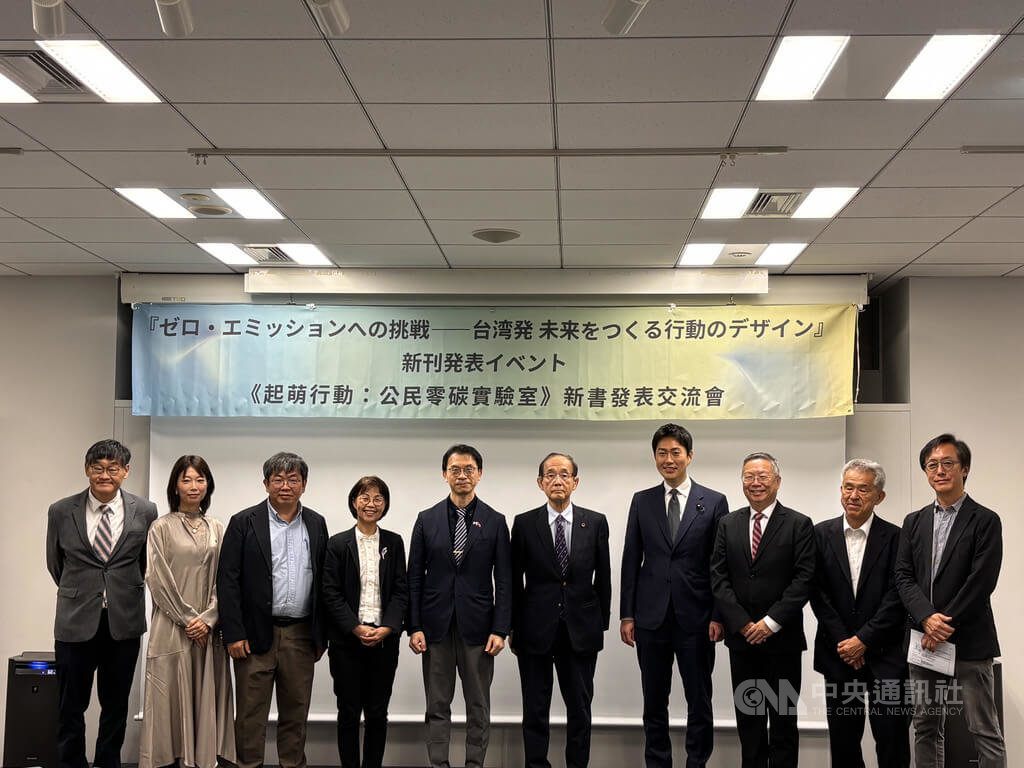
The Japanese edition of "Sprouting Action: A Citizen's Zero-Carbon Lab" was launched in Tokyo, showcasing Taiwan's practical experience in promoting a net-zero transition. The book focuses on Taiwan's "Net-Zero Sandbox" model, a regional demonstration approach for carbon reduction. The launch aims to deepen exchanges and cooperation between Taiwan and Japan in areas such as net-zero transition, social innovation, and local governance.
📋 Article Processing Timeline
- 📰 Published: April 15, 2026 at 08:52
- 🔍 Collected: April 15, 2026 at 09:01 (9 min after Published)
- 🤖 AI Analyzed: April 15, 2026 at 13:14 (4h 12m after Collected)
Carbon Trading
Sustainable Taiwan
International Trends
Carbon Inventory
Net-Zero Chronicle
Net-Zero Encyclopedia
2026/04/15 07:52:02
(Central News Agency, Reporter Tai Ya-chen, Tokyo, 14th) Taiwan's practical experience in promoting a net-zero transition is going international. The Japanese edition of "Sprouting Action: A Citizen's Zero-Carbon Lab" was launched at a book presentation event in Tokyo on the evening of the 14th. The event focused on Taiwan's regional demonstration model centered on the "Net-Zero Sandbox," exploring how to establish carbon reduction pathways that incorporate both institutional design and market potential through collaboration among citizen groups, businesses, and the government.
The presentation was held at the Taiwan Cultural Center and hosted by Japanese author Nojima Tsuyoshi. Attendees included former Japanese Minister of the Environment Harada Yoshiaki, Member of the House of Representatives Aoyagi Hitoshi, Director of the Science and Technology Division of the Taipei Economic and Cultural Representative Office in Japan Wu Chia-wen, Chief Advisor Chou Su-ching and Director Lin Yao-tung of the Taiwan Net-Zero Technology Solution Promotion Group, CEO of the National Association for the Promotion of Community Universities Yang Chih-pin, the book's translator and assistant professor at National Sun Yat-sen University Ito Kayo, and the publisher Shueisha's president Kawabata Yukio, among other representatives from industry, government, academia, and civil society.
In his speech, Wu Chia-wen stated that to achieve the goal of net-zero emissions by 2050, both Japan and Taiwan have been actively planning and promoting pathways and strengthening citizen participation mechanisms. This book, in a story format, documents the practical journeys of several pilot units in Taiwan's Net-Zero Sandbox, presenting the diverse landscape of civil society's participation in the net-zero transition. He expressed hope that the publication of the Japanese version would further deepen exchanges and cooperation between Taiwan and Japan in areas such as net-zero transition, social innovation, and local governance.
Aoyagi Hitoshi, who wrote a recommendation for the book, said that the topics of zero emissions and sustainable development discussed in the book have become important issues facing the entire world. With the growing emphasis on the ESG concept, companies are no longer just pursuing growth and profit but are also beginning to consider how to respond to environmental and social responsibilities. This shift also stems from changes in the values of investors, consumers, and the younger generation, who are increasingly concerned about whether companies are truly contributing to society.
He pointed out that against this backdrop, the bottom-up innovation emphasized by the sandbox project is particularly meaningful. Compared to large corporations, many small and medium-sized enterprises and citizen groups possess more diverse ideas and practical possibilities that are closer to daily life. Through such a mechanism, different creative ideas have the opportunity to be tried and seen, and can also correspond with existing systems, gradually accumulating the power for change.
Taiwan's efforts in this area not only demonstrate the vitality of its society but also provide a good starting point and imaginative space for future exchanges between Taiwan and Japan in the fields of sustainability and innovation.
Chou Su-ching stated that the idea to promote the sandbox project in 2023 came from a deep reflection on the issue of climate change. She pointed out that traditional top-down policy design led by the government struggles to respond to local needs in a timely manner and fails to stimulate the energy for social action. Therefore, she hoped to empower citizens to become net-zero actors who can propose solutions and conduct experiments themselves. The "Civil Society Innovation Demonstration and Sandbox Pilot Program" was born under this philosophy.
She noted that the communities and citizen groups participating in the sandbox project have long been involved in local revitalization and are closely linked to agricultural production and local life, involving issues such as water use, electricity consumption, and ecological protection. They have gradually transformed their existing experience and networks to invest in the net-zero transition.
Chou Su-ching said that over the three years of the project's promotion, through systematic guidance on "connecting resources, introducing technology, and building institutions," it has cultivated 63 projects and incubated 41 civil society groups. The experimental themes cover zero-carbon living, resource recycling, community green energy, and social welfare for the elderly. The frontline practical experience has been fed back into policy design and incorporated into the Executive Yuan's 2025 "Taiwan's Overall Carbon Reduction Action Plan," becoming part of the national carbon reduction strategy.
Chou Su-ching emphasized that publishing this book in Japan holds special significance. Japan has accumulated profound experience in local revitalization, community governance, and green transition, while Taiwan continues to explore citizen participation and social innovation. The two sides have areas of mutual resonance, and she looks forward to mutual learning and inspiration on the path to net-zero transition through exchange.
Lin Yao-tung stated that the promotion of the sandbox project started from filling the gaps in policy regarding bottom-up participation and evidence-based capabilities, gradually moving towards influencing policy design and further being internalized as part of the system. Through two phases of promotion, the project has accumulated local practical experience and cross-domain collaboration models, and has fed back frontline empirical results into the policy system. In the future, by integrating ministerial resources and long-term budget investment, the foundation for social participation will be expanded, and a net-zero transition governance model with Taiwanese characteristics will be gradually constructed.
In his keynote report at the meeting, Yang Chih-pin, Secretary-General of the National Association for the Promotion of Community Universities, pointed out that when local communities can take on the role of consensus-building, the market entry risk for businesses will be significantly reduced. "The trust of the citizens itself is the foundation of business development."
He stated that the publication of the Japanese version this time is a very precious result of experience exchange between Taiwan and Japan. The book includes 12 representative Taiwanese cases, presenting the innovative practices of civil society in the net-zero transition through storytelling, covering diverse aspects such as community energy, resource recycling, and social welfare, demonstrating the possibility of cross-disciplinary cooperation. He emphasized that the key to this type of citizen-driven model is to establish a "trigger mechanism" that allows bottom-up actions to effectively connect with policy and corporate needs. The 63 practical cases accumulated in Taiwan to date are concrete proof of the gradual formation of this mechanism. (Editor: Wei Shu) 1150415
Related News
Japanese Edition of "Sprouting Action" Launched, Bringing Taiwan's Net-Zero Sandbox Experience to Japan
2026/04/15 07:52
Japan Announces Greenhouse Gas Emissions Reached a New Low in Fiscal 2024
2026/04/14 15:36
Singapore Launches Beverage Container Deposit Scheme, Offering 10 Cents Refund to Boost Participation
2026/04/13 21:06
Hotline: 0800-256-688 | Email: [email protected]
copyright © 2026 Central News Agency. All rights reserved.
Facing the challenges of global warming and extreme climate, Taiwan, as a member of the global community, has an undeniable responsibility. As the Central News Agency (CNA) approaches its centenary, it upholds its professionalism by establishing a net-zero carbon emission website. With international reports as the longitude and domestic reports as the latitude, it provides first-hand, real-time news on net-zero trends, regulations, and new technologies, leading readers in sync with the international community towards a low-carbon future.
Logo Design Concept: Combining the CNA corporate identity and two infinity symbols (∞), it symbolizes the commitment to sustainable environmental efforts and a relentless cycle of contribution.
This website uses related technologies to provide a better reading experience while respecting user privacy. Click here to understand the Central News Agency's privacy statement. When you close this window, you agree to the above regulations.
Sustainable Taiwan
International Trends
Carbon Inventory
Net-Zero Chronicle
Net-Zero Encyclopedia
2026/04/15 07:52:02
(Central News Agency, Reporter Tai Ya-chen, Tokyo, 14th) Taiwan's practical experience in promoting a net-zero transition is going international. The Japanese edition of "Sprouting Action: A Citizen's Zero-Carbon Lab" was launched at a book presentation event in Tokyo on the evening of the 14th. The event focused on Taiwan's regional demonstration model centered on the "Net-Zero Sandbox," exploring how to establish carbon reduction pathways that incorporate both institutional design and market potential through collaboration among citizen groups, businesses, and the government.
The presentation was held at the Taiwan Cultural Center and hosted by Japanese author Nojima Tsuyoshi. Attendees included former Japanese Minister of the Environment Harada Yoshiaki, Member of the House of Representatives Aoyagi Hitoshi, Director of the Science and Technology Division of the Taipei Economic and Cultural Representative Office in Japan Wu Chia-wen, Chief Advisor Chou Su-ching and Director Lin Yao-tung of the Taiwan Net-Zero Technology Solution Promotion Group, CEO of the National Association for the Promotion of Community Universities Yang Chih-pin, the book's translator and assistant professor at National Sun Yat-sen University Ito Kayo, and the publisher Shueisha's president Kawabata Yukio, among other representatives from industry, government, academia, and civil society.
In his speech, Wu Chia-wen stated that to achieve the goal of net-zero emissions by 2050, both Japan and Taiwan have been actively planning and promoting pathways and strengthening citizen participation mechanisms. This book, in a story format, documents the practical journeys of several pilot units in Taiwan's Net-Zero Sandbox, presenting the diverse landscape of civil society's participation in the net-zero transition. He expressed hope that the publication of the Japanese version would further deepen exchanges and cooperation between Taiwan and Japan in areas such as net-zero transition, social innovation, and local governance.
Aoyagi Hitoshi, who wrote a recommendation for the book, said that the topics of zero emissions and sustainable development discussed in the book have become important issues facing the entire world. With the growing emphasis on the ESG concept, companies are no longer just pursuing growth and profit but are also beginning to consider how to respond to environmental and social responsibilities. This shift also stems from changes in the values of investors, consumers, and the younger generation, who are increasingly concerned about whether companies are truly contributing to society.
He pointed out that against this backdrop, the bottom-up innovation emphasized by the sandbox project is particularly meaningful. Compared to large corporations, many small and medium-sized enterprises and citizen groups possess more diverse ideas and practical possibilities that are closer to daily life. Through such a mechanism, different creative ideas have the opportunity to be tried and seen, and can also correspond with existing systems, gradually accumulating the power for change.
Taiwan's efforts in this area not only demonstrate the vitality of its society but also provide a good starting point and imaginative space for future exchanges between Taiwan and Japan in the fields of sustainability and innovation.
Chou Su-ching stated that the idea to promote the sandbox project in 2023 came from a deep reflection on the issue of climate change. She pointed out that traditional top-down policy design led by the government struggles to respond to local needs in a timely manner and fails to stimulate the energy for social action. Therefore, she hoped to empower citizens to become net-zero actors who can propose solutions and conduct experiments themselves. The "Civil Society Innovation Demonstration and Sandbox Pilot Program" was born under this philosophy.
She noted that the communities and citizen groups participating in the sandbox project have long been involved in local revitalization and are closely linked to agricultural production and local life, involving issues such as water use, electricity consumption, and ecological protection. They have gradually transformed their existing experience and networks to invest in the net-zero transition.
Chou Su-ching said that over the three years of the project's promotion, through systematic guidance on "connecting resources, introducing technology, and building institutions," it has cultivated 63 projects and incubated 41 civil society groups. The experimental themes cover zero-carbon living, resource recycling, community green energy, and social welfare for the elderly. The frontline practical experience has been fed back into policy design and incorporated into the Executive Yuan's 2025 "Taiwan's Overall Carbon Reduction Action Plan," becoming part of the national carbon reduction strategy.
Chou Su-ching emphasized that publishing this book in Japan holds special significance. Japan has accumulated profound experience in local revitalization, community governance, and green transition, while Taiwan continues to explore citizen participation and social innovation. The two sides have areas of mutual resonance, and she looks forward to mutual learning and inspiration on the path to net-zero transition through exchange.
Lin Yao-tung stated that the promotion of the sandbox project started from filling the gaps in policy regarding bottom-up participation and evidence-based capabilities, gradually moving towards influencing policy design and further being internalized as part of the system. Through two phases of promotion, the project has accumulated local practical experience and cross-domain collaboration models, and has fed back frontline empirical results into the policy system. In the future, by integrating ministerial resources and long-term budget investment, the foundation for social participation will be expanded, and a net-zero transition governance model with Taiwanese characteristics will be gradually constructed.
In his keynote report at the meeting, Yang Chih-pin, Secretary-General of the National Association for the Promotion of Community Universities, pointed out that when local communities can take on the role of consensus-building, the market entry risk for businesses will be significantly reduced. "The trust of the citizens itself is the foundation of business development."
He stated that the publication of the Japanese version this time is a very precious result of experience exchange between Taiwan and Japan. The book includes 12 representative Taiwanese cases, presenting the innovative practices of civil society in the net-zero transition through storytelling, covering diverse aspects such as community energy, resource recycling, and social welfare, demonstrating the possibility of cross-disciplinary cooperation. He emphasized that the key to this type of citizen-driven model is to establish a "trigger mechanism" that allows bottom-up actions to effectively connect with policy and corporate needs. The 63 practical cases accumulated in Taiwan to date are concrete proof of the gradual formation of this mechanism. (Editor: Wei Shu) 1150415
Related News
Japanese Edition of "Sprouting Action" Launched, Bringing Taiwan's Net-Zero Sandbox Experience to Japan
2026/04/15 07:52
Japan Announces Greenhouse Gas Emissions Reached a New Low in Fiscal 2024
2026/04/14 15:36
Singapore Launches Beverage Container Deposit Scheme, Offering 10 Cents Refund to Boost Participation
2026/04/13 21:06
Hotline: 0800-256-688 | Email: [email protected]
copyright © 2026 Central News Agency. All rights reserved.
Facing the challenges of global warming and extreme climate, Taiwan, as a member of the global community, has an undeniable responsibility. As the Central News Agency (CNA) approaches its centenary, it upholds its professionalism by establishing a net-zero carbon emission website. With international reports as the longitude and domestic reports as the latitude, it provides first-hand, real-time news on net-zero trends, regulations, and new technologies, leading readers in sync with the international community towards a low-carbon future.
Logo Design Concept: Combining the CNA corporate identity and two infinity symbols (∞), it symbolizes the commitment to sustainable environmental efforts and a relentless cycle of contribution.
This website uses related technologies to provide a better reading experience while respecting user privacy. Click here to understand the Central News Agency's privacy statement. When you close this window, you agree to the above regulations.