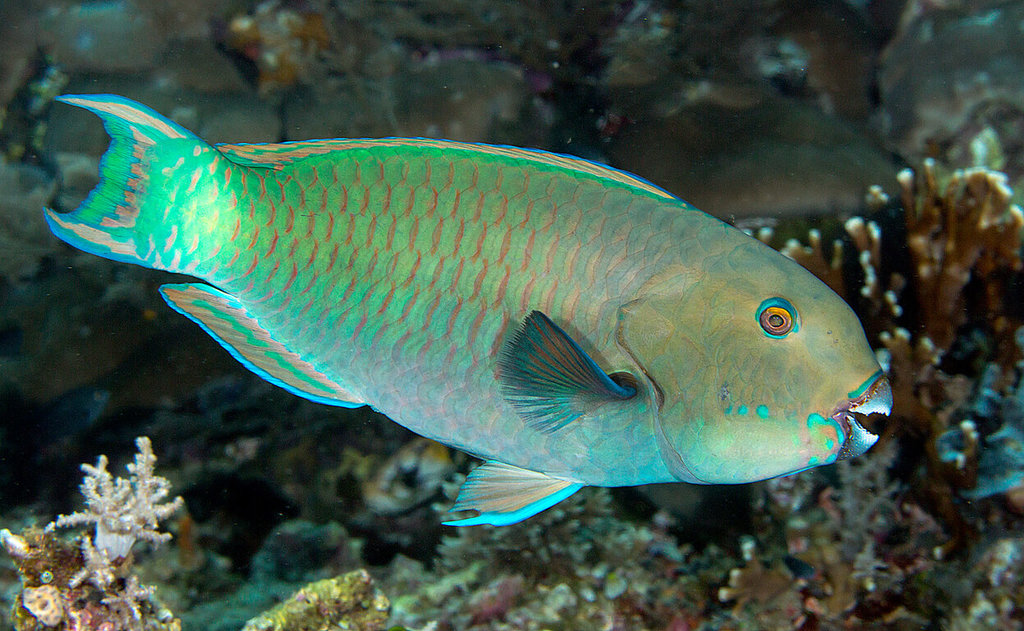
A study has found that fish resources in the Southern Penghu Islands of Penghu showed a declining trend between 2013 and 2015, with a trend of recovery in 2024. However, currently only Tiezhenyu Island has been designated as a marine protected area, and a large number of juvenile fish nursery hotspots fall outside the protected area, forming a significant conservation gap. The Taiwan Science Media Center held a press conference today on 'Marine Protected Areas Are Not Enough, What Do Studies Tell Us We Are Missing?', inviting Professor Wen Kuo-chang of the Department of Life Science at Tunghai University to share his team's latest research findings, published in 'Pacific Conservation Biology' in collaboration with the Fisheries Research Institute of the Ministry of Agriculture. Wen's team studied three types of reef-associated commercially important fish in the Penghu region: groupers, snappers, and parrotfish. They found that the population density of these three fish species decreased by about 50% between 2013 and 2015, with signs of recovery in 2023-2024. However, due to different survey methods, whether the actual population has truly recovered still requires continuous accumulation of annual monitoring data for confirmation. Wen explained that research has found that coral reef fish in the Southern Penghu Islands exhibit 'migratory' behavior. Juveniles prefer mixed habitats of algae and coral reefs as nursery grounds, while adult fish migrate to live coral and sandy reef habitats to settle. Juveniles are mainly concentrated in the areas around Dongyuping and Xiyuping, and only move to Dongjiyu and Xijiyu after growing up. Wen pointed out that the Southern Penghu Islands National Park was announced and implemented in 2014, but only the area around Tiezhenyu Island within its boundaries has been designated as an ecological protection area. A large number of juvenile fish nursery hotspots fall outside the protected area, forming a significant conservation gap. In response, Wen suggested that when formulating conservation measures, a complete 'life-history protection network' should be established for precise management. In addition to incorporating nursery hotspots and protecting some adult fish populations for sustainability, limited recreational fishing should be considered if suitable control measures are in place, and the needs of local residents for marine resources should also be taken into account. Wu Dai-ying, a technician in conservation research at the National Park Headquarters, stated that according to the National Park Law, the entire national park area is a protected area, managed by different zones according to the law, with varying intensities of control. As scientific research increases and local understanding and utilization patterns change, discussions can be held based on this data to adjust conservation strategies and practices. (Editor: Wu Su-jou) 1150416 Choose to stand with the facts, your every sponsorship is a force to protect press freedom. Download the CNA 'One News' APP to grasp the latest news in real time. The text, images, and videos on this website may not be reproduced, publicly broadcast, or publicly transmitted and used without authorization. Keywords: None
FACT BOX
- Source: CNA (Central News Agency)
- Category: research