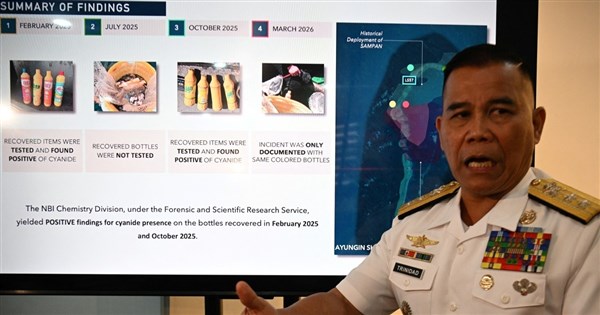
(CNA Reporter Lin Hsing-chien, Manila, 15th) The Philippines is considering filing a case with an international arbitration tribunal regarding the suspected dumping of cyanide by Chinese fishermen in the waters of Ayungin Shoal (Second Thomas Shoal) in the South China Sea. The military stated that relevant departments are gathering evidence and evaluating the feasibility of legal action.
Roy Vincent Trinidad, spokesperson for the Philippine Navy on South China Sea issues, stated on a state-run television interview program today that the Department of Foreign Affairs and the Department of Justice are studying possible legal actions based on relevant international laws, including the United Nations Convention on the Law of the Sea (UNCLOS).
Trinidad said that if the evidence is sufficient, one of the options being considered is to submit the environmental destruction issue to international arbitration, but the final decision will still rest with the Department of Foreign Affairs or other relevant government departments.
The Philippine National Security Council (NSC) issued a statement on the 13th, pointing out that the Philippine Navy had confiscated bottles containing suspicious chemicals from Chinese fishing boats near the Philippine warship BRP Sierra Madre in February and October of last year. Following testing, the contents were confirmed to be cyanide.
The statement noted that cyanide is a highly toxic substance; dumping it into seawater could endanger the health of the troops stationed on the BRP Sierra Madre and cause severe damage to coral reefs and the marine ecosystem.
Trinidad emphasized that the military will continue to patrol and gather evidence in the relevant waters and will submit the data to the Department of National Defense, NSC, Department of Foreign Affairs, and Department of Justice as a basis for subsequent diplomatic or legal actions.
In response, the Chinese Embassy in the Philippines, through Facebook, questioned the timing and credibility of the Philippine side's claims, accusing some parties of attempting to create friction just as "Sino-Philippine relations show signs of stabilization."
In another post, the Chinese Embassy counter-accused the BRP Sierra Madre of chronically leaking oil and heavy metals, thereby destroying the marine ecosystem.
Ayungin Shoal is located approximately 105 nautical miles from Palawan province in the Philippines. Manila, citing UNCLOS, asserts that it lies within the Philippines' 200-nautical-mile Exclusive Economic Zone. Beijing, citing "historical rights," claims that Ayungin Shoal has belonged to China since ancient times.
The BRP Sierra Madre is a dilapidated warship that was intentionally grounded on Ayungin Shoal in 1999 to serve as the Philippines' symbol of sovereignty and military outpost in the South China Sea, manned by stationed soldiers. China has continuously demanded that the Philippines tow the warship away, while the Philippine side has repeatedly accused China of obstructing resupply missions. (Editor: Chen Cheng-kung) 1150416
Choose to stand with facts; every sponsorship you make is a force to protect press freedom.
Download the CNA "First-hand News" APP to grasp the latest news instantly.
The text, images, and audio-visuals on this website may not be reproduced, publicly broadcast, or publicly transmitted and utilized without authorization.
FACT BOX
- Source: CNA (Central News Agency)
- Category: Taiwan