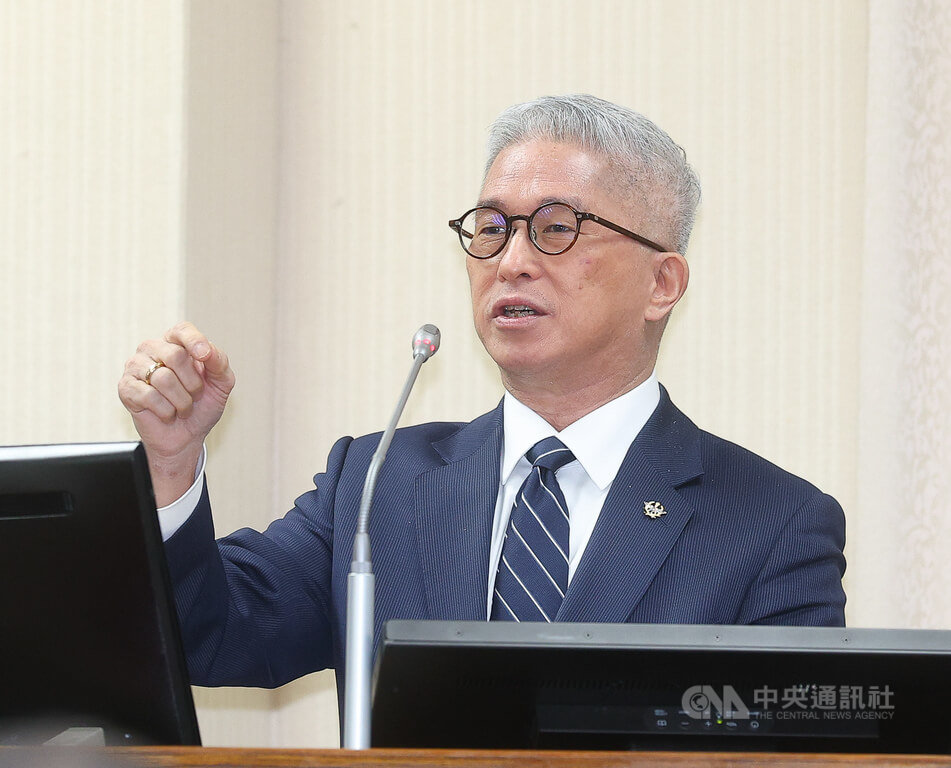
TAIPEI, April 13 (CNA) – Democratic Progressive Party (DPP) Legislator Wang Ting-yu suggested that the national military could express its willingness to assist the United States in minesweeping operations in the Strait of Hormuz. Deputy Minister of National Defense Hsu Szu-chien stated that "the idea is quite creative, but we haven't considered it that way," primarily because the tonnage of minesweepers is insufficient for distant voyages, and the heavy combat readiness burden around Taiwan means that whether the Navy's limited minesweeping capabilities are suitable for deployment still needs evaluation.
The Legislative Yuan's Foreign Affairs and National Defense Committee invited National Security Bureau Director-General Tsai Ming-yen and Deputy Minister of National Defense Hsu Szu-chien, along with representatives from the Ministry of the Interior and the Ocean Affairs Council, to deliver a special report on "Review of Reconnaissance Loopholes, Progress of Technology Surveillance Equipment Construction, and Improvement Measures Regarding Recent Illegal Incursions by Chinese Small Vessels into Our Territorial Waters," and to answer questions.
DPP Legislator Wang Ting-yu pointed out that US President Trump had complained about allies not sending troops to assist in minesweeping in the Strait of Hormuz, and asked if it would be appropriate for Taiwan's military to express its willingness to assist the US in minesweeping at this time.
National Security Bureau Director-General Tsai Ming-yen stated that this is a hypothetical issue, and Taiwan's situation is different from other US allies. It must assess its own enemy situation before deploying forces, so the conditions are more complex.
Deputy Minister of National Defense Hsu Szu-chien mentioned that "the idea is quite creative, but we haven't considered it that way," because the key is still logistics and support, and the Navy's minesweepers are not large enough and may not be able to sail to the Strait of Hormuz. In addition, Taiwan faces a heavy combat readiness burden around its territory and frequent incursions by Chinese warships, so whether the very limited minesweeping capabilities are suitable for deployment still needs evaluation.
Wang Ting-yu also inquired about the sufficiency of the Navy's minesweeping capabilities. Navy Chief of Staff Chu Hui-min replied, "We are continuously working on it." Regarding mine-laying capabilities and the development of smart mines, Chu Hui-min also responded, "We are working hard." (Editor: Su Chih-tsung) 1150413
FACT BOX
- Source: CNA (Central News Agency)
- Category: regulation