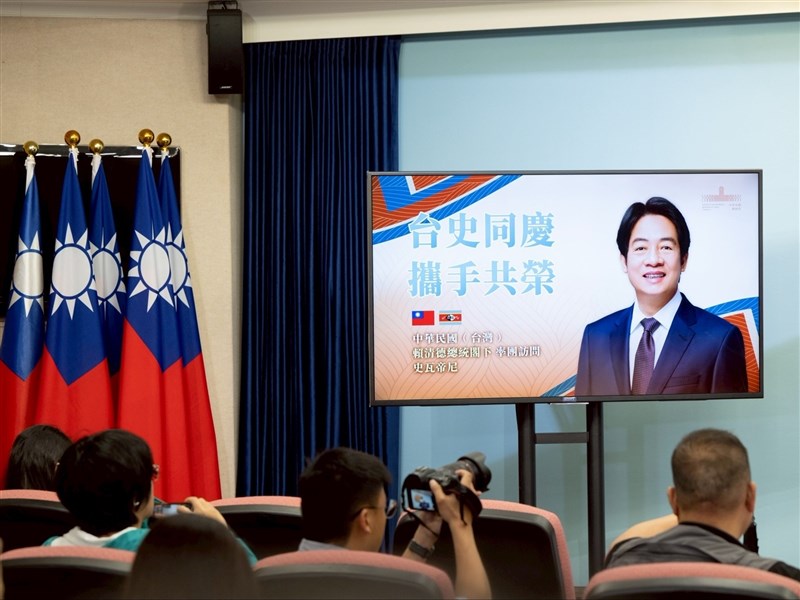
President Lai to Lead Delegation to Eswatini, Foreign Affairs Expert Analyzes 3 Significances
Taiwan's President Lai Ching-te will visit the allied nation of Eswatini in Africa. This visit holds three key significances: demonstrating the solid friendship between the two countries, contrasting with China's expanding influence, and highlighting Taiwan's substantive international contributions.
📋 Article Processing Timeline
- 📰 Published: April 13, 2026 at 12:42
- 🔍 Collected: April 13, 2026 at 12:51 (9 min after Published)
- 🤖 AI Analyzed: April 13, 2026 at 13:01 (9 min after Collected)
Central Message
(CNA, Taipei, 13th, Reporter Yeh Su-ping) President Lai Ching-te will lead a delegation to visit the allied nation of Eswatini from the 22nd. This will be President Lai's first visit to Africa and his second overseas trip since taking office. A foreign affairs expert stated today that this trip has three major significances for the diplomatic relations between the two countries: demonstrating a solid friendship, presenting a strong contrast between Taiwan's substantive diplomacy and China's approach, and highlighting practical cooperation.
President Lai Ching-te will visit the Kingdom of Eswatini from April 22nd to 27th. The trip is mainly in response to a personal signed letter of invitation from King Mswati III of Eswatini, coinciding with the King's 58th birthday and the 40th anniversary of his coronation, as well as the 58th anniversary of the establishment of diplomatic ties between Taiwan and Eswatini. The expert believes President Lai's personal visit with a delegation has three major significances for the bilateral relations.
The expert said the first significance is "demonstrating solid friendship." This year marks King Mswati III's 58th birthday and the 40th anniversary of his coronation. Eswatini is holding grand celebrations for both events, with many royal family members, government officials, and representatives from various sectors of neighboring countries expected to attend. President Lai's personal visit with a delegation is of great significance to the diplomatic ties.
Furthermore, he said, the Kingdom of Eswatini has long spoken up for Taiwan in international forums, firmly voicing support. This trip will show the international community the deep friendship between Taiwan and Eswatini, a brotherhood that transcends geographical distance.
The expert stated the second significance is the "strong contrast between Taiwan's substantive diplomacy and China's." In recent years, China has been actively cultivating its influence around the world, such as through the "Belt and Road Initiative" in Africa and establishing cooperative relations with African countries through the "Forum on China-Africa Cooperation," thereby wooing and threatening Eswatini, Taiwan's only ally in Africa.
The expert said the "Belt and Road" policy appears to be a win-win for Africa and China on the surface, but in reality, it has led many African countries to face enormous debt after accepting Chinese loans for infrastructure construction. According to the African Development Bank, more than 20 countries are either over-indebted or at high risk of debt distress. The reason China promotes the "Belt and Road" is to prioritize the construction of infrastructure that helps strengthen its control, such as electricity, roads, and bridges, as China hopes to control Africa's rich mineral resources and the entire supply chain.
The expert stated that Eswatini is Taiwan's only diplomatic ally in Africa. China has long threatened to cut off all trade with Eswatini on one hand, while continuing to build business and economic interests in the country on the other. In contrast, Taiwan continues to improve the public health environment, promote women's empowerment, assist in public construction, and cultivate talent, creating a strong contrast with hegemonic China through concrete contributions.
The expert said the third significance is "highlighting practical cooperation." Africa is a strategic core of the Global South, and Eswatini is Taiwan's only ally in Africa, as well as an important member of the Southern African Customs Union (SACU) and the African Continental Free Trade Area (AfCFTA). This trip will highlight the fruitful cooperation between Taiwan and Eswatini, using the successful cooperation experience to show neighboring African countries the contributions Taiwan can make. (Edited by: Hsieh Chia-chen) 1150413
(CNA, Taipei, 13th, Reporter Yeh Su-ping) President Lai Ching-te will lead a delegation to visit the allied nation of Eswatini from the 22nd. This will be President Lai's first visit to Africa and his second overseas trip since taking office. A foreign affairs expert stated today that this trip has three major significances for the diplomatic relations between the two countries: demonstrating a solid friendship, presenting a strong contrast between Taiwan's substantive diplomacy and China's approach, and highlighting practical cooperation.
President Lai Ching-te will visit the Kingdom of Eswatini from April 22nd to 27th. The trip is mainly in response to a personal signed letter of invitation from King Mswati III of Eswatini, coinciding with the King's 58th birthday and the 40th anniversary of his coronation, as well as the 58th anniversary of the establishment of diplomatic ties between Taiwan and Eswatini. The expert believes President Lai's personal visit with a delegation has three major significances for the bilateral relations.
The expert said the first significance is "demonstrating solid friendship." This year marks King Mswati III's 58th birthday and the 40th anniversary of his coronation. Eswatini is holding grand celebrations for both events, with many royal family members, government officials, and representatives from various sectors of neighboring countries expected to attend. President Lai's personal visit with a delegation is of great significance to the diplomatic ties.
Furthermore, he said, the Kingdom of Eswatini has long spoken up for Taiwan in international forums, firmly voicing support. This trip will show the international community the deep friendship between Taiwan and Eswatini, a brotherhood that transcends geographical distance.
The expert stated the second significance is the "strong contrast between Taiwan's substantive diplomacy and China's." In recent years, China has been actively cultivating its influence around the world, such as through the "Belt and Road Initiative" in Africa and establishing cooperative relations with African countries through the "Forum on China-Africa Cooperation," thereby wooing and threatening Eswatini, Taiwan's only ally in Africa.
The expert said the "Belt and Road" policy appears to be a win-win for Africa and China on the surface, but in reality, it has led many African countries to face enormous debt after accepting Chinese loans for infrastructure construction. According to the African Development Bank, more than 20 countries are either over-indebted or at high risk of debt distress. The reason China promotes the "Belt and Road" is to prioritize the construction of infrastructure that helps strengthen its control, such as electricity, roads, and bridges, as China hopes to control Africa's rich mineral resources and the entire supply chain.
The expert stated that Eswatini is Taiwan's only diplomatic ally in Africa. China has long threatened to cut off all trade with Eswatini on one hand, while continuing to build business and economic interests in the country on the other. In contrast, Taiwan continues to improve the public health environment, promote women's empowerment, assist in public construction, and cultivate talent, creating a strong contrast with hegemonic China through concrete contributions.
The expert said the third significance is "highlighting practical cooperation." Africa is a strategic core of the Global South, and Eswatini is Taiwan's only ally in Africa, as well as an important member of the Southern African Customs Union (SACU) and the African Continental Free Trade Area (AfCFTA). This trip will highlight the fruitful cooperation between Taiwan and Eswatini, using the successful cooperation experience to show neighboring African countries the contributions Taiwan can make. (Edited by: Hsieh Chia-chen) 1150413