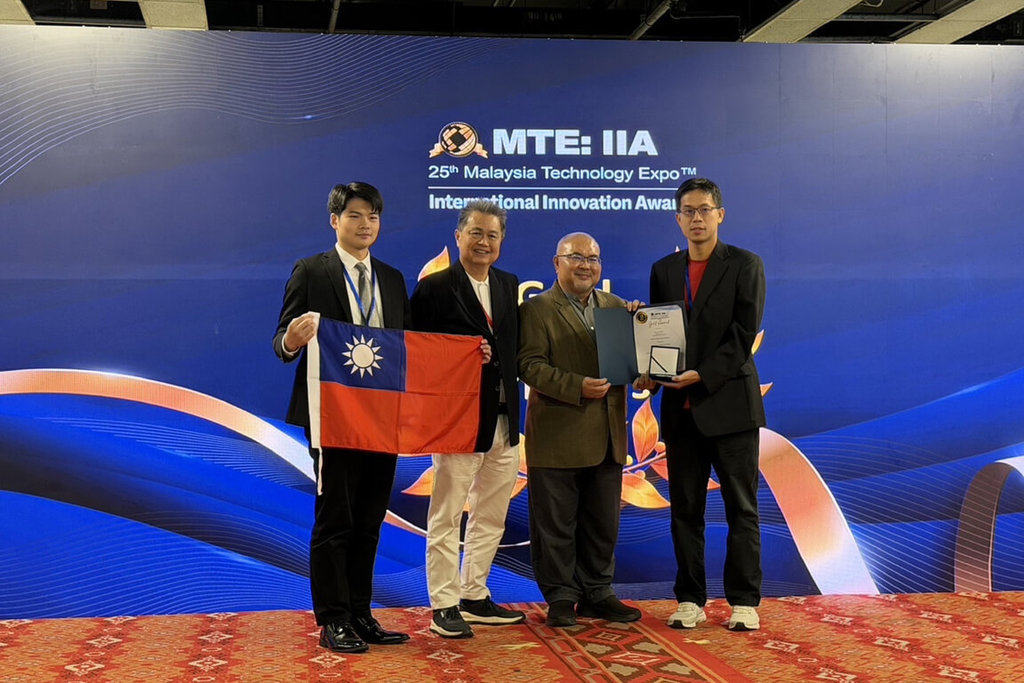
(Central News Agency reporter Yang Szu-jui, Tainan, April 13) A research team led by Professor Chen Chia-yuan of National Cheng Kung University's Department of Mechanical Engineering successfully developed an active bio-analysis platform combining magnetically controlled microrobots and microfluidic biochips, winning two major awards at the 2026 Malaysia MTE International Invention Exhibition.
NCKU today issued a press release stating that with the continuous development of medical technology, non-contact microrobot technology has gradually gained attention. The microrobot industry has flourished in recent years, with its medical application market continuously expanding. The active bio-analysis platform developed by Professor Chen Chia-yuan's team has shown breakthrough results in its application to zebrafish, widely used in the pharmaceutical industry, for sperm activation.
NCKU pointed out that Professor Chen Chia-yuan's team won two major awards at the 2026 Malaysia Technology Expo (MTE) International Invention Exhibition, including a gold medal for invention and a special award from the Malaysian Association of Research Scientists. The team was specifically introduced by the event's emcee as a university research team from Taiwan.
NCKU stated that in the application of zebrafish sperm activation, sperm activity often significantly decreases after freezing and thawing. To address this problem, the research team integrated their self-designed magnetic microrobots into a microfluidic chip. Through a self-designed miniaturized external magnetic field control system for non-contact control, the activation rate of thawed sperm was successfully increased to over 80%, and the operation time was significantly reduced, improving application efficiency.
NCKU stated that the technology developed by Professor Chen Chia-yuan and his team has been validated in animal models, establishing its reliability in biological applications. In the future, it will be further developed for human-related medical applications and extended to biomedical testing, drug screening, and smart microfluidic systems, achieving subsequent home care applications.
NCKU pointed out that the team further miniaturized the system from large laboratory equipment to a palm-sized portable device and successfully significantly reduced operating power, enhancing its practical application potential. Related research results have been published in over 20 SCI international journals in recent years and featured in 4 international publishers and over 6 different international journals, covering microrobot control, microfluidic manipulation, and biological applications, verifying its solid scientific and technological innovation capabilities.
NCKU stated that the MTE International Invention Exhibition is a highly influential international exhibition in Malaysia, long committed to promoting exhibitions and competitions in three major areas: creative inventions, emerging technologies, and social services. With the support of Malaysian government agencies such as the Ministry of Science, Technology and Innovation and the Ministry of Education, it has been held continuously for over 20 years. This year, it took place from April 9 to 11 in Kuala Lumpur, Malaysia.
NCKU pointed out that the Malaysia MTE International Invention Exhibition Special Award is usually granted to outstanding works with high innovation, practicality, and market potential. With high recognition from international judges, the research team led by Professor Chen Chia-yuan will continue to promote the developed biochip system to more international industry platforms. (Editor: Chang Ya-ching) 1150413
Choose to stand with facts, every sponsorship you make is a force to protect press freedom.
Download CNA's "First-hand News" APP to get the latest news instantly.
The text, images, and videos on this website may not be reproduced, publicly broadcast, or publicly transmitted and used without authorization.
FACT BOX
- Source: CNA (Central News Agency)
- Category: award