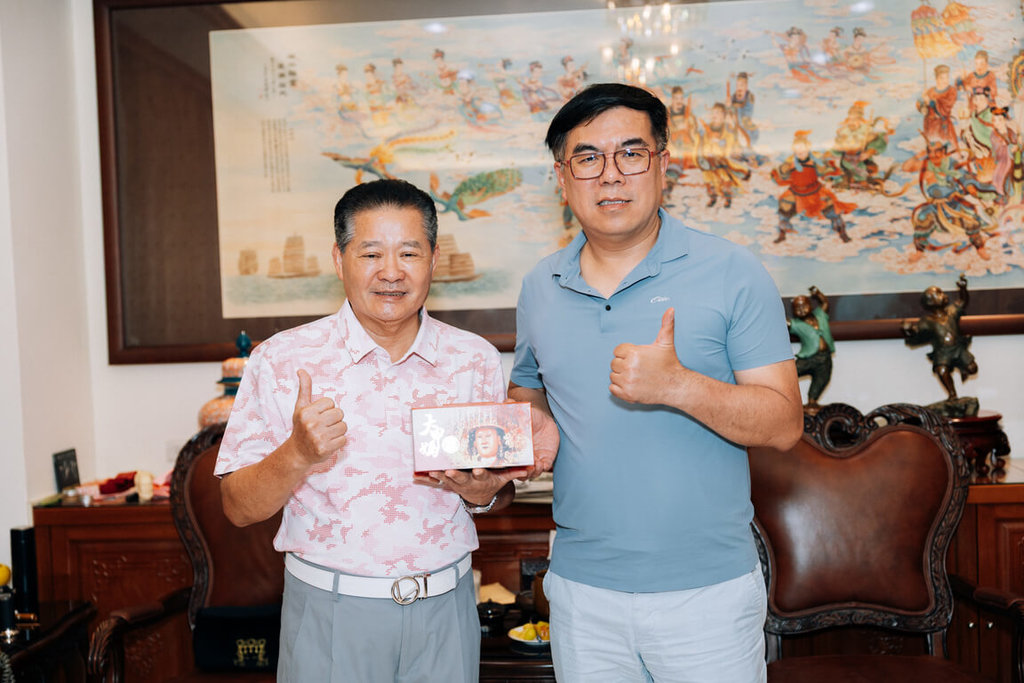
Central News Agency, Taipei, 13th (Reporter: Chang Hsiung-feng) - As the Baishatun Gongtian Temple Mazu pilgrimage began in the early hours of this morning, Minister of Environment Peng Chi-ming went to offer incense and pray. He stated that in the future, there will be in-depth cooperation with Jenn Lann Temple to promote the transformation of 'Fushi Culture,' gradually introducing reusable tableware to reduce the waste of disposable resources.
The Baishatun Gongtian Temple Mazu pilgrimage from Miaoli's Tongxiao to Beigang's Chaotian Temple began in the early hours today. This year, the 'furnace master Mazu' joins the procession, with three Mazu statues inside the 'Pink Supercar' palanquin leading over 460,000 'incense-followers' on an 8-day, 7-night pilgrimage.
The Ministry of Environment issued a press release today stating that Minister of Environment Peng Chi-ming and Director-General of the Resource Circulation Administration Lai Ying-ying went to Dajia's Jenn Lann Temple yesterday to offer incense, pray, and meet with the temple's Vice Chairman, Cheng Ming-kun. The two sides had an in-depth exchange on how to introduce waste reduction concepts into the pilgrimage activities, hoping to transform the traditional religious event into an environmentally friendly green model through cross-sector collaboration.
Peng Chi-ming stated that the Mazu pilgrimage is one of Taiwan's most representative cultural symbols, emotionally engaging millions of people each year, and its social influence is far-reaching. In the future, there will be in-depth cooperation with Jenn Lann Temple to promote the transformation of 'Fushi Culture' by gradually introducing reusable tableware and reducing the waste of disposable resources.
Cheng Ming-kun said that the theme of this year's pilgrimage places special emphasis on the practice of 'goodness,' and he stressed that the core of Mazu belief is to do good and cherish all things. Before the COVID-19 pandemic, temples along the Mazu pilgrimage route had prepared over 10,000 sets of reusable tableware, and the temple fully supports bringing back this good intention. It is hoped that through waste reduction, devotees will be guided to transform their piety for Mazu into friendliness towards the land.
The Ministry of Environment stated that it will promote a circular path through a 'public-private partnership' model. Corporate resources will be injected to support environmental protection materials and hardware; management by civil society groups will connect professional organizations to assist with the cleaning, transportation, and operational management of reusable tableware; and most importantly, temples will lead devotees to respond, establishing a comprehensive recycling mechanism to make environmental protection an active faith.
The Ministry of Environment hopes that through cooperation with Jenn Lann Temple, a new model of 'eco-friendly pilgrimage' can be established, allowing the public to practice resource circulation while participating in their faith, extending their good thoughts to the protection of the environment. (Editor: Chen Ching-fang) 1150413
FACT BOX
- Source: CNA (Central News Agency)
- Category: Partnership