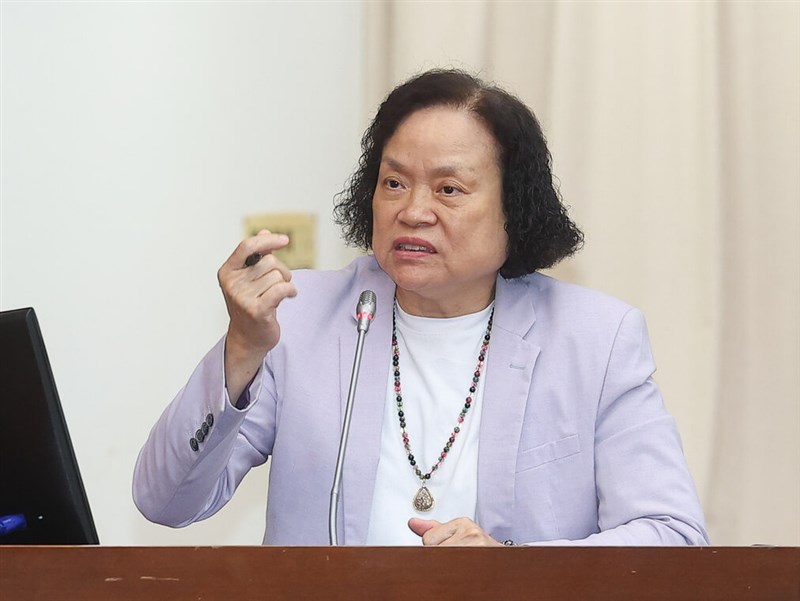
The Middle East conflict continues to escalate, with its impact on people's livelihoods gradually emerging. In response to a legislative inquiry about whether the government plans to allocate a special budget to address the impact of the Middle East conflict on people's livelihood and prices, Chen Shu-tzu, Director-General of the Directorate-General of Budget, Accounting and Statistics, stated that if there is a funding gap, enacting a special budget through special regulations is one of the options. After assessment, the required scale is estimated to be nearly NT$130 billion.
The Legislative Yuan's Finance Committee today invited relevant ministries to deliver a special report on "The Medium-to-Long-Term Impact and Response to the Middle East Conflict on Energy, Prices, People's Livelihood, Medical Supplies, and Market Order, and the Implementation of the Special Budget for Strengthening Economic, Social, and Livelihood National Resilience in Response to International Situations."
Democratic Progressive Party Legislator Lee Kun-cheng pointed out that the government previously proposed the "Special Regulations for Strengthening Economic, Social, and Livelihood National Resilience in Response to International Situations" due to US tariffs. Now, the Middle East conflict has affected various industries, and relevant ministries have implemented measures such as tax reductions, price freezes, and subsidies, all of which require funding. He questioned whether these could be covered by the special budget for strengthening resilience.
The resilience special regulations currently have a reserved flexible quota of NT$25.3 billion. However, Chen Shu-tzu stated that the Directorate-General of Budget, Accounting and Statistics had discussed with various ministries whether it could be applied to the needs arising from the Middle East conflict. After evaluation, it was deemed non-compliant, requiring amendments to the regulations and additional budget.
Chen Shu-tzu stated that all units have been asked to compile statistics, and the required funds are approximately NT$129.2 billion, including the Ministry of Economic Affairs, CPC Corporation, Taipower, Ministry of Transportation and Communications, and Ministry of Agriculture. The current funds for these needs are "far from sufficient." If this gap is to be filled, there are two approaches: one is to process an additional budget, but this is stalled because the general budget has not yet passed; the other is to propose special regulations and allocate a special budget, estimated at NT$130 billion.
Lee Kun-cheng asked whether the Directorate-General of Budget, Accounting and Statistics believes there is a necessity for a special budget. Chen Shu-tzu replied that relevant departments would be asked to submit their demands, and the Executive Yuan would make a decision.
In addition, the South Korean government plans to issue high oil price support funds to alleviate the burden of high oil prices and commodity prices caused by the Middle East war on its citizens. Lee Kun-cheng and Kuomintang Legislator Lo Ming-tsai both expressed concern about this issue and whether the Taiwanese government intends to follow suit.
Deputy Minister of the National Development Council, Kao Hsien-kuei, explained that South Korea's approach differs slightly from Taiwan's. Taiwan blocks oil price increases at the front end through CPC Corporation's absorption mechanism, thereby curbing the impact on people's livelihood prices at the back end. This is a key reason why the Consumer Price Index (CPI) increase in the first quarter of this year was only 1.23%, lower than the February forecast of 1.38%.
Kao Hsien-kuei added that prices have downward rigidity, so the government hopes to block them at the front end rather than subsidizing affected groups after prices have risen.
Lo Ming-tsai asked how much funding would be needed if Taiwan were to issue an oil subsidy of NT$10,000 per person. Chen Shu-tzu replied that, similar to universal cash handouts, it would require approximately NT$236 billion, boosting the Gross Domestic Product (GDP) by about 0.415 percentage points. However, the government's current approach is to start by freezing oil prices to avoid additional fiscal expenditures later.
During today's meeting, legislators from both ruling and opposition parties expressed concern about domestic prices and their impact on people's livelihoods. Taiwan People's Party Legislator Liu Shu-pin asked about the Central Bank's subsequent monetary policy stance. Central Bank Deputy Governor Yen Tsung-ta stated that subsequent monetary policy adjustments would focus on domestic inflation, with a CPI of 2% as the alert line. In addition, international economic and financial situations would also affect price changes, and continuous attention would be paid. (Editor: Pan Yi-ching) 1150413
FACT BOX
- Source: CNA (Central News Agency)
- Category: regulation