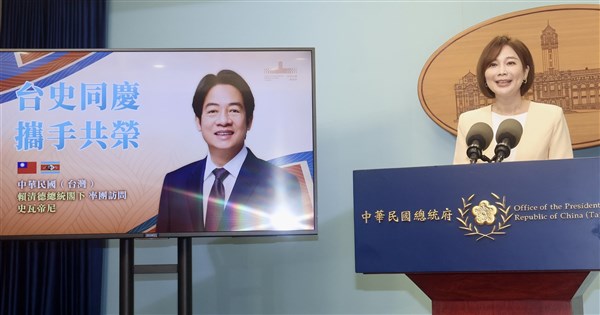
Taiwan President Lai Ching-te is scheduled to visit the Kingdom of Eswatini from April 22 to 27, under the theme 'Taiwan and Eswatini Celebrate Together, Hand in Hand for Common Prosperity.' Presidential Office spokesperson Kuo Ya-hui stated that President Lai aims to achieve three co-prosperity goals during this trip: security, economic, and digital co-prosperity. President Lai will meet with the King of Eswatini, sign a joint communiqué, and witness the foreign ministers of both countries sign a 'Customs Mutual Assistance Agreement.' Additionally, President Lai will receive briefings on the 'Taiwan Industrial Innovation Park' and 'Strategic Oil Storage Tank,' witness Taiwanese businesses sign letters of intent for investment, inspect the 'Smart Medical Outpatient Clinic' of the medical team stationed in Eswatini, and attend the achievement presentation for the 'Women's Entrepreneurship Microcredit Revolving Fund.' The Ministry of Foreign Affairs confirmed that this trip will be a direct flight, not overflying the Middle East, and without any transit arrangements in third countries.
Lee Chen-hsiu, a Chinese spouse, has been embroiled in controversy regarding her nationality and legislator qualifications, and was accused of claiming Hsinchu Mayor Kao Hung-an received NT$7 million from Ko Wen-je in a live broadcast. The Taiwan People's Party Central Review Committee decided on April 13 to expel Lee Chen-hsiu from the party, effective immediately, which results in her losing her proportional representation legislator qualification. Committee member Chen You-cheng revealed that Lee had offered to resign as a proportional representation legislator in exchange for 'specific monetary compensation for herself,' severely damaging the Taiwan People's Party's image. Lee Chen-hsiu stated that she accepts the disciplinary action for the greater good and will not pursue legal action, but she denied the 'resignation for benefit' claim. The Central Election Commission announced that the Taiwan People's Party has sent a letter to the Commission, which will then request the Legislative Yuan to cancel Lee Chen-hsiu's legislator registration. According to the Election and Recall Act, the Central Election Commission will announce the replacement list within 15 days from the date the Legislative Yuan's official letter canceling Lee Chen-hsiu's registration is received. Lee Chen-hsiu's legislator seat will be filled by Hsu Chung-hsin, a law professor at National Cheng Kung University.
Labor Minister Hung Shen-han's previous statement that the first batch of Indian migrant workers might be introduced this year sparked discussion. The KMT legislative caucus stated on April 13 that it fully opposes any expansion of migrant worker sources until the current system is improved and the issue of runaway migrant workers is effectively resolved, demanding that the Executive Yuan explain the complete policy motivation and sources of industry demand. DPP legislative caucus whip Chuang Jui-hsiung stated that the government has heard various voices and hopes that both ruling and opposition parties will carefully review and rationally discuss the matter. Hung Shen-han reiterated that the introduction of Indian migrant workers has cross-party support, but it requires two prerequisites: demand from businesses for Indian migrant workers, and the Indian side's implementation plan meeting Taiwan's requirements and scrutiny. If these two principles cannot be met, there will be no issue of introduction, nor a timetable.
A recent case where a sanitation worker was sentenced to 10 months in prison for giving low-value recyclables to a scavenger has sparked public discussion on minor corruption cases. The Legislative Yuan's Judiciary and Organic Laws and Statutes Committee initially passed an amendment to Article 12 of the Anti-Corruption Act. This amendment, in addition to the existing provision for reduced sentences, adds a new provision allowing for exemption from punishment for minor cases or those involving property valued under NT$50,000, granting judicial bodies more discretion.
US President Trump ordered a blockade of the Strait of Hormuz, further exacerbating the economic crisis faced by energy-dependent Asian economies, including US allies in the region and China. Food and transportation prices have surged in Southeast Asia, with diesel prices rising by 67% in Thailand, approximately 140% in the Philippines, 110% in Vietnam, and about 100% in Malaysia. The Taiwan government continues to monitor energy and various raw material supply chain dynamics to respond. Premier Cho Jung-tai explained that natural gas supply is sufficient from April to May; gas sources for June are almost secured, and arrangements for after July are underway. CPC Corporation has four oil tankers, carrying a total of 8 million barrels of crude oil, transported from the Red Sea, with the first one expected to arrive in Taiwan in early May. Formosa Petrochemical and CPC have successively purchased or increased refining ratios, and the supply of asphalt raw material is no longer an issue. The Ministry of Economic Affairs' affordable plastic bag project will gradually enter the market starting this week. Directorate-General of Budget, Accounting and Statistics Minister Chen Shu-tzu stated that if funding gaps need to be filled, the compilation of a special budget through special regulations is one option, and after assessment, the required scale is approximately NT$130 billion.
Hungary's conservative 'Respect and Freedom Party,' led by Péter Magyar, won a two-thirds majority in the parliamentary elections on April 12, defeating nationalist Prime Minister Viktor Orbán. After the election, Magyar announced he had received a 'historic mandate to govern.' Just a few years ago, Magyar was applauding Orbán's speeches from the front row; soon after, Magyar's identity changed, becoming the most challenging opponent to the nationalist leader. Magyar promised change, vowing to dismantle Orbán's entire political system 'brick by brick,' stating he would amend the constitution and fight corruption, expressing hope to be inaugurated by May 5. Following the defeat of pro-Russian Orbán, the Russian government expressed hope for establishing 'pragmatic' relations with Hungary's new leadership. The Ukrainian government, meanwhile, canceled its advice for citizens to avoid traveling to Hungary. European Commission President Ursula von der Leyen wrote on the X platform: 'Hungary has chosen Europe. Tonight, the heart of Europe beats stronger in Hungary.'
Australian Defense Minister Richard Marles announced that Lieutenant General Susan Coyle will be appointed as the Chief of Army, becoming the first female Chief of Army in the Australian Army's 125-year history. Marles described this as a 'profound and historic moment.' Coyle has accumulated rich practical experience during her 30-year military career, including deployments to the Solomon Islands, Afghanistan, and the Middle East. The Australian Army is currently undergoing a major transformation, introducing long-range firepower, drones, and other modern combat equipment. Coyle also emphasized her experience in areas such as cyber warfare.
Palauan President Surangel Whipps Jr. told AFP on April 13 that Beijing had 'very directly' asked Palau to abandon its diplomatic recognition of Taiwan, but Palau does not accept others dictating its allies. He emphasized: 'Those of us who support Taiwan have the same rights as those who support China, and we should be treated equally.' He also mentioned that the global oil crisis has had a significant impact on the people of Palau.
Vietnamese idol ISAAC, Taiwan's tourism ambassador in Vietnam, performed at the Taiwan booth at the Hanoi International Travel Fair, attracting a large number of fans. ISAAC specifically traveled to Taiwan to film a tourism promotion video and composed a song for Taiwan, 'Trạm Dừng Của Anh' (My Heart's Stopover), incorporating elements such as Taipei 101, Sun Moon Lake, and bubble tea into the lyrics. In March, ISAAC also rallied nearly 500 Vietnamese tourists to Kaohsiung Neimen to experience traditional culture such as banquets and Song Jiang Battle Array. ISAAC revealed that he was already a fan of Taiwan tourism before taking on the role of tourism ambassador, and after accepting the ambassadorial mission, he hopes to motivate more people to visit Taiwan.
The Mazu pilgrimage from Baishatun Gongtian Temple in Miaoli Tongxiao to Beigang Chaotian Temple began in the early hours of April 13, with the 'Luzhu Mazu' joining this year. Three Mazu statues inside the palanquin—Gongtian Temple's main Mazu, Luzhu Mazu, and Shanbian Mazu—set off, leading over 460,000 'Xiang Deng Jiao' (pilgrims) on an 8-day, 7-night challenging pilgrimage. In the morning, the Mazu palanquin made a sharp turn into a primary school in Dajia District, where many children waited on the playground for the 'Zuan Jiao Di' (passing under the palanquin). Subsequently, the palanquin entered Zhenlan Temple, making three entrances and exits in the temple square, showcasing the charm of the 'Pink Supercar.' As the gathering of the four Mazu statues is a rare event, pilgrims crowded the temple square, shouting 'Jin Luo! Jin Luo!' (Entering! Entering!) to catch a glimpse of the goddess.
FACT BOX
- Source: CNA (Central News Agency)
- Category: 外交, 政治, 労働政策, 法改正, 経済, 国際関係, 軍事, 観光, 文化Event