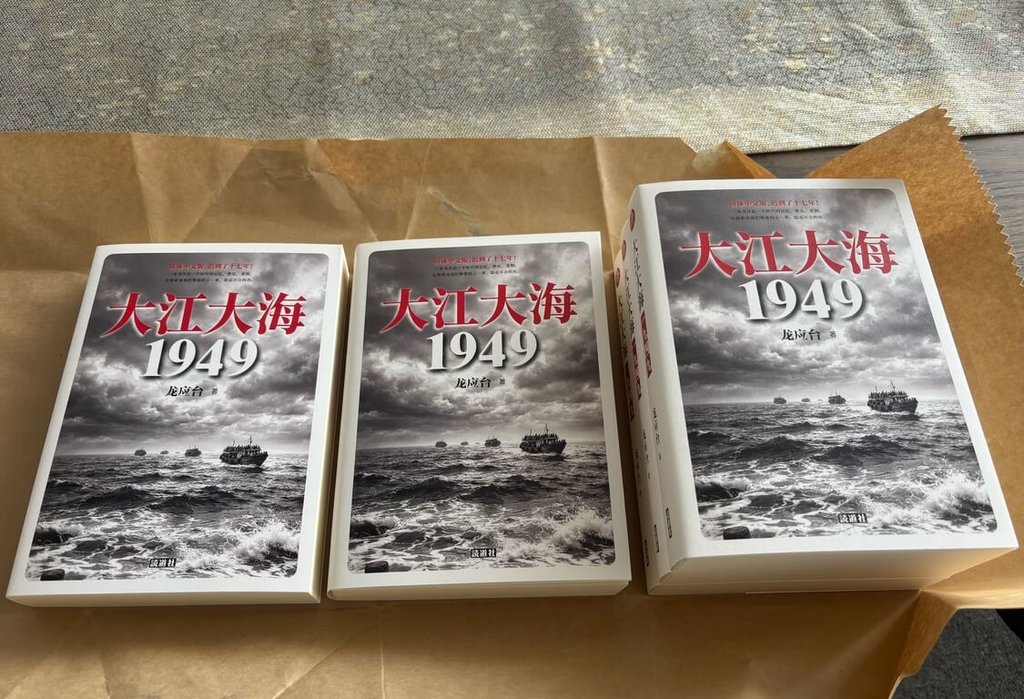
TAIPEI (CNA) -- Seventeen years after its initial release, author Lung Ying-tai's 'Big River, Big Sea 1949' has been published in a simplified Chinese edition, though the book remains banned in mainland China. Regarding the significance of the new edition, Lung stated in the preface: 'Today's simplified Chinese nation is the main battlefield of wailing and desolation back then.'
'Big River, Big Sea 1949' (referred to as 'Big River, Big Sea') was first published in 2009, marking the 60th anniversary of the Kuomintang government's retreat to Taiwan and the establishment of the Communist regime. The book uses literary prose to recount the stories of ordinary people displaced by the Chinese Civil War. The author aims to 'pay tribute to all those trampled, humiliated, and hurt by the times,' and hopes to prevent history from repeating itself.
Due to its historical perspective, the book was banned in mainland China from the outset, but some traditional Chinese editions were smuggled into the country.
Chinese publisher Zhang Shizhi read the book over a decade ago and was deeply moved. He told CNA that his education always portrayed the 1949 establishment of 'New China' as the Communist army's overwhelming victory over the 'reactionary Kuomintang,' a glorious event. However, Lung Ying-tai's perspective, from the 'loser's' viewpoint, and her reflections on the cruelty of war, offered a completely new understanding for many mainland readers.
In recent years, Zhang Shizhi moved from Beijing to Japan and founded the publishing house 'Dudao She' in Tokyo, committed to preserving valuable content in simplified Chinese. Although 'simplified Chinese books published overseas' may not enter the Chinese market, they enjoy the advantage of publishing freedom. With a growing number of Chinese people moving overseas, these publications are gradually gaining a foothold.
In January 2024, Zhang Shizhi had the opportunity to meet Lung Ying-tai and expressed his desire to publish 'Big River, Big Sea.' 'I know this book is where she put in the most effort,' Zhang said, hoping that mainland readers who haven't read the book would have a simplified Chinese option. But what made Lung agree to entrust him with the copyright?
Lung Ying-tai once said she particularly hoped mainland Chinese readers could see this book. Since publishing in mainland China was impossible, publishing a simplified Chinese edition overseas was a way to reach simplified Chinese readers. Zhang Shizhi believes this was the reason that moved Lung.
The simplified edition includes a new preface of about 4,000 characters. Lung Ying-tai describes 'Big River, Big Sea' as a 'literary offering' to millions of departed souls. In the preface, she writes: 'The 2026 simplified Chinese publication – today's simplified Chinese nation is the main battlefield of wailing and desolation back then – though only overseas, is still a wisp of smoke, and the souls must know.'
As a second-generation 'waishengren' (mainlander who moved to Taiwan) in Taiwan, Lung Ying-tai strongly advocates for peace. 'Big River, Big Sea' includes stories of her own parents. However, from her New York Times op-eds in 2023 and 2025 (titled 'Beijing Hasn’t Fired a Shot, But It Has Already Caused Cracks in Taiwanese Society' and 'Taiwan’s Only Path to Peace and Freedom Is Reconciliation with China'), to her new book sharing event at the Monsoon Bookstore in Washington D.C. this April, her 'peace theory' has stirred controversy and criticism from some individuals.
Meanwhile, Chinese self-media personality Chai Jing's YouTube program featuring a dialogue with Lung Ying-tai about the Chinese Civil War has accumulated 1.26 million views and over 8,000 comments in five months, mostly from mainland readers expressing aversion to war and empathy for Lung Ying-tai.
Lung Ying-tai's articles and statements receive different evaluations between the two sides of the strait, and between internet celebrities and ordinary readers.
Zhang Shizhi believes some criticisms are valid, but one should not overlook that 'Big River, Big Sea' is about a mother talking to her 19-year-old son, who has received a draft notice, about the state apparatus and war. As a father of middle school students himself, he also faces the challenge of discussing national and historical views with his children. Therefore, Lung Ying-tai's sincere writing style, starting from the individual, particularly resonated with him.
On the 18th of this month, Lung Ying-tai will give a lecture at the University of Tokyo, titled 'When the War Doesn't End – Eighty Years After 'Big River, Big Sea'.' Dudao She has rented a venue that can accommodate 600 people, and judging by the enthusiastic registration, Zhang Shizhi says this will be the largest humanities and thought event involving Chinese people in Tokyo in the past three or four years.
After Lung Ying-tai's peace theory sparked differing opinions, some critics viewed it as weakness or capitulation to the CCP regime. Zhang Shizhi disagrees with this view.
Lung Ying-tai's published articles have always shown a certain tension with the CCP authorities. In 2006, she wrote an open letter to then-CCP General Secretary Hu Jintao, 'Please Convince Me with Civilization,' discussing freedom of speech in the context of the 'Bingdian' magazine suspension incident.
In September 2019, she published a long article on social media, describing Hong Kong youth as 'eggs' and the authorities as 'copper walls and iron fortifications,' calling on China to treat Hong Kong gently. As a result, she was criticized by the official media People's Daily. After this, major Chinese book-selling platforms JD.com and Dangdang.com began removing Lung Ying-tai's works.
Lung Ying-tai was once a best-selling author in mainland China. In the 10th Writers Rich List promoted by several media outlets in 2016, the highest-ranked Taiwanese author was Lung Ying-tai, at 15th place, with 'The Farewell' as her representative work, earning 8.7 million RMB (approximately 43.5 million NTD at the time) in royalties.
Zhang Shizhi said that many people, weighing the pros and cons, might remain silent on many issues for fear of losing existing interests. But in his view, authors Yan Geling and Lung Ying-tai both chose to speak out on social issues, knowing they would pay a price. (Editor: Chen Kai-yu) 1150413
Choose to stand with facts, every sponsorship you provide is the power to protect press freedom.
Download CNA's 'First-hand News' APP to stay updated with the latest news.
The text, images, and audio-visual content of this website may not be reproduced, publicly broadcast, publicly transmitted, or utilized without authorization.
FACT BOX
- Source: CNA (Central News Agency)
- Category: product_launch