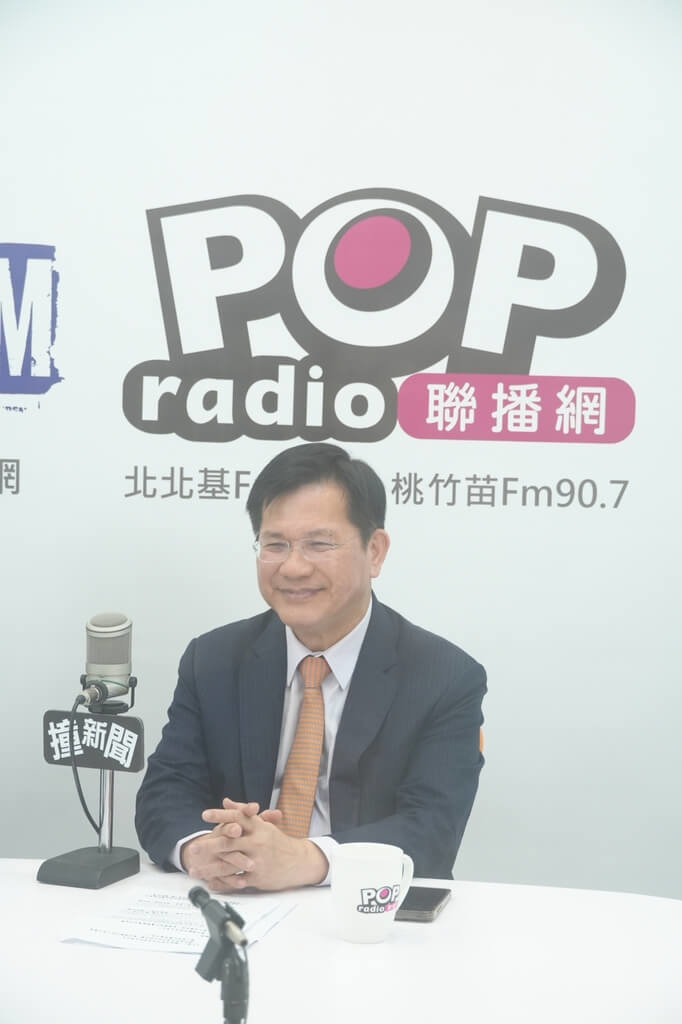
President Lai Ching-te will visit the Kingdom of Eswatini, an African ally, from April 22 to 27, to attend the 40th anniversary of the King's enthronement and his 58th birthday. He will sign a joint communiqué with the King and witness the signing of a mutual customs assistance agreement between the foreign ministers of the two countries. He will also receive briefings on Taiwan's industrial innovation parks. Lin Chia-lung, speaking during an interview on the radio program "POP Hit News" on the morning of [Date of article, assume April 20, 2026], said that direct flights by the presidential aircraft were effective during former President Tsai Ing-wen's tenure, shortening travel time, and this was based on comprehensive considerations of security, comfort, and convenience for state visits. Lin Chia-lung stated that not transiting through the United States is natural; one goes east, the other west. Although the Earth is round, there's no need to go around a full circle. Moreover, President Lai previously transited through US territories of Hawaii and Guam on his way to Pacific nations. Regarding external doubts about whether President Lai can transit through US mainland territory, Lin Chia-lung emphasized, "The United States always welcomes President Lai." He added, "We should have confidence in future customary transits, and explanations will be provided when the time is ripe." Taiwan has significant investments in the US, and there are many choices for transit locations. Furthermore, considering the current global context including the Middle East war and the potential US-China summit, President Lai's travel requires suitable timing and objectives. The host asked about China's attempts to entice Taiwan's allies and its zero-tariff policy for Africa this year, which uniquely excludes Eswatini. Lin Chia-lung admitted that China's zero-tariff policy towards Africa exerts considerable pressure on Taiwan, but Taiwan-Eswatini diplomatic relations are stable. He contrasted this with the lingering issues caused by China's "Belt and Road Initiative" for recipient countries, highlighting that Taiwan cooperates with its allies based on its own development experience, through the "Taiwan model." The achievements of Taiwan-Eswatini cooperation have made neighboring countries envious. When asked about Brazil's representative to Taiwan, Luís Cláudio Villafañe Gomes Santos, stating that Taiwan is part of China and that the Kuomintang chairman holds a similar view, Lin Chia-lung responded that the Ministry of Foreign Affairs has protested this. He noted that while Villafañe was initially discussing economic and trade opportunities between Brazil and Taiwan, the conversation later "went off-topic." The Ministry of Foreign Affairs takes this matter seriously and believes that internal cross-strait interactions in Taiwan might have given some individuals the wrong impression, which needs to be addressed and prevented. He also explained to Villafañe that the "One China" principle offers no guarantee for Taiwanese investors. Lin Chia-lung pointed out that Taiwan's relations with some countries are unrelated to the "One China" principle. As Taiwan's national strength continues to grow and the world wants to be friends with Taiwan, "Why should we be bound by 'One China'?" He questioned why some countries repeatedly invoke "One China," and how the government can encourage corporate investment when such issues arise, which not only pertains to sovereignty but also to corporate property rights. (Editor: Hsieh Chia-chen) 1150420.
FACT BOX
- Source: CNA (Central News Agency)
- Category: Event