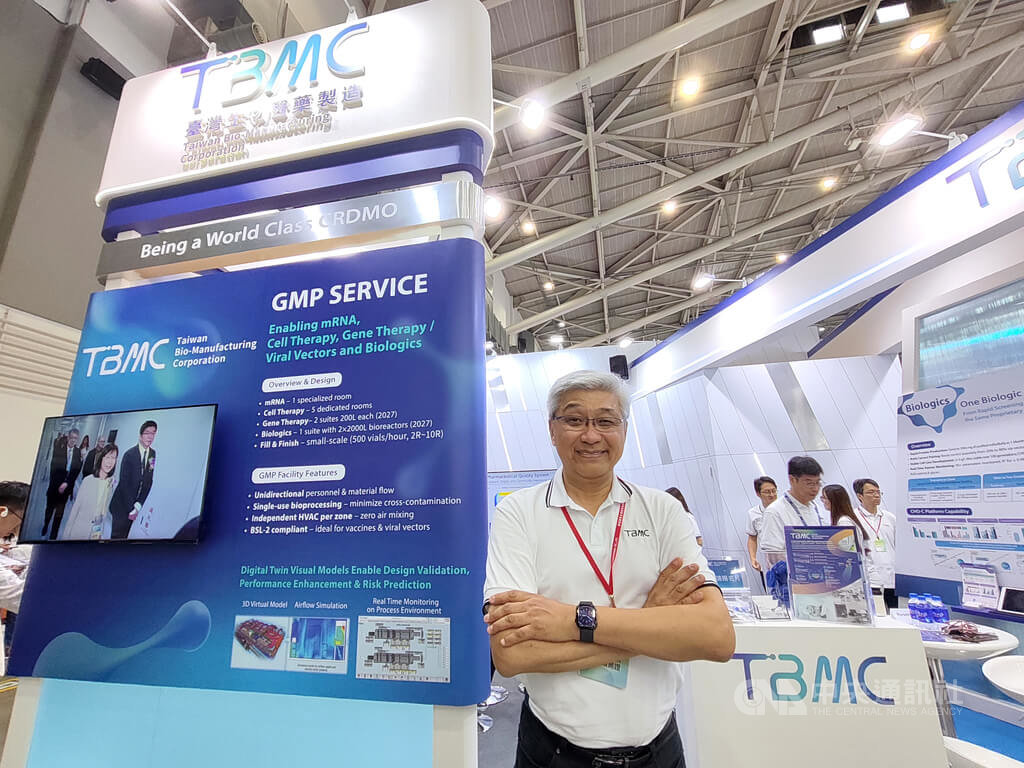
The Hsinchu GMP facility of Taiwan Biopharmaceutical Manufacturing Company (TBMC) commenced operations in March 2024. CEO Chang You-hsiang announced that the plant has completed initial trial manufacturing of mRNA vaccines and CAR-T cell therapy products, with customer production set to begin sequentially in the second half of the year. The company aims to achieve operational growth within 2024. The second phase of the Hsinchu plant is scheduled to become operational in the second half of 2027.
The Asia Biotech Congress opened today. TBMC is exhibiting this year; its Hsinchu plant began operations in March 2024, marking Taiwan’s first GMP facility capable of mass-producing nucleic acid vaccines (mRNA). Phase I has established production zones for mRNA nucleic acid vaccine drugs, cell therapies such as CAR-T (chimeric antigen receptor T-cell) and MSC (mesenchymal stem cells), viral vectors, and biopharmaceuticals.
Chang You-hsiang stated in an interview with Central News Agency today that the facility spent approximately three months conducting environmental, equipment, and cleaning validation. It has now completed demonstration batch production for mRNA (nucleic acid vaccines) and CAR-T. The next steps include engineering batches and process scale-up, gradually advancing toward formal mass production compliant with GMP standards.
He noted that there are currently two GMP clients for cell therapies: an overseas client for MSC and a domestic client for CAR-T, with product manufacturing scheduled to begin in the second half of the year. Additionally, TBMC is in discussions with clients across other fields, including viral vectors and mRNA.
He emphasized that biotech manufacturing clients require a certain preparation period—from initial discussions to process development and full-scale production. Therefore, TBMC is not only engaging clients that can immediately utilize current capacity but is also simultaneously negotiating with clients across different technological platforms such as mRNA, cell therapy, viral vectors, and biopharmaceuticals to proactively secure future capacity.
Regarding AI applications, Chang said that the Hsinchu plant was designed from the outset with digitalization in mind, incorporating a digital twin system. Manufacturing processes and operational records are managed digitally, with plans to further introduce automation, remote monitoring, production scheduling, and AI-driven process optimization in the future.
On the progress of Phase II of the Hsinchu plant, TBMC stated that design and contractor selection have been completed and preparations are underway to enter the construction phase, with trial operations scheduled for the second half of 2027. Phase II will expand production capacity for viral vectors and biopharmaceuticals, including 200-liter and 500-liter viral vector production lines and two 2,000-liter bioreactor production lines. (Editor: Chang Chun-mao)
FACT BOX
- Source: CNA (Central News Agency)
- Category: New Product