HELSINKI — Facing escalating drone threats, Finland and several European nations are accelerating the development of new defense mechanisms. Moving beyond traditional military stockpiles, the focus is shifting toward cross-border intelligence sharing and tactical, mobile factories capable of operating from the front lines.
Drone technology evolves rapidly; today’s advanced designs risk obsolescence within months. Ville Herva, COO of Finnish anti-drone firm Sensofusion, explains that rather than hoarding finished goods that quickly become outdated, the strategy is to relocate production closer to the operational theater.
Interior ministers and representatives from nine EU nations recently met in Helsinki to formalize a consensus on regional cooperation, emphasizing that threats are borderless and require urgent coordination. The Finnish government has allocated an additional 50.2 million euros this spring to bolster counter-drone capabilities.
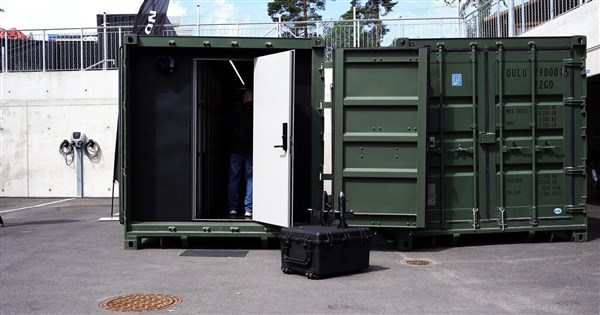
A standout innovation is the "Tactical Drone Factory." Housed within a standard 20-foot shipping container, the unit contains a full production line, including industrial 3D printers, electronic assembly stations, and a parts inventory. Managed by a team of three, it can produce 50 interceptor drones per day, with current models reaching speeds of 350 km/h. Herva notes that the system allows for real-time adjustments to hardware and software based on immediate battlefield requirements, eliminating reliance on distant supply chains.
This decentralized approach mitigates risk; while a large centralized factory serves as a prime target, a dispersed network of mobile containers is difficult to neutralize. These units are designed for easy transport via road, rail, sea, or air, appearing identical to standard commercial shipping containers.
Mikko Hypponen, Sensofusion’s Chief Research Officer and a renowned cybersecurity expert, highlights that the conflict in Ukraine illustrates the nature of an evolutionary arms race. Success depends on the ability to adapt: "You don't want 10,000 drones in a warehouse; you want the ability to create the drones you need, when you need them."
Regarding recent drone incursions into Finnish airspace, Herva acknowledges the seriousness of the situation. While these specific incidents resulted in minimal damage, they serve as a warning of the potential scale of future conflicts, which could involve thousands of units simultaneously.
Dependency on Chinese components remains a significant hurdle. Herva admits that while the company is actively striving to decouple from the "red supply chain," complete elimination remains a global challenge that requires ongoing effort.
Founded by Tuomas Rasila, Sensofusion was born out of early, dismissed warnings about the tactical potential of drones. The onset of the Russia-Ukraine war validated these early predictions, leading to rapid business growth for the company.
FACT BOX
- Source: CNA (Central News Agency)
- Category: Defense Technology / Strategic Industry