Central News Agency Report
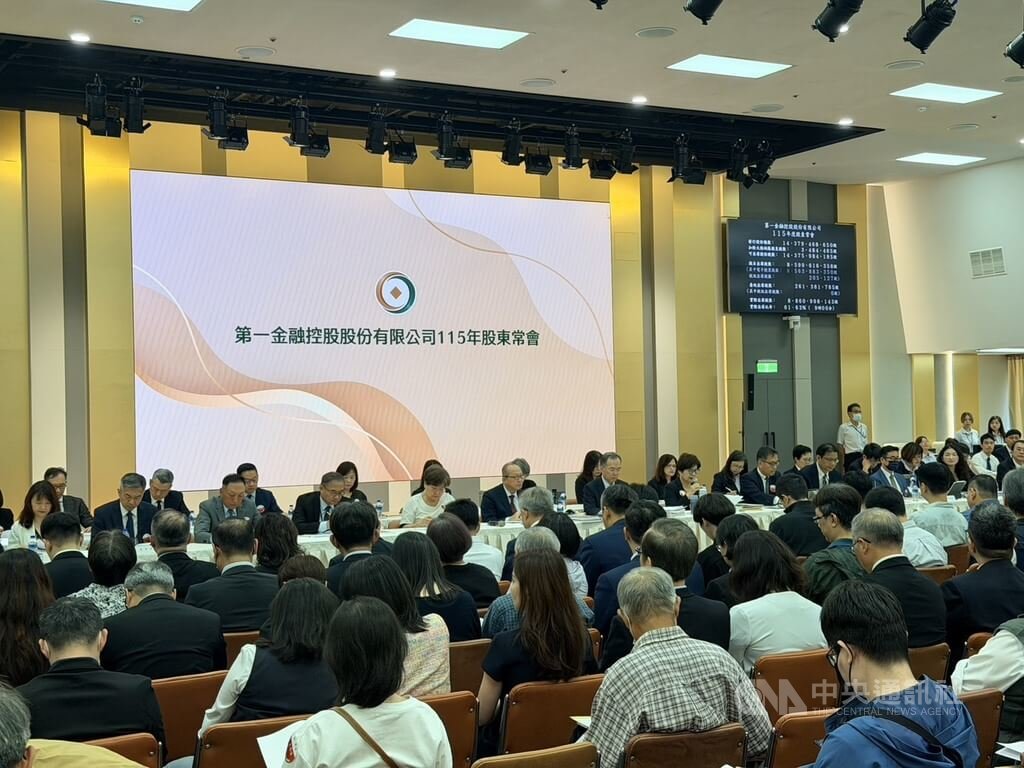
(CNA reporter Lu Yan-Ci, Taipei, June 18) First Financial Holding held its annual shareholder meeting today, during which shareholders raised questions about the proposed consolidation of four public asset management companies. General Manager Fang Ying-Ji stressed that any merger must adhere to three core principles: compliance with regulations, enhancement of operational synergies, and protection of stakeholders’ rights. Regarding the market’s speculation on a potential public-private merger, Vice President Li Shu-Ling told reporters that public financial holding companies now feel the pressure of 'shrinking if not merging.' She added that, given the right opportunity, the company would not exclude merging with strong private-sector partners to accelerate growth.
First Financial Holding approved its earnings distribution plan at today’s shareholder meeting, announcing a cash dividend of NT$1.30 per share. Chairman Chi Yueh-Chin reported that the company achieved a record post-tax net profit of NT$26.933 billion last year, representing a 6.21% year-on-year increase. Earnings per share (EPS) reached NT$1.87, and total assets surpassed the NT$5 trillion mark for the first time.
Chairwoman Chi noted that amid global economic fluctuations, Taiwan’s export growth surged due to rising demand for emerging technologies such as artificial intelligence (AI) and high-performance computing. Wage increases and rapid wealth accumulation among consumers have also boosted private consumption, resulting in better-than-expected economic growth. The group will leverage fintech transformation as a driver of innovation, focusing on core businesses across its subsidiaries, deepening cross-selling of products, channels, and customer segments to build new profit engines.
During the meeting, a shareholder questioned reports that the Ministry of Finance is actively promoting the merger of First Financial Securities,兆豐投信, Cooperative Bank Securities, and华南永昌投信, with First Financial Securities as the surviving entity. The shareholder urged the implementation of a transparent employee placement plan to avoid labor disputes similar to those seen during past private bank mergers.
In response, Fang Ying-Ji explained that as a listed company, First Financial is subject to strict disclosure regulations, and any merger-related information can only be announced after board approval. He emphasized three key principles for any merger: first, full compliance with regulatory requirements; second, alignment with the company’s long-term strategy to expand scale, enhance synergies, and strengthen competitiveness; and third, safeguarding the rights of shareholders, customers, and employees.
After the meeting, Li Shu-Ling told the media that in the past, public financial holdings avoided discussing mergers due to union resistance. However, as private financial groups consolidate, public holdings now feel increasing pressure to merge or risk becoming smaller. For example, in international business, insufficient financial strength, product offerings, or team capabilities can prevent participation in certain markets.
Li stated that mergers are not limited to other public institutions. If a good opportunity arises, the company would not rule out merging with quality private-sector firms such as securities or asset management companies to bring in new technologies, products, and customer bases. While such moves may pressure stock prices in the short term, she believes they are beneficial in the long run. Remaining confined within a small circle could deprive the company of fair competitive opportunities.
Li also noted that the Ministry of Finance’s willingness to consider bold scenarios like public-private mergers is encouraging. 'It doesn’t have to be the rumored Cathay Financial Holding—any good opportunity is worth exploring,' she said. However, she emphasized that a merger can only occur if the target company is willing to exit the market, creating an opportunity to acquire its equity.
Another shareholder asked whether the company would continue prioritizing cash dividends. Fang explained that five years ago, First Bank was designated a domestic systemically important bank (D-SIB) by regulators. To meet capital adequacy requirements, the bank previously issued more stock dividends and fewer cash dividends. After meeting capital needs at the end of last year, the dividend policy has reverted to a cash-first approach, with a payout ratio of over 60% in principle.
Looking ahead, First Bank General Manager Zhou Chao-Chong told reporters that Taiwan’s economic growth this year could reach 10% due to the AI boom, and the bank’s loan disbursements are expected to exceed budget targets. Regarding the housing market, the central bank has indicated no plans for additional credit tightening, and the new Young Citizen Housing Loan 2.0 policy is set to launch. As a result, housing prices are already beginning a soft landing. (Edited by Pan Yi-Ching) 1150618
FACT BOX
- Source: CNA (Central News Agency)
- Category: Taiwan