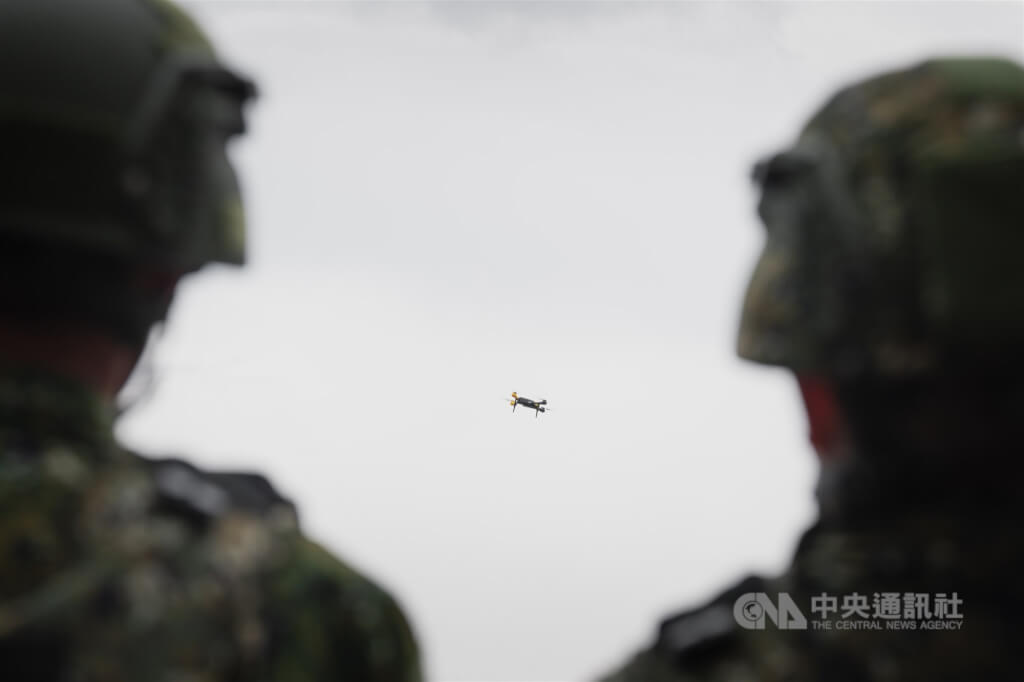
(Central News reporter You Kaixiang, Taipei, June 18) The Executive Yuan meeting today passed the draft of the Unmanned Vehicle Procurement Special Act, paving the way for the acquisition of drones and unmanned vessels. Scholars analyzed that this legislation is urgent and significant, not only meeting the military's operational readiness requirements and encouraging corporate investment, but also effectively aligning with the U.S. 'Blue Skies for Taiwan Act of 2026' to deepen Taiwan-U.S. drone technology cooperation and expand commercial opportunities.
In May this year, the Legislative Yuan passed the 'Special Act for the Procurement of National Security Protection and Asymmetric Warfare Capability Enhancement Plan' with a total budget of NT$780 billion in its third reading. It stipulates that the first batch of military procurement requests has a budget cap of NT$300 billion, and the second batch has a cap of NT$480 billion. However, commercial procurement and commissioned manufacturing projects related to drones, unmanned vessels, the Taiwan Tactical Network (TTN), the Team Awareness Kit (TAK), and the Qianggong missile were not included.
The Executive Yuan added a new agenda item today and passed the draft of the 'National Defense Autonomous Unmanned Vehicle Procurement Special Act.' In accordance with Article 83, Paragraph 1 of the Budget Act, a special budget with a total funding cap of NT$210 billion is allocated. The plan is scheduled to run from August 1 this year to December 31, 2031, with autonomous unmanned vehicles acquired annually. Items include coastal surveillance drones, coastal attack drones, and small suicide unmanned vessels.
Su Tzu-yun, a scholar at the Institute for National Defense and Security Research (a think tank under the Ministry of National Defense), analyzed that pushing forward the special act is urgent and necessary. The main reasons are the military's actual needs, the growing global drone market, and the U.S. having expressed willingness for technological cooperation. This move also aligns with the U.S. Congress' authorization of cooperation with Taiwan on drones through the 'Blue Skies for Taiwan Act of 2026,' expanding bilateral technological collaboration and procurement from Taiwan.
Su stated that while annual budget allocations under the Budget Act are possible, given current security threats, military preparedness requires timeliness, and only a special act can meet this 'timeliness' requirement. He emphasized that anchoring future military needs and market scale through a special act will give private companies 'long-term orders,' encouraging them to make longer-term, stable investments. At the same time, military units can begin tactical and operational training early based on the drone performance specifications outlined in the act, yielding dual benefits for national defense and industrial development.
Regarding unmanned vessels, naval sources pointed out that unmanned surface vessels (USVs) offer high stealth and low-cost advantages. Deploying them in large numbers can create asymmetric 'shark swarm' attacks. Equipped with sensors, they can serve as mobile maritime outposts, greatly extending intelligence, surveillance, and reconnaissance (ISR) coverage. Their use in suicide attacks or as decoys offers the highest 'low-cost, high-return' efficiency.
Su Tzu-yun stated that unmanned vessels further reduce combat risks for frontline personnel. In the future, through coordinated operations between mother ships and unmanned vessels, maritime ISR capabilities and overall strike capacity can be significantly expanded. (Editor: Su Chih-tsung) 1150618
Stand with facts. Your support is the force that protects press freedom.
Download the Central News Agency's 'First-Hand News' app to stay updated with the latest news.
Text, images, and videos on this website may not be reproduced, broadcast, publicly transmitted, or utilized without authorization.
FACT BOX
- Source: CNA (Central News Agency)
- Category: Taiwan