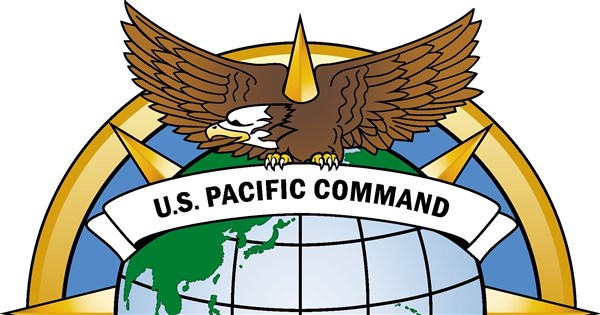
(Central News Agency reporter Lin Honghan, Los Angeles, June 17) The U.S. Department of Defense announced yesterday that the 'Indo-Pacific Command' will revert to its former name, 'Pacific Command'. While officials stress that the mission and area of responsibility remain unchanged, the term 'Indo-Pacific' has been a key strategic concept used by the U.S. in recent years to rally India and allies in response to China's regional influence, prompting scrutiny over the implications of this name change.
The U.S. Pacific Command was established in 1947 and headquartered in Hawaii. It is one of the oldest and largest unified combatant commands in the U.S. military, covering half the globe and 38 countries—from the waters off the U.S. West Coast, across the Pacific Ocean, to India's western border.
On May 30, 2018, during President Trump's first term, then-Defense Secretary James Mattis announced the renaming of 'Pacific Command' to 'U.S. Indo-Pacific Command' at Pearl Harbor, Hawaii.
At the time, Mattis stated the change reflected the 'increasingly interconnected nature' between the Indian and Pacific Oceans, signaling that the U.S. strategic focus was 'shifting westward'.
Reuters interpreted the move as highlighting India's growing importance to the Pentagon. U.S. strategic documents have since adopted 'Indo-Pacific' as a policy framework encompassing alliance cooperation and security competition, stretching from the Indian Ocean to the U.S. West Coast.
The most prominent example is the 'Quad' (Quadrilateral Security Dialogue), a regional cooperation platform among the U.S., Japan, India, and Australia. After the Biden administration took office in 2021, the Quad was elevated to a leaders' summit, with the four nations pledging to advance a 'free and open Indo-Pacific'.
The Biden administration's 2022 'Indo-Pacific Strategy' explicitly states support for India's continued rise and regional leadership role, positioning the Quad as a key regional cooperation architecture.
The term 'Indo-Pacific' reflected the U.S. strategic approach to Asia: on one hand, treating the Indian and Pacific Oceans as an integrated security space with rising strategic importance for India; on the other, countering China's expanding influence in the South China Sea, Indian Ocean, and through its 'Belt and Road Initiative' with the policy language of a 'free and open Indo-Pacific'.
The Trump administration's 2017 'National Security Strategy' stated that China seeks to replace the U.S. in the Indo-Pacific and reshape the regional order. When Mattis announced the 2018 name change, he said the Indo-Pacific should not be constrained by 'predatory economic practices or coercive threats' from any country—clearly referencing China's 'Belt and Road Initiative'.
The Taiwan Strait issue frequently appears in U.S. 'Indo-Pacific' policy discourse. In recent years, when U.S. warships or military aircraft transit the Taiwan Strait, the U.S. military consistently emphasizes that such actions comply with international law and demonstrate America's commitment to a 'free and open Indo-Pacific'.
On June 16, the U.S. Department of Defense announced in Hawaii that the Indo-Pacific Command will revert to 'U.S. Pacific Command'. The official reason given is historical continuity.
The Department stated that restoring the name 'Pacific Command' honors the command's 'deep historical roots' and recognizes its role in shaping regional security architecture after WWII, the Korean War, the Vietnam War, and humanitarian operations.
Officials emphasize that the name change does not alter the command's area of responsibility or mission. The geographic scope remains unchanged—from the waters off the U.S. West Coast to India's western border. The command's core mission and commitment to working with regional allies and partners to maintain a free and open region remain intact.
In 2018, the term 'Indo-Pacific' was imbued with strategic significance—linking the Indian and Pacific Oceans, highlighting India's role, and countering China's regional influence. Now, reverting to the old name, while officially maintaining continuity, raises questions about whether the U.S. is adjusting its strategic language in Asia. (Editor: Tang Pei-chun) 1150618
FACT BOX
- Source: CNA (Central News Agency)
- Category: Taiwan