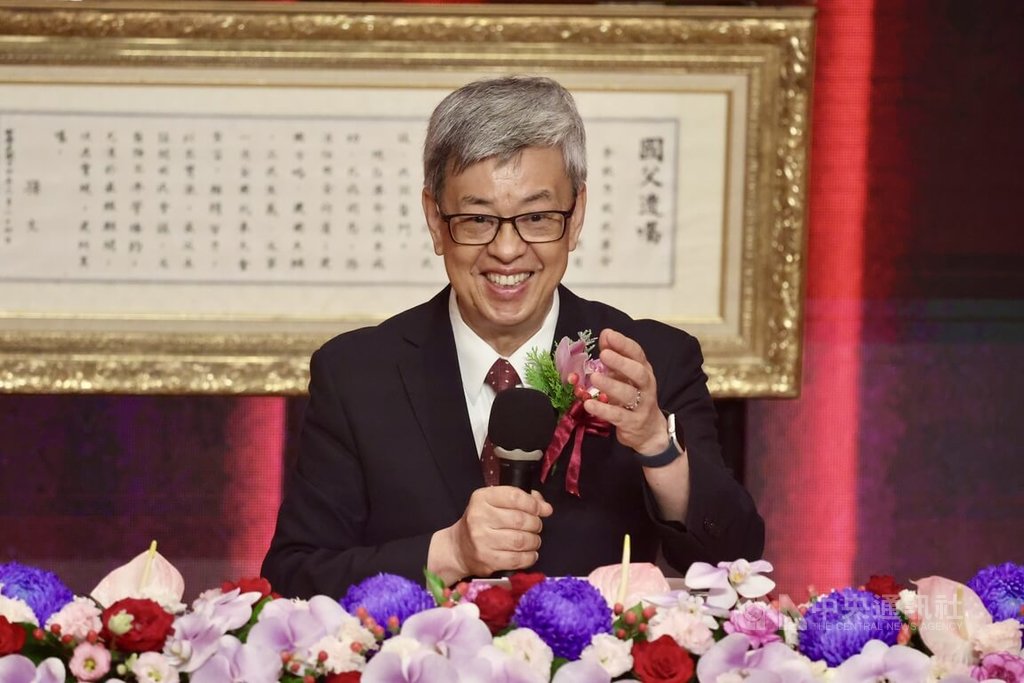
(Central News Agency, reporter Wu Hsin-yun, Taipei, June 18) Former Vice President Chen Chien-jen will assume leadership of Academia Sinica on June 21. He stated today that he aims to transform Academia Sinica into a premier research institution in the Asia-Pacific region, positioning Taiwan as an initiator and leader in international academic networks, while advancing knowledge transmission and public communication to address national and global critical needs.
Academia Sinica held a handover ceremony today for the incoming and outgoing presidents, with Chen Chien-jen succeeding as the 13th president. His term runs from June 21, 2024, to June 20, 2031. Under the supervision of Vice President Hsiao Bi-khim, incumbent President Liao Chi-chen formally handed over the official seal to Chen. Former President Tsai Ing-wen, former President Lee Yuan-tseh, and other distinguished guests attended the ceremony.
In his speech, Chen first expressed gratitude to the selection committee for their nomination, the Council of Academic Affairs for their voting support, and President Lai Ching-te for his appointment, allowing him the opportunity to undertake this mission. He also highlighted the outstanding contributions made by Academia Sinica under the leadership of previous presidents Lee Yuan-tseh,翁啟惠 (Weng Chi-huei), and Liao Chi-chen.
Chen stated that Academia Sinica will celebrate its centennial in 2028, and he will lead the institution along five strategic directions. First, he will continue pursuing academic excellence by supporting original, forward-looking, and high-potential research. He pledged to improve research support systems, deepen interdisciplinary collaboration, and strengthen partnerships with domestic research universities and institutions to form national teams in key humanities and technological fields.
Second, Chen emphasized transforming Academia Sinica into a premier research institution in the Asia-Pacific region, expanding substantive collaborations with top global research institutions, and jointly leading and planning multinational research projects. This will elevate Taiwan’s role in international academic networks to that of an initiator and leader. He also aims to provide comprehensive institutional support—from young scholars to leading researchers—to attract international talent to settle and thrive at Academia Sinica.
Additionally, drawing from his long career in public health research, Chen stressed that humanities and scientific research are not merely knowledge exploration but also foundational to public trust, national governance, and global cooperation. In the face of major challenges such as low birth rates, aging populations, climate change, energy transition, and global health risks, Academia Sinica will leverage its strengths in knowledge integration and technological innovation to support public policy with evidence from humanities and sciences, helping address long-term development issues and promoting national and global prosperity and sustainability.
Chen also pledged to promote knowledge transmission and public communication, including establishing intergenerational academic succession mechanisms, encouraging academicians and senior researchers to actively mentor young scholars, and advancing science communication and knowledge sharing. Through platforms such as campus open days, the Academia Sinica Lecture Series, 'Research Matters' (Yan Zhi You Wu), digital videos, and social media, he aims to foster dialogue between academia and the public.
Furthermore, in response to the rapid advancement of artificial intelligence, Chen stated that Academia Sinica will not only continue investing in cutting-edge research but also establish a governance framework that balances ethics, privacy, human rights protection, and social trust. By leveraging Academia Sinica’s long-accumulated research data and digital archives, the institution will build an AI governance model that integrates innovation with social responsibility, positioning Taiwan as an international model for AI research and governance.
Chen noted that the academic foundation and international reputation Academia Sinica enjoys today are built upon the visionary leadership of past presidents and broad societal support. He expressed hope to work collaboratively with Academia Sinica and its partners to advance top-tier research through wisdom, ensuring the institution remains a vital force in driving knowledge innovation and human progress, and jointly building a world-class academic research institution that leads in Asia-Pacific and connects globally.
In his remarks, Liao Chi-chen reflected on returning to Taiwan ten years ago with the goal of introducing new concepts, systems, and practices to enhance Academia Sinica’s foresight and integration in the AI-driven scientific era. Upon taking office, he promoted the spirit of 'ambition and benevolent intelligence' to achieve world-leading research, fulfill key social responsibilities, and attract and cultivate outstanding talent. He expressed gratitude to the administrative team and all staff for their collective efforts in achieving multiple goals.
Academia Sinica announced that after stepping down, Liao will serve as a Distinguished Research Fellow at the Institute of Biological Chemistry and continue to support interdisciplinary team collaborations. (Edited by Li Shu-hua)
FACT BOX
- Source: CNA (Central News Agency)
- Category: 人事