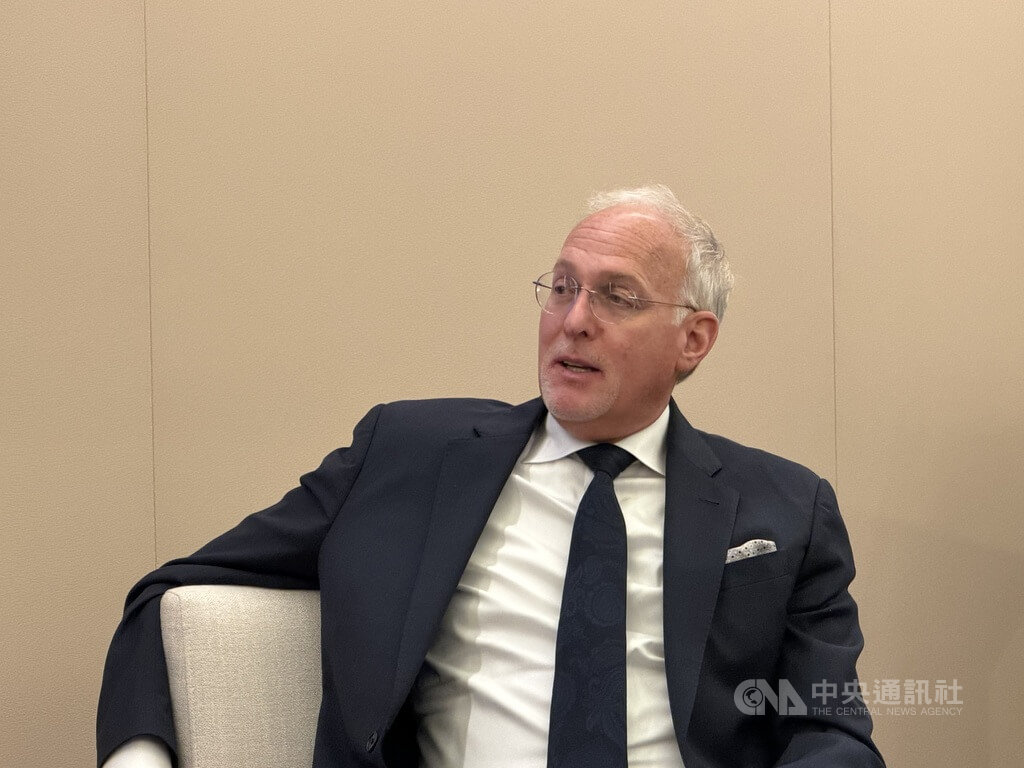
(CNA reporter Hou Tzu-Ying, Washington, June 17) U.S.-Taiwan economic and trade relations are becoming increasingly close. Experts noted today that U.S. imports of semiconductors and related components from Taiwan have grown significantly in recent years, accounting for approximately 70% of total U.S. imports from Taiwan. Driven by artificial intelligence (AI) and specific industries, Taiwan's exports to the U.S. have surged. Some experts are optimistic that progress on avoiding double taxation between the U.S. and Taiwan could be made next year.
The Washington-based think tank Global Taiwan Institute (GTI) hosted a symposium today titled 'The Benefits and Challenges of Economic Engagement: Major Issues in the U.S.-Taiwan Trade Relationship.' One session was moderated by Riley Walters, senior research fellow at the Hudson Institute, with panelists Fred Fischer, former Deputy Assistant U.S. Trade Representative, and Pamela Phan, former Deputy Assistant Secretary at the U.S. Department of Commerce.
Fischer stated that Taiwan is the fifth-largest source of U.S. imports, and imports from Taiwan have increased substantially due to support from AI and specific industries.
He projected that by 2026, around 70% of U.S. imports from Taiwan will be chips and components directly related to chips—'a significant increase'—compared to just 20% in 2020.
Regarding U.S.-Taiwan economic cooperation, Phan highlighted several priority areas, including semiconductors and advanced electronics; AI and high-performance computing infrastructure; supply chain resilience beyond semiconductors and AI, such as automotive parts, aircraft components, and lumber; bilateral investment; and export control measures.
Phan also pointed out complex challenges facing U.S.-Taiwan economic cooperation, including volatility in U.S. tariff and trade policies. As the U.S. government focuses on reshoring production, there are concerns that Taiwan's 'silicon shield' protection could weaken or that Taiwan's traditionally perceived strategic influence might shift. Additionally, on energy reliability, Taiwan relies on imports for over 90% of its energy, and power shortages could threaten technological and industrial competitiveness.
Following Donald Trump's return to the White House, the U.S. has continued implementing tariff measures aimed at reducing trade deficits and encouraging manufacturing to return to the U.S. Earlier this year, Taiwan and the U.S. signed an Agreement on Reciprocal Trade (ART) and established a high-tech supply chain cooperation mechanism through an Investment Cooperation Memorandum of Understanding (MOU).
Despite increasingly close economic ties, the U.S. and Taiwan have not yet signed a double taxation avoidance agreement. Fischer believes that with the U.S. midterm elections in November, progress this year is unlikely.
Walters is optimistic that after Taiwan's legislature ratifies the U.S.-Taiwan reciprocal trade agreement, and after the 2026 U.S. midterms and Taiwan's local elections conclude, progress on a U.S.-Taiwan double taxation avoidance agreement could be made in 2025.
The U.S. House of Representatives has already passed the 'U.S.-Taiwan Expedited Double Taxation Relief Act.' During Minister of Economic Affairs Kung Ming-hsin's visit to the U.S. in May, he noted the bill is still awaiting Senate scheduling.
If the bill passes the Senate, it will be sent to the White House for the U.S. President's signature, followed by an exchange of international instruments between Taiwan and the U.S. to confirm mutual and equitable tax relief before taking effect. (Edited by Tien Jui-Hua) 1150618
FACT BOX
- Source: CNA (Central News Agency)
- Category: Taiwan