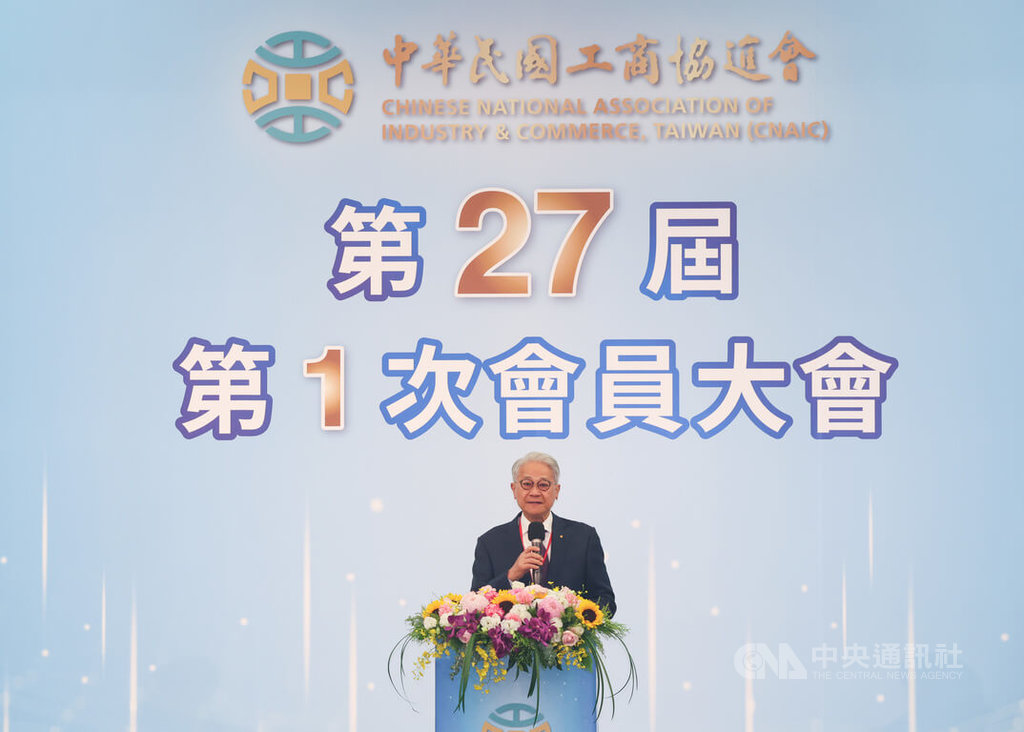
(CNA Reporter Tseng Yun-ting, Taipei, 18th) Wu Tung-liang, Chairman of the Chinese National Association of Industry and Commerce (CNAIC), stated today that benefiting from the AI wave and the supply chain advantages led by TSMC, Taiwan's stock market fundamentals remain supported with opportunities for continued strong performance. He expressed optimism about the full-year economic growth, believing that with ongoing cooperation between the government and industry, this year's GDP growth rate can definitely exceed 10%, elevating Taiwan into the world's top 20 trillion-dollar economies.
In addition, with the US Federal Reserve recently deciding to keep interest rates unchanged and the Central Bank of Taiwan scheduled to hold its board of directors and supervisors meeting this afternoon, Wu believes that the current domestic economic and financial situation is generally normal, and he personally thinks the probability of an interest rate adjustment is low.
The CNAIC held its 27th 1st Member Assembly today, attended by Vice President Hsiao Bi-khim, Foxconn Chairman Young Liu, and others.
Speaking to the media before the meeting about the recent record highs in Taiwan stocks, Wu stated that Taiwan's stock market has benefited from the development of TSMC and the AI industry chain. These advantages are currently at the forefront of global economic development. From a fundamental perspective, Taiwan stocks still have room for further performance in the future.
Regarding the economic outlook for the second half of the year, Wu pointed out that the preliminary ceasefire agreement reached between the United States and Iran is good news for the global economy. As geopolitical risks ease, international oil prices have fallen below $80 per barrel, which will help reduce inflation pressure in the second half of the year and have a positive effect on global economic development.
Addressing the industry's recent concerns over the draft amendments to the Air Pollution Control Act, Wu noted that the legislative changes will have a significant impact, affecting not only small and medium enterprises but all production businesses. If the central and local governments implement different management standards in the future, enterprises will be at a loss, increasing operational difficulties and even affecting investment intentions. He emphasized that the government should fully communicate and negotiate with the business community during the legislative process, taking into account both environmental protection goals and industry development needs.
Furthermore, following the US Federal Reserve's (Fed) recent decision to keep interest rates unchanged, the market is closely watching the future direction of monetary policy, as well as the conclusions of Taiwan's Central Bank meeting today.
Wu stated that this meeting was the first policy meeting chaired by the new Fed Chair Kevin Warsh. Although the outside world interprets the policy tone as leaning hawkish, the subsequent policy direction remains to be seen. He mentioned that the "dot plot," which the market watches for future interest rate expectations, did not seem to be published as usual. If such guidance information decreases, market forecasting could become more difficult, and volatility may increase.
As for Taiwan's Central Bank interest rate policy, he stated that the current domestic economic and financial situation is generally normal. He personally believes the probability of a rate adjustment is low, saying "the chances of a move are not high," but noted that the final decision rests with the Central Bank's board.
During his speech, Wu pointed out that in recent years, Taiwan's economy has faced multiple challenges such as global supply chain restructuring, digital transformation, and net-zero emissions. However, with the joint efforts of the government and industry, Taiwan's economic growth rate reached 8.76% last year, ranking first in Asia; the GDP in the first quarter of this year reached 14.55%, hitting a 48-year high, and the stock market surged in both price and volume, jumping to become the world's 5th largest capital market.
He expressed his belief that as long as the government and the industry continue to work together, this year's economic growth rate is expected to exceed 10%, making Taiwan a top 20 trillion-dollar economy globally.
Wu highlighted that as a bridge between the government and enterprises, CNAIC has long focused on four main working axes: "optimizing the business environment, deepening global trade, strengthening innovation momentum, and implementing sustainable prosperity." It continues to promote the upgrading of industrial structures and assist enterprises in expanding their global footprint.
He also stated that with nearly half the year gone, he hopes the Legislative Yuan can accelerate the passage of the general budget bill through cross-party negotiations to ensure that the momentum of national development continues to advance.
FACT BOX
- Source: CNA (Central News Agency)
- Category: Event