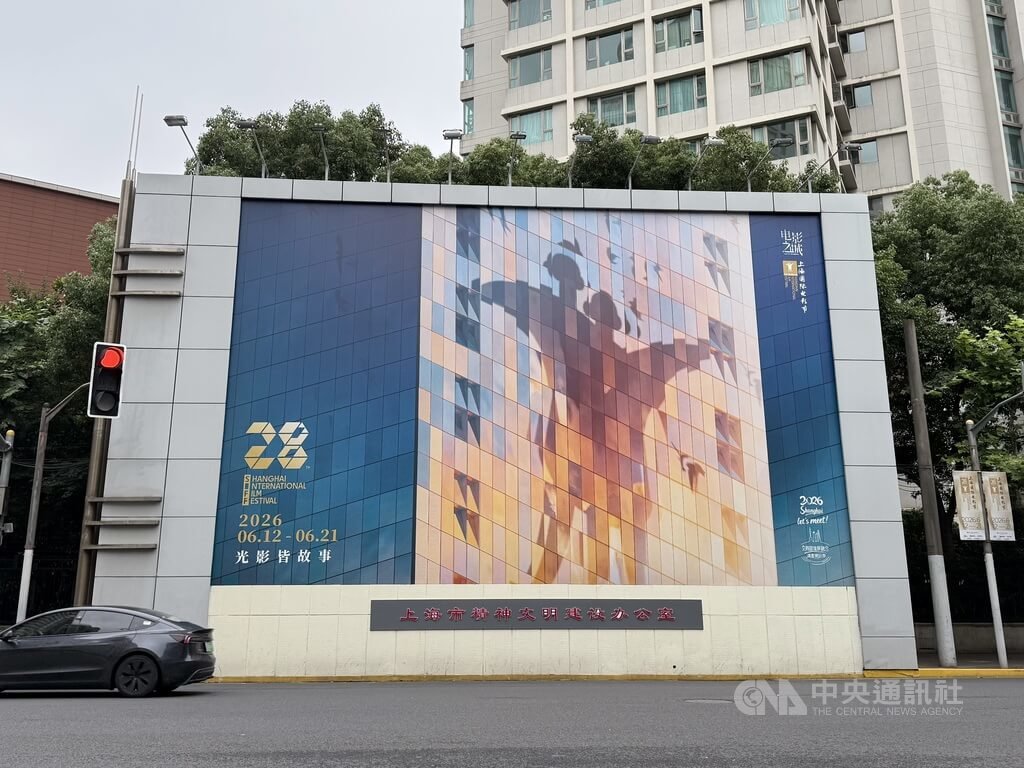
(CNA, Reporter Liao Wen-chi, Shanghai, June 18) Affected by deteriorating Sino-Japanese relations, the 2026 Shanghai Film Festival is not screening any Japanese films, a rare occurrence. A veteran film fan pointed out that in the past, even when Sino-Korean relations were poor, the Shanghai Film Festival could still screen Korean films. The absence of Japanese films this year is a more serious situation.
Since Japanese Prime Minister Sanae Takaichi made remarks about "Taiwan contingency" in November last year, Sino-Japanese relations have worsened. The 28th Shanghai International Film Festival, held from June 12 to 21, not only lacks a "Japanese Film Week" to introduce the latest Japanese cinema but also is not screening any Japanese films or inviting Japanese jurors.
Regarding this phenomenon, a veteran film fan who specifically traveled to Shanghai to attend the festival believes that a Shanghai Film Festival without Japanese films is "greatly diminished." He said, "Japanese films at the Shanghai Film Festival are always highly sought after every year, and they are indispensable. In the hearts of fans, they are deeply intertwined with the Shanghai Film Festival."
He added that a large number of Japanese films participate in the Shanghai Film Festival annually, with many even having their world premieres in Shanghai. Many Japanese filmmakers also come to participate in events, and numerous Japanese directors have served as jurors at the Shanghai Film Festival.
Having attended the Shanghai Film Festival for 10 years, he observed that Japanese films have been a very important component since the festival's inception. Among the approximately 400 films exhibited at the Shanghai Film Festival each year, the number of Japanese films often ranks second only to those from China and the United States. For instance, in 2025, the Shanghai Film Festival had as many as 224 screenings of Japanese films, and many of the exhibited Japanese films received excellent reviews. This year, neither the Beijing nor the Shanghai Film Festival is screening Japanese films, and "everyone truly feels that many good films are missing."
Cao Yin, Deputy Director of the Shanghai International Film and Television Festival Center, also stated at the opening ceremony of the 2025 Shanghai Japanese Film Week that "Japanese Film Week is one of the Shanghai International Film Festival's most beloved brand sections."
Especially since the Shanghai "International" Film Festival is an A-list film festival, like the Cannes Film Festival, Berlin International Film Festival, and Busan International Film Festival. This veteran film fan believes that given the importance of Japanese cinema, "almost no international film festival would not screen Japanese films," particularly this year when many prominent Japanese film directors like Ryusuke Hamaguchi and Hirokazu Kore-eda have released new works, making it a "big year" for Japanese cinema.
Speaking of the films he was looking forward to, he mentioned Hamaguchi Ryusuke's new film "All of a Sudden," which won the Best Actress award at the Cannes Film Festival, and Kore-eda Hirokazu's "After the Storm" and "The Little Hand," which he had eagerly anticipated. He expressed regret that they cannot be released in China, adding, "And we don't know when they will be shown, and we don't know how long this will last."
He noted that even when Sino-Korean relations were poor in the past, and many Korean films could not be shown in theaters, the film festival still featured Korean films. "Even when Sino-Korean relations were that bad, the film festival could still have them," including the Shanghai Film Festival, which would screen several Korean films each year.
China, in opposition to the deployment of the Terminal High Altitude Area Defense (THAAD) system by the United States in South Korea, implemented the "Hallyu Ban" (Korean Wave Ban) in 2017, never approving any K-POP concerts, Korean TV programs, or artist activities.
However, now even film festivals are not screening Japanese films. This veteran film fan believes the current situation is very serious, stating, "There has indeed never been an example of a complete ban on films from a particular country."
This veteran film fan also pointed out that the Chinese film market is currently shrinking due to the impact of short videos and AI, with a continuous decrease in Chinese audiences and box office revenue. Many film industry professionals have a strong sense of crisis. In this context, importing Japanese films would be beneficial for box office performance.
He gave an example, saying that last year "Demon Slayer: Kimetsu no Yaiba" also performed very well at the box office. Other animated films like Detective Conan, One Piece, and Naruto also have large audiences in the market. "Cutting Japanese films is almost like 'hurting the enemy by ten, but harming oneself by eight,' causing almost no damage to Japan, but the absence of Japanese films is actually a further blow to the Chinese film market's box office." (Editor: Chou Hui-ying) 1150618
Stand with facts, your every sponsorship is a force to protect press freedom.
Download CNA's "One News" APP for real-time updates.
This website's text, images, and videos may not be reproduced, publicly broadcast, publicly transmitted, or used without authorization.
FACT BOX
- Source: CNA (Central News Agency)
- Category: 國際關係