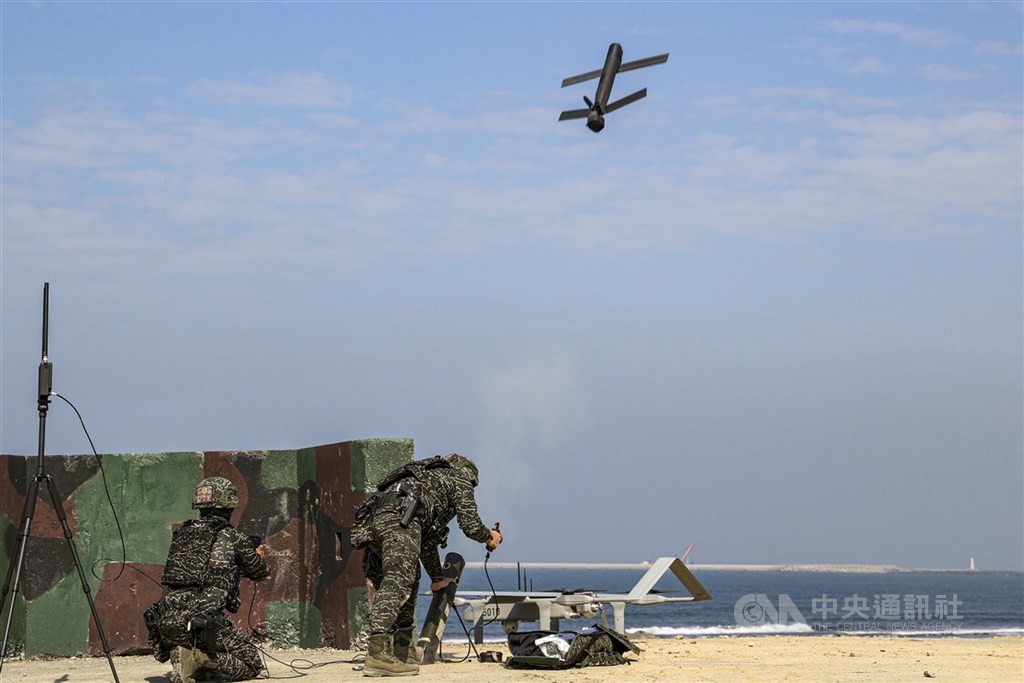
The annual overall budget has yet to be approved, sparking public discussion. The Executive Yuan released a press statement today, stating that Deputy Premier Cheng Li-chun, during a special task force meeting on the 12th, highlighted that the proposed budget includes comprehensive planning for key drone technologies, cybersecurity testing, regulatory system development, test environment improvements, and industrial chain upgrades. Cheng urged the Legislative Yuan to expedite the review process to continue building Taiwan’s next strategic industry.
On the 12th, Cheng presided over the Executive Yuan’s 'Special Task Force Meeting on Unmanned Vehicle Industry Development and Management Mechanisms,' emphasizing that in response to the rapid global growth of the unmanned vehicle sector, the Executive Yuan continues to optimize the regulatory environment, refine inspection procedures, enhance test zones, strengthen industry promotion measures, and promote government procurement mechanisms based on non-red supply chains to foster a more favorable industrial ecosystem and enhance Taiwan’s drone industry competitiveness.
Regarding regulatory improvements, Cheng noted that various ministries have completed key foundational legal work, including the Ministry of Transportation and Communications’ (MOTC) December 2024 revision and promulgation of the 'Remote Unmanned Aircraft Management Regulations,' the Digital Development Ministry’s formulation of the 'Remote Unmanned Aircraft Cybersecurity Testing Guidelines,' and the joint completion by MOTC and the Ocean Affairs Council (OAC) of the 'Safety Management Regulations for Specific Testing Waters for Surface and Underwater Unmanned Vehicles' and the 'Guidelines for Spatial Use in Surface/Underwater Unmanned Vehicle Maritime Testing Activities' last year.
Additionally, the Public Construction Commission under the Executive Yuan issued the 'Guidelines for Remote Unmanned Aircraft Procurement Operations' this year. The Digital Development Ministry and MOTC jointly introduced the 'Cybersecurity Testing Guidelines for Drone Countermeasure Systems,' while the Executive Yuan promulgated the 'Asset Management Procedures for Unmanned Aircraft.'
On recent regulatory developments, Cheng stated that MOTC aims to complete the 'General Safety Management Regulations for Surface and Underwater Unmanned Vehicles' by July 2024. By year-end, MOTC will submit an amendment to the 'Vessel Act,' and the OAC will forward the 'Maritime Spatial Use Management Act' to the Executive Yuan for review.
On cybersecurity testing alignment with international standards, Cheng announced that Taiwan has become the first overseas Green UAS accredited evaluation site outside the United States. Domestic manufacturers can now complete Green UAS cybersecurity verification and evaluation procedures locally, significantly shortening time-to-market and reducing validation costs for international entry.
Cheng acknowledged that drone products must undergo multiple inspection procedures across different ministries before market entry—covering flight safety, registration, low-power radio frequency, information security, and product safety. While agencies have progressively simplified inspection methods, avoided redundant cybersecurity testing, and promoted modular flight inspections, she stressed the need for continuous review and improvement. A unified inspection integration mechanism should be established, moving toward a single-window system and streamlined processes to reduce overall administrative timelines to a reasonable range.
Taiwan’s drone industry output has grown from NT$5 billion in 2024 to NT$12.9 billion in 2025, an increase exceeding 2.5 times. Complete drone exports surged from NT$140 million in 2024 to NT$2.95 billion in 2025—a 21-fold increase. Notably, first-quarter 2025 exports already exceeded the total annual export value of the previous year.
Cheng emphasized that the current fiscal year’s central government overall budget includes comprehensive planning across key areas such as unmanned vehicle technologies, cybersecurity testing, regulatory frameworks, test environment enhancements, and industrial upgrading. These initiatives depend on stable and sufficient budgetary support. She urged the Legislative Yuan to swiftly complete the budget review to help Taiwan continue building its next critical strategic industry. (Edited by Wan Shu-chang)
FACT BOX
- Source: CNA (Central News Agency)
- Category: Taiwan