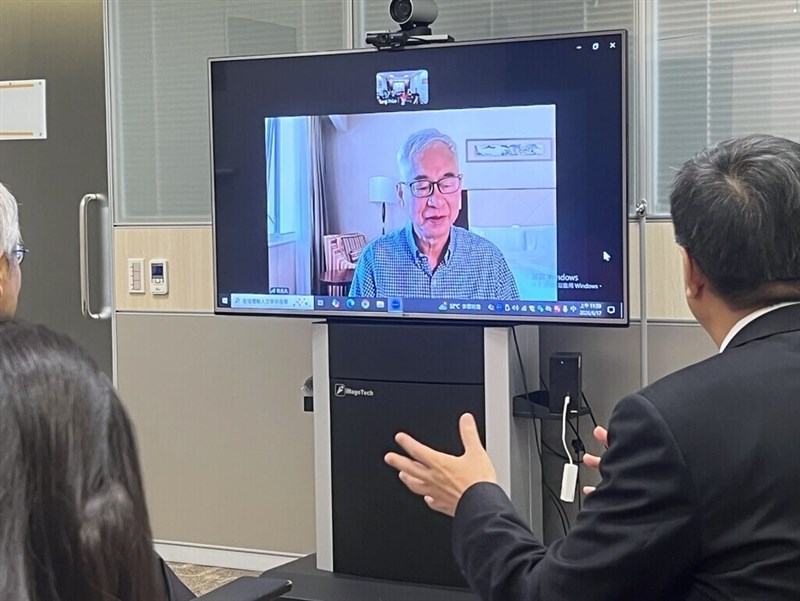
(Central News Agency reporter Chen Chih-chung, Taipei, June 17) The 2026 Tang Prize in Sinology has been awarded solely to Ge Zhaoguang, a professor at Fudan University in China. He hopes that methodologies, approaches, and forms of Chinese studies will become more diverse and engage in deeper dialogue with international fields such as Japanese studies, Indian studies, Persian studies, and Egyptology, thereby refining more theoretical models.
The Tang Prize Foundation announced today its latest Sinology awardee, recognizing Ge Zhaoguang as a representative figure in China's humanities development over the past 40 years. The foundation commends him for maintaining the subjectivity of Chinese scholars while opening space for global dialogue and expanding the scope of Sinological research.
After the announcement, Ge Zhaoguang held a joint media briefing. He stated that the methods, approaches, and forms of studying China can be highly diverse. He expressed hope that the Tang Prize will elevate Chinese studies onto the international stage, enabling richer dialogue with Japanese studies, Indian studies, Persian studies, and Egyptology, and ultimately refining theoretical models that are both shared and distinct.
When asked about his connections with Taiwan, Ge mentioned that many of his father's siblings had relatives residing in Taiwan. Since the 1990s, he has maintained close academic exchanges with Taiwan's scholarly community, having served as a visiting professor at National Taiwan University's Department of History for six months and spending three months at Jinwen University, where he experienced the scenic beauty of Sun Moon Lake. Later, when establishing the Institute for Literature and History at Fudan University, he invited several Taiwanese scholars to serve as committee members.
Ge's most recent visit to Taiwan was in 2019, when he was invited by the Lung Yingtai Cultural Foundation to deliver a lecture. From a modern historical perspective, he shared insights on how to understand the concept of 'China'.
In today's interview, he pointed out that traditional empires did not have 'borders' but only 'frontiers,' with ethnic groups and spatial boundaries constantly shifting. The Song and Ming dynasties were relatively Han-centric, whereas the Mongol Yuan and Manchu Qing dynasties encompassed much larger territories and more diverse ethnic groups—factors that continue to complicate contemporary understandings of the concept of 'China'.
At today's press conference, some media noted that Ge Zhaoguang is the first scholar from mainland China to win the Sinology Prize, raising concerns about sensitive political implications.
Chen Chen-chuan, Executive Director of the Tang Prize Foundation, emphasized that the selection process disregards race, nationality, religion, and gender, focusing instead on substantive contributions and influence. He also noted that the Sinology Prize receives the highest number of nominations among the four Tang Prize categories, with recommendations coming not only from across the Taiwan Strait but from around the world.
Wang Dewei, convener of the Sinology Prize, stated that Tang Prize selections involve lengthy debates and meticulous deliberations. Ge Zhaoguang has consistently been a prominent candidate in past evaluations. The selection committee focuses on his long-term academic contributions, not his country of origin. (Editor: Li Heng-shan) 1150617
Stand with truth—your support is a force in defending press freedom.
Download the CNA 'First News' app to instantly access the latest updates.
Text, images, and videos on this website may not be reproduced, broadcast, transmitted, or utilized without authorization.
FACT BOX
- Source: CNA (Central News Agency)
- Category: Taiwan