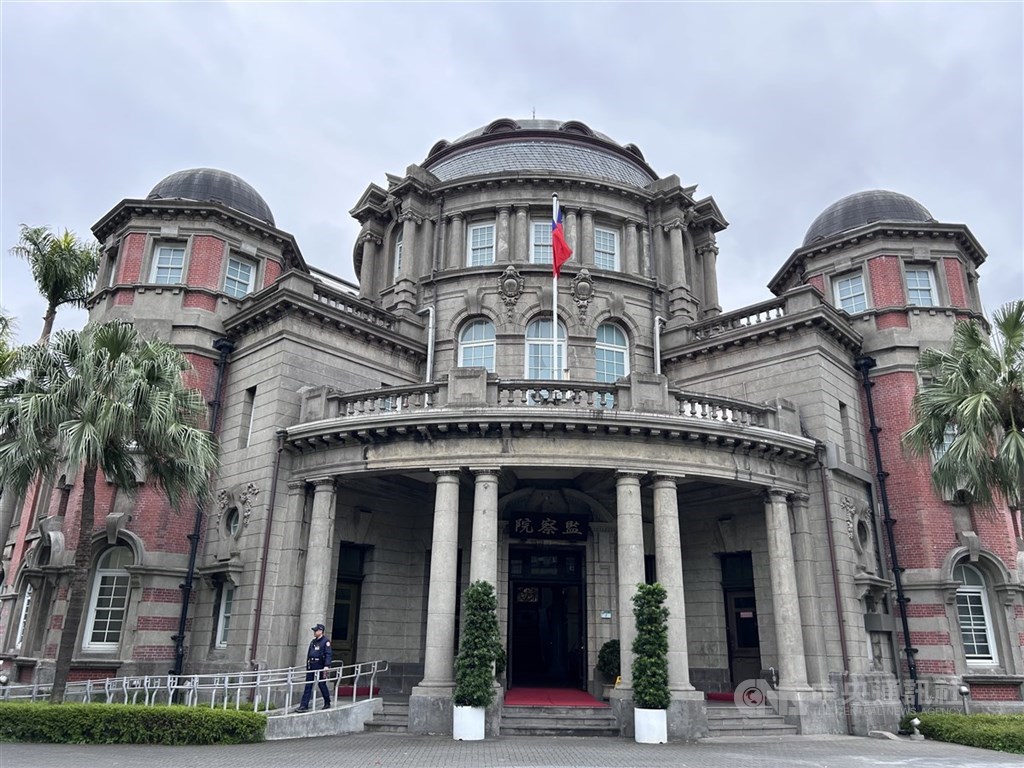
(Central News Agency reporter Lai Yu-chen, Taipei, June 17) Control Yuan members Chang Chu-fang and others announced today that the 'Taiwan Railways Electrification Smart Upgrade Project,' supervised by the Ministry of Transportation and Communications (MOTC) and implemented by Taiwan Railways Company, was originally scheduled for execution from fiscal year 2017 to 2024. However, most engineering components have experienced severe delays, with some extended to 2029. Additionally, the preliminary planning for the modernized Centralized Traffic Control (CTC) system was inadequate, leading the Control Yuan to issue a formal censure against both the MOTC and TRA.
Control Yuan members Chang Chu-fang, Kuo Wen-tung, and Chen Ching-chun stated in a press release today that the total budget for the 'Taiwan Railways Electrification Smart Upgrade Project' is NT$30.61 billion, with an original timeline from 2017 to 2024. The project comprises four sub-projects: Signal Infrastructure Enhancement, Telecommunications Infrastructure Enhancement, Power Infrastructure Enhancement, and the New Centralized Traffic Control System, encompassing 16 individual engineering works.
According to the Control Yuan, by the end of 2024, only the upgrade of ground equipment for the ATP (Automatic Train Protection) system was completed on schedule. All other works—including the installation of remote signal status monitoring systems, axle counter duplication, signal interlocking system upgrades, substation capacity expansion, CTC system deployment, power remote control system construction, relocation of the train dispatching radio network management center, and integration of emergency response center information—have been delayed, with completion now pushed to 2029, representing a six-year extension.
The Control Yuan noted that the CTC system installation, originally scheduled for completion by the end of 2023, has now been delayed to the end of 2029, making it difficult to achieve its functional goals on time. Furthermore, the project budget has increased from NT$2.5 billion to NT$4.1 billion. The installation of new crossing gates has also progressed slowly; by the contract’s end date, less than 30% of the first batch—approximately 427 units—had been installed and tested successfully. The MOTC failed in its supervisory duties, and TRA’s poor execution caused losses, constituting negligence.
Regarding the new crossing gate installation, the Control Yuan pointed out severe delays in development and installation, inadequate contract management, and frequent malfunctions after deployment due to 'environmental factors'—including 48 incidents of insect and ant intrusion and 23 cases of excessive humidity. These failures have significantly compromised the functionality, stability, and reliability of crossing protection systems, posing risks to train safety, constituting misconduct.
Additionally, the Control Yuan criticized TRA’s headquarters relocation plan, initiated in 2014. After eight years of evaluation, a comprehensive assessment concluded that retaining the corporate headquarters at Taipei Main Station offered the best cost-benefit ratio. The decision, finalized in January 2022, relocated the CTC system installation to Taipei Station. This revealed a lack of rigorous planning and failure to develop an appropriate procurement strategy based on project characteristics, causing delays from the outset—another instance of misconduct.
The Control Yuan’s Transportation and Procurement Committee approved the investigation by Control Yuan members Chang Chu-fang, Kuo Wen-tung, and Chen Ching-chun, and formally censured the MOTC and TRA. (Edited by Su Chih-tsung) 1150617
FACT BOX
- Source: CNA (Central News Agency)
- Category: Taiwan