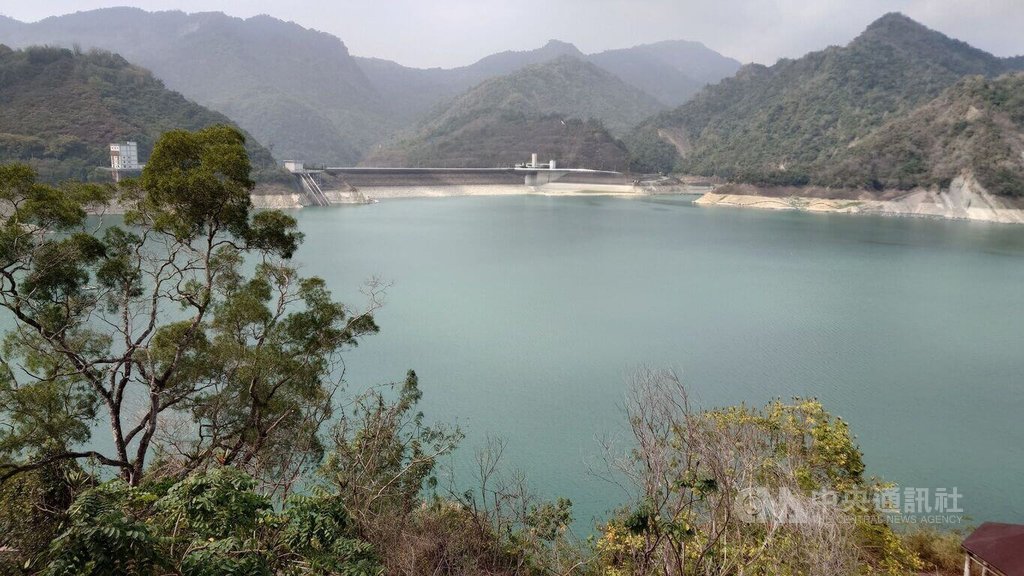
(Central News Agency reporter Hsieh Yi-hsuan, Taipei, June 17) The Ministry of Economic Affairs (MOEA) announced that this year's dry season experienced the lowest winter rainfall in 75 years. Through the 'Pearl String Project,' 520 million tons of water were transferred across regions, stabilizing water supply for domestic and industrial use. After evaluating that water conditions across regions have improved, the MOEA's Drought Disaster Emergency Response Team and the Water Resources Agency's Emergency Response Team were officially disbanded today.
The MOEA stated in a press release today that this year's dry season saw the lowest winter rainfall in 75 years, with rainfall in reservoir catchment areas across Taiwan amounting to only about 50–70% of the historical average for the same period. Central and local agencies began early coordination and cooperation as early as last June, implementing total reservoir outflow control, enhanced irrigation management in agriculture, and industrial water conservation. These measures cumulatively achieved water-saving and transfer benefits totaling 1.1 billion tons. Among these, the 'Pearl String Project' transferred 520 million tons of water across regions, maintaining stable water supply for households and industries. Irrigation for first-season rice cultivation has been completed across regions, effectively reducing the impact of insufficient rainfall on water supply.
The Water Resources Agency explained that prior to the arrival of this year's plum rains, regional water conditions were relatively tight. The timely implementation of the Pearl String Project played a crucial role in stabilizing water supply. In northern Taiwan, projects such as the Ban-er Plan, Taoyuan-Hsinchu Trunk Pipeline, and transfers from Yonghe Mountain Reservoir to Hsinchu cumulatively delivered approximately 260 million tons of water—equivalent to the combined capacity of Shihmen Reservoir and Baoshan and Baoshan II Reservoirs.
In central Taiwan, transfers from Lichi潭 Reservoir to Miaoli, the Taichung system to Changhua, and the Yun-Chang system to Chiayi cumulatively delivered about 50 million tons of water—equivalent to the capacity of one Hushan Reservoir. In southern Taiwan, authorities maximized river flow during the wet season to store water in reservoirs and enabled mutual support between reservoirs during the dry season. Since October last year, water has been transferred from Kaohsiung to Tainan, cumulatively delivering about 25 million tons. Additionally, since January this year, the 'Zengwen-Nanhua Interconnection Pipeline' has transported water from Zengwen Reservoir to Nanhua Reservoir, cumulatively transferring about 20 million tons. This ensured that Nanhua Reservoir maintained approximately 17 million tons of stored water even at its lowest level on June 4, avoiding a reservoir depletion crisis.
According to Water Resources Agency statistics, rainfall since June 4 has replenished Taiwan's major reservoirs with approximately 690 million tons of water, and reservoir storage rates have rebounded. Specifically, Taoyuan's Shihmen Reservoir reached 93% capacity, Hsinchu's Baoshan and Baoshan II Reservoirs reached 100%, Miaoli's Yonghe Mountain Reservoir reached 98%, Taichung's Lichi潭 Reservoir reached 76%, and Techi Reservoir reached 95%. Chiayi's Lantan and Jenyi Reservoirs reached 62%, Tainan's Nanhua Reservoir reached 87%, and Zengwen and Wushantou Reservoirs reached 42%.
The MOEA stated that after comprehensive assessment, regional water conditions have clearly improved and water supply is stable. Therefore, the MOEA's Drought Disaster Emergency Response Team and the Water Resources Agency's Emergency Response Team were officially disbanded on the 17th. Going forward, the Water Resources Agency and its regional water resource branches will continue monitoring water supply conditions, water conservation, and transfer management.
The Water Resources Agency noted that thanks to the recent plum rains, Zengwen and Wushantou Reservoirs have stabilized and rebounded to over 220 million tons in storage. Public water supply in southern Taiwan can remain stable until the end of September, with over one month's worth of safety reserve maintained. This meets the irrigation requirements for Groups 1 to 4 of the second-season rice cultivation in the Chianan Irrigation District. The Council of Agriculture's Chianan Management Office will now initiate irrigation preparation and distribution operations.
The Water Resources Agency emphasized that extreme climate and rainfall uncertainty are increasingly becoming the norm. Moving forward, it will continue daily water condition monitoring and prudent responses, collaborate with relevant agencies to implement water conservation, strengthen cross-regional water transfer through the Pearl String Project, and enhance river water diversion and reservoir storage. The goal is to ensure stable public water supply across Taiwan until the end of September while maintaining approximately one month's worth of safety reserve, securing water needs for households, industries, and agriculture. (Edited by Yang Lan-hsuan) 1150617
FACT BOX
- Source: CNA (Central News Agency)
- Category: Taiwan