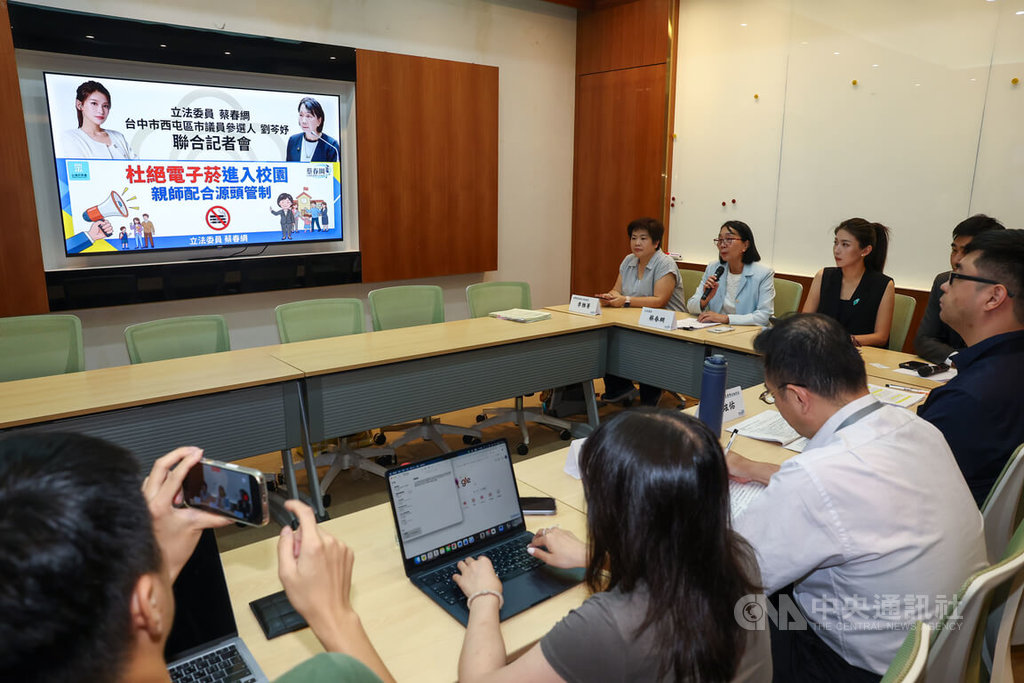
Taipei, June 17 (Central News Agency reporter Chen Chun-hua) — Tsai Chun-tsou, a legislator from the Taiwan People's Party, today highlighted a nearly sevenfold surge in e-cigarette-related incidents involving students in junior high schools and below over the past three years, calling for inter-ministerial efforts to trace sources and disrupt distribution channels.
At a press conference titled "Preventing E-Cigarettes from Entering Schools: Parent-Teacher Collaboration for Source Control," Tsai warned that emerging tobacco products and disguised drugs are rapidly infiltrating school campuses. According to the Ministry of Education's "Campus Safety Reporting System," overall reports of students violating the Tobacco Hazards Prevention Act in senior high schools and below have remained relatively stable, with 203 cases in 2023 and 182 in 2025.
However, reports of students suspected of carrying or using e-cigarettes have exploded: 237 cases in 2023, 499 in 2024, and a sharp rise to 1,692 in 2025 — a nearly sevenfold increase. As of May 31, 2025, just five months into the year, reports have already reached 1,050 — over 60% of the total for all of 2024.
Tsai cited the 2025 Youth Smoking Behavior Survey by the Health Promotion Administration (HPA), which found e-cigarette use rates of 2.1% among junior high students and 5.1% among senior high and vocational students. However, flavored tobacco use was significantly higher — 40.2% among junior high students, 49.4% among senior high and vocational students, and reaching 61.4% among female vocational students. Law enforcement has repeatedly seized so-called "zombie cartridges" containing etomidate, a new psychoactive substance, disguised as regular e-cigarette pods.
Tsai urged authorities to trace the original sources through which students obtain e-cigarettes, heated tobacco, or unknown cartridges. She advocated for tech-enabled enforcement to crack down on online platforms, social media accounts, messaging app resellers, and adult suppliers around schools. She also called for standardized school procedures for identification, evidence preservation, parental notification, school safety reporting, health inspections, and police cooperation.
She emphasized launching anti-smoking education and counseling for students, with medical referrals and "Chunhui Counseling" when necessary. Local governments should regularly publish data on campus and off-campus enforcement, penalties, drug-related cases, counseling outcomes, and source-tracking results. The HPA should continue to publicly release youth e-cigarette usage survey data.
Lin Ju-jung, a specialist from the Health and Physical Education Section of the Ministry of Education's National Academy for Educational Research, stated that in 2025, the ministry had already notified local governments to include student tobacco and tobacco-like product use in school safety reports. The ministry has joined an inter-ministerial e-cigarette enforcement platform to jointly develop strategies to block e-cigarettes from campuses and urged schools to follow established e-cigarette response protocols.
Lin explained that when youth e-cigarette use is detected, parents will be notified to facilitate parent-teacher communication, anti-smoking education, and medical referrals. For high-risk off-campus smoking zones, joint inspections by multiple agencies will be conducted. If e-cigarette use is suspected on campus, health authorities may conduct on-site inspections to maintain a tobacco-free campus environment.
Tseng Po-chang, Section Chief of the Tobacco Control Division at the Ministry of Health and Welfare, said financial transaction tracking has helped dismantle several domestic underground e-cigarette manufacturing operations. Collaborating with the Financial Supervisory Commission, authorities can trace purchase and delivery records from students to identify product origins and locate illegal factories.
Tseng noted ongoing legislative efforts to impose criminal penalties on the manufacturing, import, sale, and supply of e-cigarettes, with administrative fines for possession and use, and new confiscation provisions. The ministry will actively support the Ministry of Education's campus tobacco control initiatives and participate in the Interior Ministry's summer youth protection "Youth Project" to combat tobacco harms from multiple angles.
When asked about media reports linking Tsai's nephew, Tsai Chin-tsai, to alleged drug-related youth gangs infiltrating schools, Tsai responded, "Let the evidence speak." She noted that the case is already under judicial investigation and expressed hope for a clear resolution through the legal process. (Edited by Hsieh Chia-chen)
FACT BOX
- Source: CNA (Central News Agency)
- Category: Taiwan