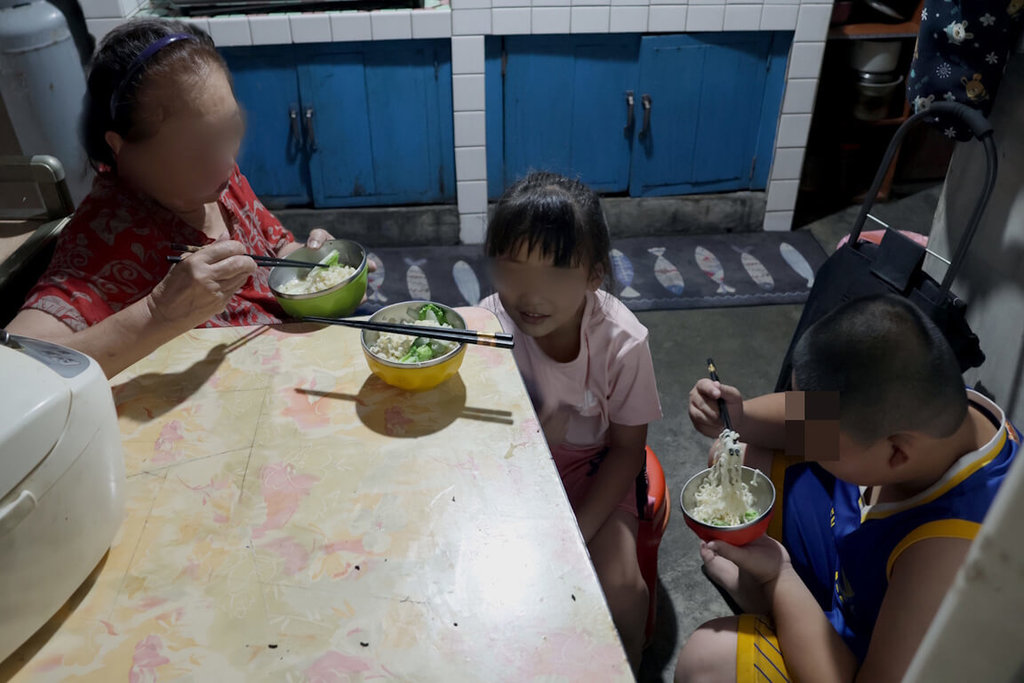
As the long summer vacation approaches, many disadvantaged children face the interruption of school meals and caregiving support. The Child Welfare League Foundation (CWLF) has released its 'Taiwan Urban-Rural Children's Welfare Survey,' which examined the basic living needs of 1,162 disadvantaged elementary school students (grades 4–6) during summer break.
The survey reveals that during school holidays, disadvantaged children face severe gaps in material living conditions, health risks, and family care resources. 32.6% rarely have the chance to buy new clothes or shoes; 23.4% continue wearing shoes with holes; and 22.9% must wear ill-fitting or damaged uniforms.
At the most basic level of nutrition, 20.0% of disadvantaged children have resorted to eating snacks instead of proper meals because they are not adequately fed at home.
CWLF notes that parents in disadvantaged families face heavier economic and caregiving burdens during long holidays, making it difficult to meet both their children's physical and emotional needs.
Data shows that during summer vacation, 29.7% of disadvantaged children must care for younger siblings or sick family members; 14.0% help with family businesses; and 13.2% are left alone at home, facing periods without companionship.
Ten-year-old 'Dada' lives with his grandmother and two younger siblings. The family of four survives on elderly allowances and CWLF subsidies. When school lunch ends in summer, three meals a day become a heavy burden. During the hardest times, Dada’s grandmother, worried the children have nothing to eat, has had to borrow food ingredients from nearby stores. Normally, they just 'cook something simple, eat whatever, as long as they’re full.'
Dada’s family is a microcosm of many intergenerational households. The survey found that 11.7% of children live with grandparents. Among families receiving CWLF’s holiday material boxes, 67.0% of children said their families cooked food from the boxes for them, and 58.4% said they always had something to eat when hungry—highlighting the critical role these boxes play in ensuring food stability and psychological support during long breaks.
The survey also asked children about their top wish for 2026. The most common answer was 'no one in my family gets sick' (56.5%), surpassing academic achievement.
CWLF analyzes that primary caregivers in disadvantaged families often face serious health or aging issues. If elders fall ill or become disabled, the entire family faces immediate economic and caregiving collapse. This uncertainty has become deeply internalized as daily anxiety among disadvantaged children, directly reflected in their priority wishes for the future.
CWLF points out that disadvantaged families lose school lunches, after-school care, and learning support during long holidays—yet this period receives the least policy attention. To address this, CWLF has launched the 'Disadvantaged Children Holiday Nutrition Support Program,' organizing 158 summer recreational camps across 99 schools, expecting to serve 3,357 children. Additionally, 1,998 summer material boxes will be distributed to directly meet food and care needs during the break. (Edited by Li Xi-Zhang)
FACT BOX
- Source: CNA (Central News Agency)
- Category: Survey