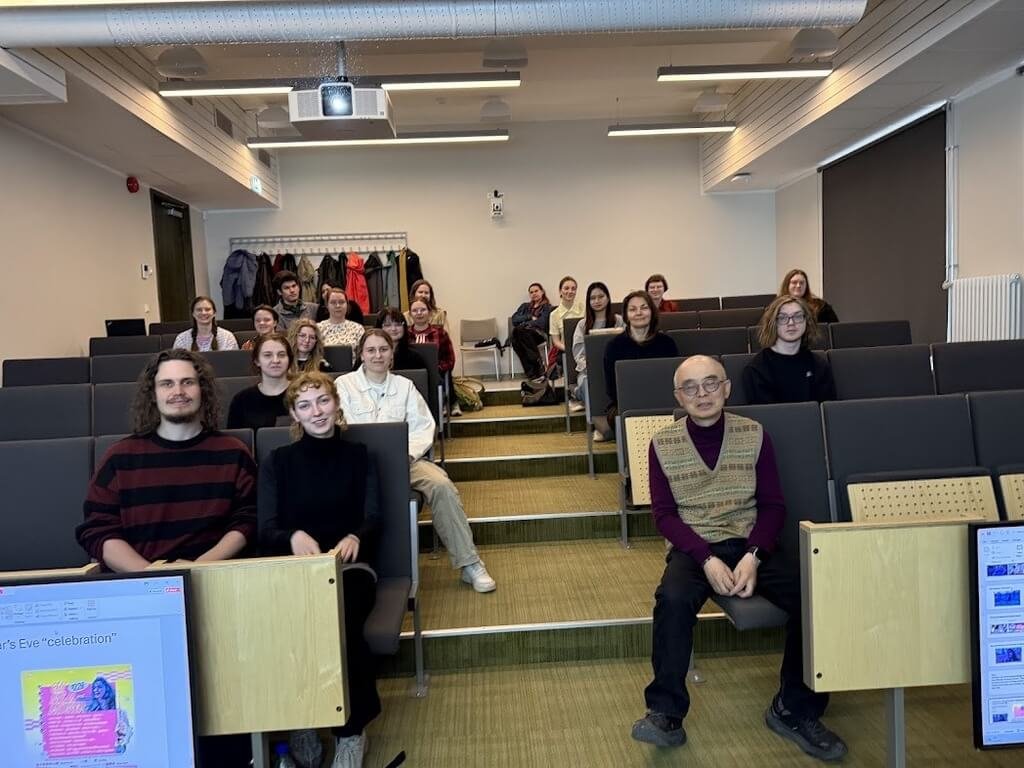
(Central News Agency reporter Hsu Chi-wei, Taipei, June 17) Professor Chen Ju-hsiu from National Chengchi University participated in the Taiwan Studies Lecture Program and delivered a course on the cultural and political aspects of Taiwanese cinema at the University of Tartu in Estonia. The initiative promoted Taiwan's visual and cultural narratives internationally and inspired six local students to decide on exchange programs and learning Mandarin in Taiwan.
National Chengchi University announced today that, to promote the internationalization of Taiwan studies, the Ministry of Education has launched the 'Taiwan Studies Lecture' program through its European offices. This initiative collaborates with multiple European universities, inviting Taiwanese scholars to teach abroad. Professor Chen Ju-hsiu was selected as the Taiwan Studies Lecturer at the University of Tartu in Estonia and delivered a semester-long lecture series on film culture this year.
Chen's course centered on three major themes: 'Colonial Memory,' 'Martial Law and the White Terror,' and 'Modernity.' Estonia, having been ruled by powerful neighboring nations such as Imperial Russia, Germany, and the Soviet Union, experienced over 40 years of communist authoritarian rule and 'Red Terror' after World War II. Many intellectuals and professionals were forcibly relocated to Siberia. These shared historical traumas enabled Estonian students to deeply resonate with the political and historical themes depicted in Taiwanese films.
Chen shared that when screening the film 'Super Citizen,' which explores the White Terror, one student recalled their uncle's real-life experience of being arrested by the Russian government in Crimea and imprisoned in Siberia for 17 years. When discussing modernity, films such as 'The Wayward Cloud' and 'Vive L'Amour'—which portray urban alienation and loneliness—also deeply moved Estonian students.
Estonia integrates 'transitional justice education' into primary and secondary education curricula.
Chen noted that Taiwan often presents historical trauma through sorrow, solemnity, or political messaging, which can create distance or resistance among younger generations. In contrast, Estonia uses soft media such as literature, film, and music festivals to subtly incorporate past oppression and persecution into everyday teaching. This gentle, gradual approach is more effective in encouraging politically disengaged youth to actively learn about and reflect on history.
Following the conclusion of Chen's course, six local students decided to pursue exchange programs and learn Chinese in Taiwan. Some students, inspired by the cinematic imagery, are already planning hiking trips through Taiwan's mountainous landscapes. This marks a successful transformation of cultural resonance into concrete actions to visit Taiwan. (Editor: Chen Ching-fang) 1150617
FACT BOX
- Source: CNA (Central News Agency)
- Category: Event