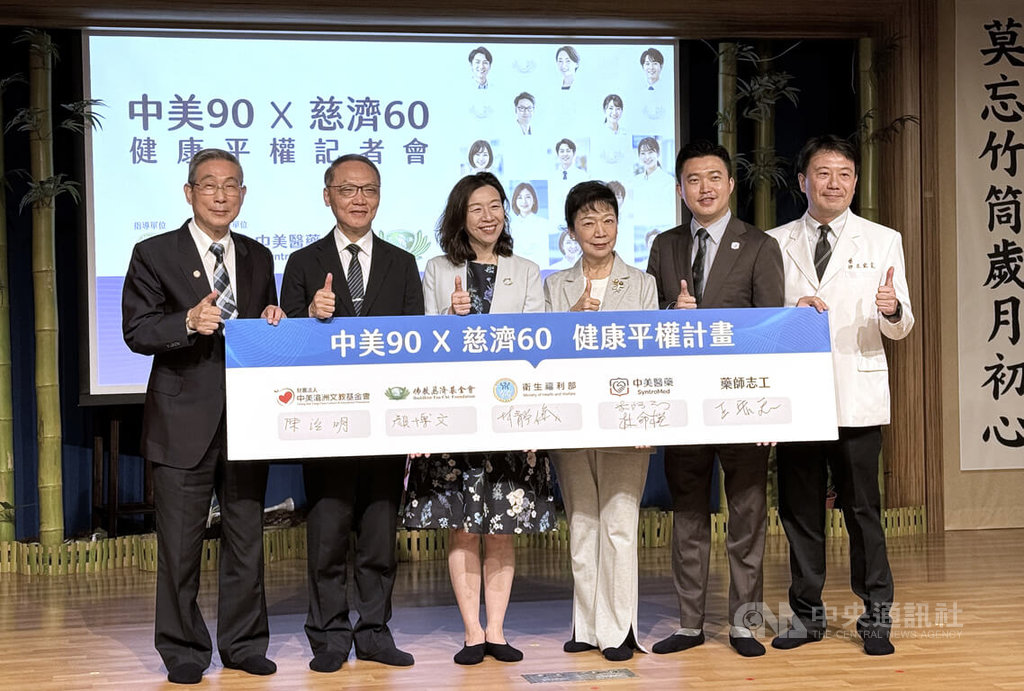
(Central News Agency reporter Shen Pei-yao, Taipei, June 17) The Ministry of Health and Welfare (MOHW) has launched a pilot program for Sunday and national holiday Urgent Care Centers (UCCs) in six major cities. To improve usage rates, the ministry is collaborating with the Tzu Chi Foundation and Sino-American Pharmaceutical to promote awareness through community pharmacists, who will conduct 67 health education seminars across multiple counties, aiming to serve over 4,500 elderly individuals and family caregivers.
As Taiwan officially enters a super-aged society—where one in five people is aged 65 or older—Sino-American Pharmaceutical and Tzu Chi, under MOHW guidance, today jointly announced the launch of a Health Equity Initiative. The program will mobilize at least 53 community pharmacists across 14 counties to deliver 67 health education sessions, all of which will include promotion of UCC services.
Dr. Wang Hung-wen, a practicing pharmacist, shared his years of experience working in community pharmacies. In Changhua County, where his pharmacy serves a vast area, he frequently encounters elderly patients asking, "How exactly should I take this medication?" Most seniors face polypharmacy issues, managing conditions such as hypertension and diabetes, and even seeking advice on sleep aids.
Wang highlighted common medication misconceptions among seniors using the example of cough syrup misuse: despite instructions to divide the dose into three servings, many elders consume the entire bottle at once. He emphasized that through this health equity initiative, pharmacists are stepping out of their pharmacies and into communities, engaging seniors in face-to-face conversations. This personal touch, he noted, makes seniors more receptive to professional advice.
To address medical needs for minor or urgent conditions on holidays, the MOHW has operated 13 "Sunday and National Holiday Urgent Care Centers" (UCCs) in the six major cities since November last year. By early this year, these centers had served over 4,800 patients.
In a post-event media briefing, Wang stressed that UCCs are currently only available in the six major cities, yet remote and underserved areas also urgently need such services. In Changhua, many coastal and rural regions lack adequate medical resources. Establishing UCCs there would allow residents with minor ailments to avoid long trips to urban clinics, improving care for elderly residents. He also suggested integrating UCCs with local clinics and pharmacies to provide health consultations, especially for isolated seniors.
Another attending pharmacist, Kuo Hsiao-ying from Kaohsiung, shared that community awareness of UCCs remains low based on her firsthand experience. She expressed hope that the seminar series would educate more seniors to avoid rushing to hospitals and instead make active use of UCCs.
MOHW Deputy Minister Lin Ching-yi stated that the ministry does not currently track the age demographics of UCC users. Usage varies by location, depending on local medical resources and operational capacity. In some pilot areas, the program has shown strong results, prompting local health bureaus to recommend expansion. The MOHW, she affirmed, will fully support any local requests for additional UCC sites if deemed necessary by local health authorities. (Edited by Chen Ching-fang) 1150617
FACT BOX
- Source: CNA (Central News Agency)
- Category: キャンペーン