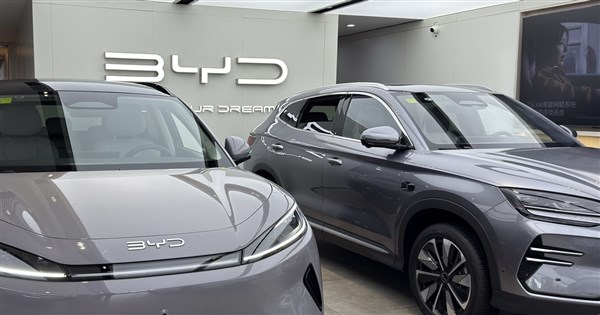
(Central News Agency reporter Lin Shang-Ying, Berlin, 17th) Germany restarted its electric vehicle (EV) purchase subsidy program in May this year, aiming to reduce consumer purchasing pressure and drive the transformation of Europe’s automotive industry. However, data shows that since the policy’s launch, Chinese EV brands have received the majority of the benefits. German and EU political figures have raised concerns about the policy’s effectiveness, questioning whether taxpayer money is being used to support Chinese competitors.
The German government restarted EV purchase subsidies in May. Depending on household income, number of children, and vehicle type, individuals can apply for subsidies ranging from €1,500 to €6,000 (approximately NT$55,000 to NT$220,000). By early June, the German Federal Ministry for the Environment had received around 42,000 applications, over 90% of which were for fully electric vehicles.
However, this policy, originally intended to balance carbon reduction and support for European automotive industries, has shown initial results that diverge from government expectations. Burkhard Weller, president of the German Association of Automobile Dealers (VAD), recently told Handelsblatt that after the subsidy program was announced, sales of Chinese-brand EVs surged significantly—far outpacing most European brands.
Weller noted that most subsidy applicants are purchasing EVs priced between €20,000 and €30,000. In the German market, vehicles in this price range are predominantly from Chinese manufacturers, which also represents the most competitive segment for Chinese brands.
Among the 42 automotive dealerships he manages, sales of affordable Chinese EVs in May increased by more than double compared to previous levels, with BYD’s sales rising by 235%.
According to WirtschaftsWoche, this policy, originally designed to support both decarbonization and European industry, has sparked political controversy. Some EU and German politicians criticize that the subsidies may effectively be helping Chinese brands expand their market share in Europe.
Jens Gieseke, Vice-Chair of the European Parliament's Transport Committee, stated that if German and European taxpayer funds are being used, they should strengthen local European industries. He urged the German government to quickly review the current system.
Markus Ferber, a European Parliament member from Germany’s Christian Social Union (CSU), criticized that a subsidy program primarily benefiting Chinese competitors has deviated from its original goal. He emphasized that German taxpayers should not be funding market expansion costs for companies competing directly against European automakers.
However, Nicole Hoffmeister-Kraut, Minister of Economic Affairs in Baden-Württemberg—the home of Mercedes-Benz—offered a different perspective. She said that while the subsidies may have limited direct impact on Germany’s premium carmakers, related companies such as local automotive parts suppliers can still benefit through the EV supply chain. Additionally, if the subsidies boost overall market demand, they could also support automotive dealerships, maintenance, and after-sales services.
WirtschaftsWoche analysis highlights that this controversy underscores Europe’s growing anxiety over the rise of Chinese EVs. Last year, the EU imposed additional tariffs on Chinese-made EVs, citing unfair competition due to Chinese government subsidies.
European Commission President Ursula von der Leyen previously warned that Europe should not engage in a subsidy race with China and advocated that EV subsidies should be tied to production location—prioritizing vehicles manufactured in Europe to prevent public funds from flowing to Chinese automakers.
Currently, the EU is negotiating the 'Industry Accelerator Act,' which could allow member states to restrict certain subsidies to products made in Europe. (Edited by Chen Hui-Ping) 1150617
FACT BOX
- Source: CNA (Central News Agency)
- Category: Taiwan
- Organizations: BYD / Mercedes-Benz / Handelsblatt
- Dates in source: 1150617