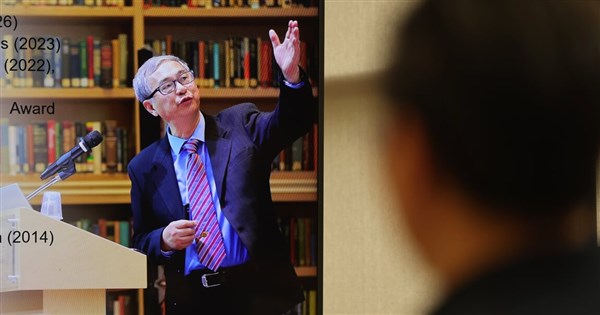
(Central News Agency reporter Chen Chih-chung, Taipei, June 17) The 2026 Tang Prize in Sinology has been awarded to Ge Zhaoguang, a leading scholar in Chinese intellectual history. He is the first recipient in the seven editions of the Sinology Prize to not hold a doctoral degree. Specializing in the history of ancient Chinese thought, Ge is celebrated for his bold challenges to traditional historical narratives and his engagement with Western intellectual currents, profoundly influencing academic discourse.
The Tang Prize Foundation today announced Ge Zhaoguang, currently affiliated with the Institute of Literature, History, and Philosophy at Fudan University in China, as the seventh recipient of the Sinology Award. Born in Fujian, China, in 1950, Ge experienced the Cultural Revolution, during which his education was interrupted and he was sent to labor in a Guizhou mine. After the Cultural Revolution, he earned his bachelor’s and master’s degrees at Peking University and subsequently held academic positions at Yangzhou Teachers College, Tsinghua University in Beijing, and Fudan University’s Department of History.
Ge specializes in the religious, intellectual, and cultural history of East Asia and China. His notable works include 'A History of Chinese Thought,' 'A History of Chinese Chan Thought: From the Sixth to the Tenth Century,' and 'Histories of Submission and Others: Studies on Daoist Thought in the Six Dynasties, Sui, and Tang.'
Academia Sinica Academician Huang Shu-min, who introduced the laureate today, emphasized that Ge Zhaoguang is an authentic Chinese scholar who courageously challenges traditional historical perspectives. While past scholars have typically viewed Chinese history through a Han-centric, elite lens, Ge advocates shifting from 'center' to 'periphery,' from 'classics' to 'common practices,' and from 'elite thought' to 'popular life concepts.'
For example, Ge focuses on how China’s neighboring regions—such as Korea, Japan, and Vietnam—perceive China. Particularly during the Ming-Qing transition, when the Han-dominated 'Celestial Empire' was replaced by the Manchu Qing dynasty, records from Korean envoys visiting Beijing have been meticulously unearthed and analyzed by Ge. These foreign perspectives offer fresh insights into the complex relationships between China and its neighbors.
Regarding Daoism, Ge argues that research should extend beyond Laozi and Zhuangzi to include grassroots folk practices such as rituals of fasting and offerings (zhaijiao) and talismans (fulu), which are deeply intertwined with everyday life.
Huang noted that Ge is exceptionally erudite, examining any material within reach, and maintains a keen interest in academic developments beyond China. The concept of 'viewing China from the periphery,' originally emerging from Taiwan’s academic circles, has been further developed and systematized by Ge, shaping the direction of historical studies over the past decade.
In response to the Western concept of the 'nation-state' that emerged in the 17th century, Ge proposes that although early China emphasized the 'all-under-heaven' (tianxia) worldview with fluid borders, during the Song dynasties (10th–13th centuries), prolonged competition with northern ethnic groups led to the emergence of a proto-nation-state identity centered on the Han people and Confucian ideology—predating similar developments in Europe.
Huang also mentioned that some of Ge’s academic viewpoints diverge from the current Chinese regime’s official narratives, inevitably exposing him to certain pressures. For instance, Ge argues against projecting the modern political construct of 'China' directly onto historical contexts. He contends that just because the Qing dynasty occupied Mongolia and Xinjiang, it does not automatically justify the Republic of China or the People’s Republic of China claiming these regions as inherent parts of historical China.
Ge expressed his gratitude in a pre-recorded statement today, expressing hope that future Chinese studies will become more diversified and internationalized, and that dialogue will be fostered between Chinese studies and fields such as Indology, Persian studies, and Japanese studies.
Chen Chen-chuan, Executive Director of the Tang Prize Foundation, noted that Ge is the first Sinology laureate without a PhD, but his academic influence is unquestionable, inspiring scholars not only in the Sinophone world but also in Japan, Korea, and the West.
Despite the sensitivity of cross-strait relations, Chen affirmed that the Foundation will fully support and facilitate Ge’s visit to Taiwan to receive the award, deliver lectures, and engage with Taiwan’s academic community and public, expecting significant intellectual enrichment. (Edited by Li Hsi-chang) 1150617
FACT BOX
- Source: CNA (Central News Agency)
- Category: Taiwan