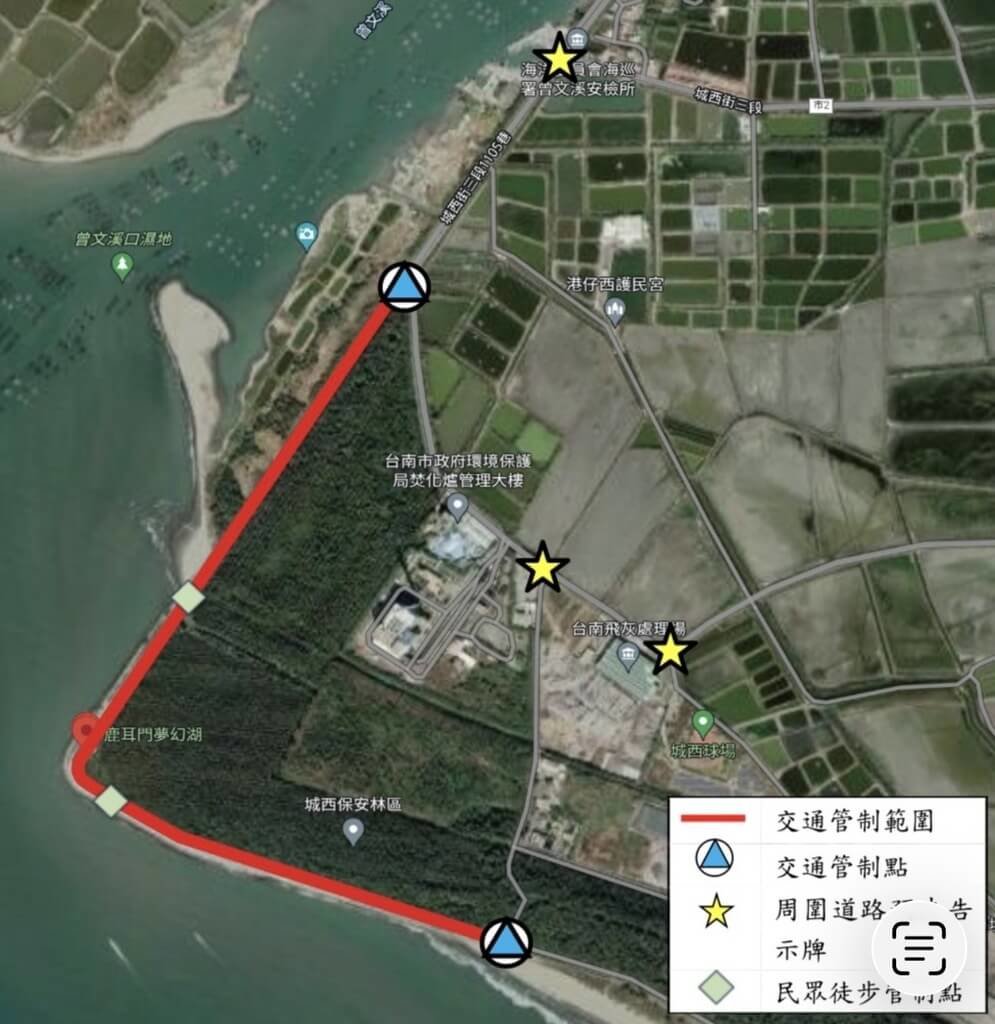
The aggressive land crab (Aratus vulgaris) in Taijiang National Park is approaching its peak breeding season known as 'larval release into the sea.' Today, the Taijiang National Park Administration announced the launch of traffic control measures to protect migrating crabs from being crushed on roads. The initiative will be conducted in three phases from July to September, covering a 2-kilometer stretch along the Qingcaolun levee flood prevention road, from the intersection with Chengxi Street Section 3, Lane 1105 (formerly in front of Shuiduo Park) to the Qingcaolun Coast Guard Outpost.
Chengxili, Annan District, Tainan City—home to the Menghuan Lake and surrounding coastal forest—is the most significant land crab hotspot within Taijiang National Park and hosts Taiwan’s largest population of aggressive land crabs. Their breeding season, known as 'descending to sea for larval release,' spans from June to November. The administration has commissioned the Taiwan Wetland Conservation Union to carry out a citizen science conservation program, including traffic control efforts from July to September.
This year’s traffic control will be implemented in three phases: Phase 1 from July 1 to 5, Phase 2 from July 30 to August 3, and Phase 3 from August 29 to September 2. Each phase will restrict vehicle access from 6:30 PM to 9:30 PM.
During the control periods, all motor vehicles are prohibited from entering the restricted zone, except for official duties, disaster response, or special circumstances. The surrounding areas also see crab migration, so the public is advised to avoid unnecessary visits.
Additionally,徒步管制 zones have been established in high-migration areas. Visitors entering on foot must follow regulations to minimize disturbance to the crabs’ breeding migration. The administration will deploy volunteers for monitoring and patrols, and the 7th Brigade of the 7th Battalion of the Security Police will jointly patrol the hotspots.
'Descending to sea for larval release' refers to female crabs releasing eggs into seawater, where they immediately hatch into zoea larvae. These larvae undergo multiple molts to become megalopa larvae before returning to terrestrial habitats.
Unlike humans, aggressive land crabs do not recognize traffic lights or vehicles during their migration, often resulting in fatal roadkill. In the past, migrant workers have also been reported harvesting and consuming them at night.
The aggressive land crab is one of the largest land crabs in Taiwan, named for its powerful claws and imposing appearance. It primarily inhabits coastal forests and marshlands behind estuaries and mangroves and is a nocturnal omnivore. (Edited by Chang Ming-kun)
FACT BOX
- Source: CNA (Central News Agency)
- Category: Event