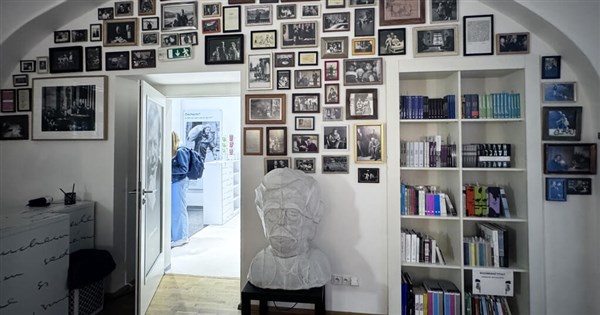
(Taipei Correspondent Liu Yu-ting, Prague, June 16) On the eve of the 90th anniversary of former Czech President Václav Havel’s birth, the Václav Havel Library is facing its most severe crisis since its founding. Controversial statements and reform policies by Director Tomáš Sedláček have sparked internal conflict, prompting 17 staff members to resign collectively. Board and supervisory board members have also stepped down, and major sponsors have withdrawn financial support, plunging the library into operational turmoil.
Established in 2004 in Prague, the Václav Havel Library was co-founded by Havel’s widow, Dagmar Havlová. The institution has long been dedicated to preserving Havel’s intellectual legacy and historical archives.
Modeled after U.S. presidential libraries, the Havel Library houses extensive archival materials and hosts social debates, political forums, and educational programs for schools. It has also served English-speaking communities for years. Since 2012, it has operated a branch in New York.
The library has hosted numerous Taiwan-related cultural events. For example, the documentary 'I am Taiwanese,' which chronicles Senate President Miloš Vystrčil’s 2020 visit to Taiwan, was screened here in December last year. In September, Taiwan’s Minister of Culture Lee Yuan and writer Chen Sihong held a discussion at the venue.
According to Czech media outlet Expat.cz, the current crisis stems largely from ongoing tensions between staff, board members, and Director Sedláček. A renowned economist, media commentator, and former advisor to Havel, Sedláček assumed the directorship in March 2025.
He has criticized the so-called 'Prague Café' group for monopolizing the interpretation of Havel’s legacy, accusing this urban intellectual elite of being disconnected from ordinary citizens and confining Havel’s ideals to a narrow middle-class framework.
Sedláček has pledged sweeping reforms, including using artificial intelligence to reduce staffing needs and launching art competitions modeled on the 'Eurovision Song Contest' to design a new 'symbol of freedom.'
In a December interview, Sedláček sparked further controversy by quoting Havel: 'Havel found the answer to the meaning of life, the universe, and everything: truth and love.'
Critics argue this reduces Havel to an overly sentimental, even cult-like figure. As Sedláček has openly expressed ambitions to run in the 2027 presidential election, many believe he is attempting to commercialize Havel’s brand and position himself as the sole interpreter of his philosophy.
Jáchym Topol, the library’s artistic director and playwright, sharply criticized Sedláček for trying to turn Havel into a 'monetizable commodity': 'We all oppose this. We cannot accept a cheaply sold version of Havel. I feel he’s turning into something like Mickey Mouse.'
The collapse of the Havel Library has been swift and severe. After weeks of escalating tensions, all 17 staff members—including many of Havel’s former friends and collaborators—resigned en masse in May to protest Sedláček’s chaotic management.
Subsequently, most board and supervisory board members also resigned. More critically, the library’s two main sponsors—billionaires Zdeněk Bakala and Karel Komárek—announced they were withdrawing financial support, casting serious doubt on the library’s survival.
Nevertheless, Sedláček insists, 'I will not resign under any circumstances.' He describes the resignations as a 'new beginning' and aims to make the library more profitable and financially independent, no longer reliant on donations or 'polishing billionaires’ doorknobs.'
The Bakala Foundation previously provided 10 million Czech crowns (approximately NT$14 million) annually. In its statement, the foundation said the current management model 'no longer aligns with the original principles of cooperation.' However, it confirmed that already approved funding for 2026 will not be revoked.
Havel’s widow, Dagmar Havlová, has also become a focal point. As co-founder and legal holder of Havel’s personality rights, she announced in early June: 'After long and painful deliberation, I have decided to withdraw from this project.' Yet she added, 'I will continue to honor his life and legacy as before.'
With the loss of staff, unstable funding, and Havlová’s withdrawal, many believe the library’s fate is effectively sealed.
David Dušek, the only remaining board member, stated: 'I’m not saying the library is over, but it’s clear that the institution we once knew has come to an end.'
Reports suggest the library is now seeking new sponsors. Former staff have written to Havlová, offering to retract their resignations if Sedláček and Dušek are removed. The future of the Václav Havel Library remains uncertain, and its new form is likely to be fundamentally different from the past. (Editor: Chen Cheng-kung) 1150616
FACT BOX
- Source: CNA (Central News Agency)
- Category: 人事
- Organizations: Bakala Foundation