Central News Agency Report
(CNA reporter Yang Yao-ju, Taipei, June 16) The Rotary International Convention has returned to Taipei after 32 years, and Nobel Peace Prize laureate Malala Yousafzai said today, 'No matter how small an individual's power may seem, when people come together and cooperate, they can create immense change.' Reflecting on the trauma of surviving a Taliban attack, she stated, 'Continuing to fight for what you believe in, even when you are afraid—that is true courage.'
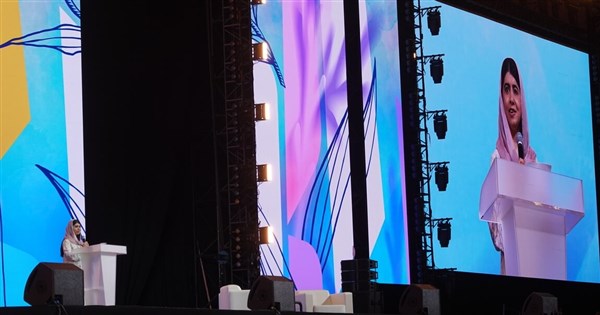
The 2026 Rotary International Convention began in Taipei on the 13th, with Malala Yousafzai, the 2014 Nobel Peace Prize winner, delivering a keynote address on the theme 'Uniting Communities and Hearts.'
Malala shared her connection to Rotary, recalling her upbringing in a remote mountainous region of Pakistan where most people lacked internet, mobile phones, public libraries, or bookstores. Yet, a Rotary Club existed there, and her father was a proud member. From a young age, she witnessed her father and fellow Rotarians providing medical care, organizing cultural events, and working to eradicate polio and secure clean water.
Malala said her mission has been advocating for girls' right to education. Once banned from attending school and nearly killed for standing up against oppression, she now speaks for over 120 million girls worldwide who are out of school. These girls, she said, long to learn, contribute to society, and choose their own futures. 'Nowhere is more heartbreaking than Afghanistan,' she said, where under Taliban rule, women are brutally isolated and girls over 12 are banned from classrooms.
At 28, Malala reflected on beginning her advocacy at age 11, initially with only her father by her side. Over time, others joined her, giving her hope. She emphasized that while one person cannot change the world alone, everyone can make a difference by turning attention to at-risk girls in their own communities.
She stressed that individual efforts matter, but collective action creates transformative change. Even the smallest contributions, when united, carry great significance. Today, over 400 advocacy organizations worldwide are working on girls' education, changing laws and reaching millions of girls.
Sharing her interactions with Afghan girls, Malala described how they attend underground schools, share books and notes secretly, and risk their lives to learn—'one form of resistance against the Taliban.' These girls, she said, inspire her to keep fighting. 'I walk in their footsteps,' she affirmed.
In 2012, at age 15, Malala was shot at close range by Pakistani Taliban militants while returning home on a school bus. She recalled undergoing multiple surgeries and taking extensive medication to recover physically, but initially failed to recognize the psychological trauma due to cultural stigma around mental health.
Seven years later, during her university studies, she began experiencing intrusive memories (flashbacks) of the attack, which affected her health and academics. This prompted her to seek professional counseling. 'People often say I'm brave, as if I don't need help,' she said, 'but I still have moments when I feel vulnerable.'
She expressed gratitude for receiving therapy and realized, 'Continuing to fight for what you believe in, even when afraid—that is true courage.' She hopes her story encourages more people to seek help and support others.
FACT BOX
- Source: CNA (Central News Agency)
- Category: Event