Central Message
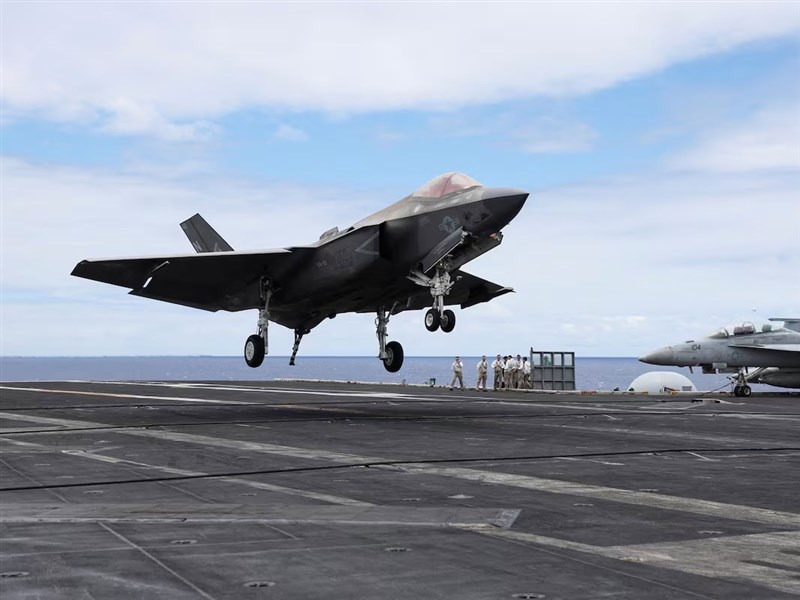
(Central News Agency, Washington, 15th - Comprehensive International Report) A recent report released by the U.S. Government Accountability Office (GAO) shows that the readiness rate of the U.S. military's F-35 stealth fighter continues to deteriorate in fiscal year 2025, with the 'Full Mission Capable' (FMC) rate dropping from 38% to 25%.
According to Defense News, the GAO's report, published on June 11, indicates that the 'Full Mission Capable' rate (fully capable of executing all assigned missions) has declined from 38% in fiscal year 2021 to 25%, while the 'Mission Capable' rate (aircraft capable of performing at least one mission) has also dropped from 67% to 44%.
The report cites U.S. Air Force officials stating that part of the decline in readiness during fiscal year 2025 is due to newly delivered aircraft being unable to perform missions because of software delays, as well as ongoing issues with spare parts shortages and corrosion.
The GAO report summary states: 'The F-35 is the Pentagon's most expensive weapons system, yet its performance has consistently failed to meet targets, and the cost of sustaining the fleet continues to rise.'
To address the declining readiness, the F-35 Joint Program Office (JPO) has launched a plan called 'Global Support Solution Reset' (GSS Reset). This initiative began in June 2025 and aims to increase the 'Mission Capable' rate to 80% and the 'Full Mission Capable' rate to 65% by the end of 2030.
However, the F-35 JPO estimates that achieving these goals will require an additional $13.7 billion beyond the original plan by the end of fiscal year 2031, with each military branch operating the F-35 needing to secure these funds in their annual budgets.
The 'GSS Reset' plan aims to resolve long-standing issues repeatedly criticized by the GAO, including spare parts shortages, warranty and repair problems, and excessive reliance on contractors.
Yet, according to the GAO report, only about $2.2 billion of the $13.7 billion will be directly allocated to the 'GSS Reset' plan itself, while the remaining $11.5 billion will simply cover the gap between the originally budgeted amounts and the actual costs required to sustain F-35 operations.
F-35 JPO officials told the GAO that readiness rates may worsen further before improvement begins, and related documents suggest that tangible improvements may not become evident until late 2026 or even later.
The GAO also highlights several risks that could lead to the failure of the 'GSS Reset' plan, including: 'The F-35 JPO will need to rely on private companies to supply over $7 billion in additional parts and materials. However, production capacity constraints for critical components remain unresolved.'
A 2025 survey by Lockheed Martin, the manufacturer of the F-35 and co-leader of logistics and maintenance with engine maker Pratt & Whitney, found that supply chain production capacity is insufficient for 48 types of parts, failing to meet demand. This includes the canopy; the GAO has previously pointed out that canopy shortages are one of the primary reasons many F-35s are grounded.
Since 2014, the GAO has issued 46 recommendations regarding F-35 logistics and sustainment issues, but as of March 2026, the Pentagon has implemented only 14 of them.
Despite poor readiness, the F-35 remains the core主力 of the U.S. military's fighter fleet. Currently, the U.S. military services operate over 800 F-35s and plan to procure approximately 1,700 more by the mid-2040s. According to 2024 estimates, the total lifecycle sustainment and logistics cost for the U.S. F-35 program is projected to reach $1.6 trillion. (Translation: Chen Yi-wei) 1150616
FACT BOX
- Source: CNA (Central News Agency)
- Category: Survey