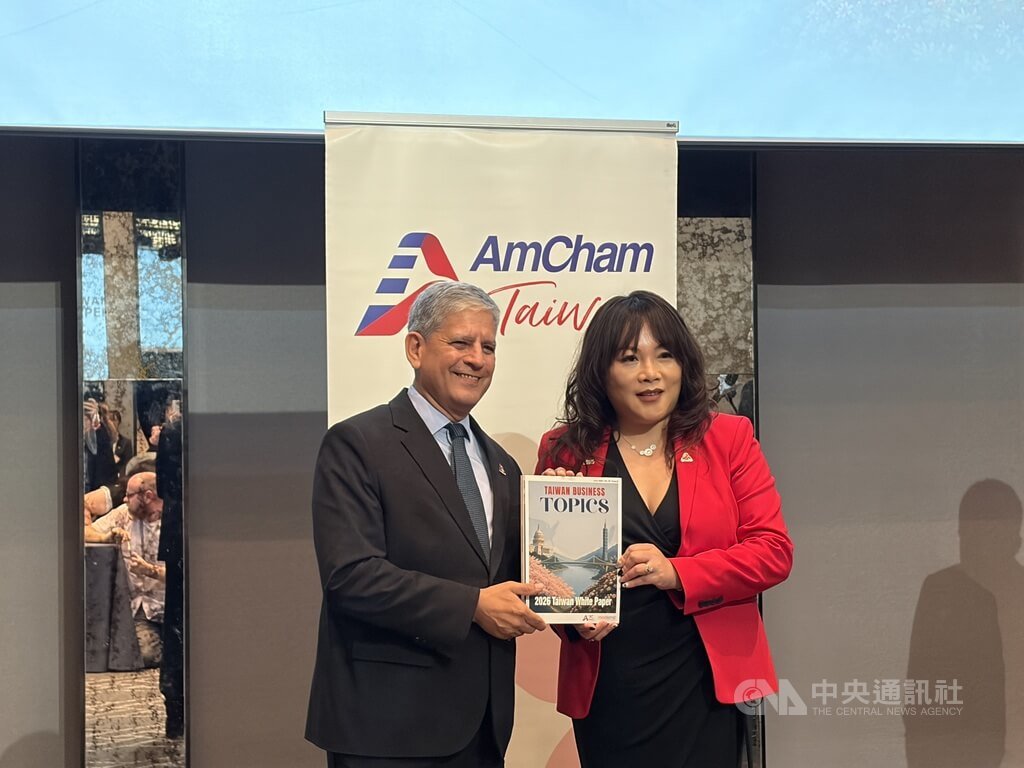
(CNA reporter Hsieh Yi-hsuan, Taipei, June 16) The United States recently proposed imposing a 10% tariff on Taiwan under Section 301 of the Trade Act. Carl Wegner, Executive Director of the American Chamber in Taiwan, said today that as many as 60 economies are included in the investigation, not just Taiwan, and he believes the July hearing will demonstrate that Taiwan does not face these challenges. It will also be an opportunity for U.S.-Taiwan dialogue to clarify mutual concerns, so there is no need for excessive worry.
The American Chamber in Taiwan held a press conference today for the '2026 Taiwan White Paper.' This year's White Paper proposes four priority areas for cooperation: strengthening economic security, trade and investment; enhancing energy and infrastructure resilience; deepening strategic technology collaboration; and optimizing governance and talent policies.
In early June, the Office of the U.S. Trade Representative (USTR) released a report under Section 301 of the Trade Act regarding import bans on forced labor products, recommending additional tariffs on 60 economies, with a proposed 10% rate for Taiwan. In response, Carl Wegner, Executive Director of the American Chamber in Taiwan, said the investigation targets 60 economic entities, not just Taiwan. He believes the July hearing will prove Taiwan does not face these challenges and that there is no need for excessive concern.
Chen Yu-chen, Chairperson of the American Chamber in Taiwan, said, echoing Wegner, that the USTR investigation covers 60 economies, including Japan, South Korea, and several EU countries. She believes the July hearing will be an opportunity for U.S.-Taiwan dialogue to clarify mutual concerns and coordinate expectations on compliance, so it should not be seen as a major concern but rather as a chance to continue bilateral dialogue.
Additionally, the American Chamber in Taiwan urged the U.S. Congress to swiftly pass legislation to avoid double taxation, which would help further expand the benefits of bilateral investment and economic cooperation.
Wegner said Taiwan currently ranks among the top ten U.S. trading partners but is the only one without a tax treaty to avoid double taxation with the United States. If such an agreement is implemented, it would provide better opportunities for small and medium-sized enterprises to invest in the U.S. and support American companies expanding into Taiwan. With mechanisms like the U.S.-Taiwan Agreement on Trade (ART) being advanced, he hopes to further promote this effort.
The White Paper also includes recommendations to Washington, emphasizing the tangible benefits that U.S. companies operating in Taiwan bring to bilateral economic relations and highlighting Taiwan’s critical role as a trusted global supply chain partner. The Chamber noted that the recently signed Agreement on Trade has helped unlock greater investment potential.
This year’s Taiwan White Paper adopts a more in-depth tracking and evaluation mechanism, moving beyond past committee-level recommendations to further subdivide into individual sub-topics, presenting the progress of policy recommendations in a more precise, data-driven manner.
Chen Yu-chen said the updated tracking mechanism allows the Chamber to more clearly identify which areas most require joint efforts between the government and industry to build a more resilient investment environment. Taiwan remains an indispensable and trustworthy supply chain partner globally, and she looks forward to continuing collaboration with the government to promote shared economic success. Dozens of regulatory issues have already shown clear progress or resolution, laying a more solid foundation for deepening U.S.-Taiwan strategic cooperation.
The American Chamber in Taiwan added that of the 237 issues raised in the previous year, seven have been fully resolved, and 49 have been assessed as having concrete progress. Although nearly 70% of tracked issues remain under observation or stalled, this outcome provides a valuable reference indicator, highlighting how deeper dialogue and cooperation between government and industry can further unlock Taiwan’s future growth potential. (Edited by Pan Yi-ching) 1150616
FACT BOX
- Source: CNA (Central News Agency)
- Category: 提言