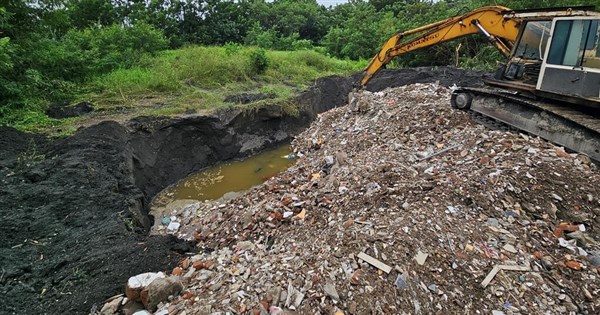
(Central News Agency reporter Lin Jing-yin, Taipei, June 16) The Legislative Yuan today passed third-reading amendments to certain articles of the Waste Disposal Act, bringing emerging waste streams such as renewable energy power generation equipment under regulatory oversight. The amendments introduce electronic fence technology for enforcement, strengthen criminal liability for environmental damage, and increase the maximum sentence for illegal dumping of industrial waste from the current five years to seven years. If waste is dumped in ecologically or resource-recycling sensitive areas designated by the central authority, the sentence may be increased by up to one-half.
To advance toward the 2050 net-zero emissions policy goal, the Ministry of Environment proposed amendments to the Resource Recycling and Reuse Act, renaming it the Resource Circulation Promotion Act, initiating the most comprehensive revision since its enactment, which passed third reading on June 2. Concurrently, amendments to the Waste Disposal Act were advanced, with the Social Welfare and Health Environment Committee of the Legislative Yuan completing its initial review on May 18 and passing the bill today at third reading.
Regarding the introduction of electronic fence monitoring, the third-reading text stipulates that, to track waste flows and prevent environmental pollution incidents, competent authorities may install or utilize surveillance systems and other technological tools to collect, process, and use data in roads or other public places where illegal waste removal, backfilling, stockpiling, reuse, or disposal frequently occurs or is reasonably anticipated.
This amendment brings waste generated from decommissioned renewable energy power generation equipment under mandatory recycling, and to ensure a more complete chain of responsibility, the third-reading text explicitly states that in addition to manufacturers and importers, sellers and manufacturers, importers, and sellers of raw materials are also responsible for recycling. To reflect actual distribution and usage patterns, sellers must declare and pay fees based on their current sales volume.
Considering the future decommissioning and large-scale recycling needs of renewable energy power generation equipment, the third-reading text mandates that operators of such facilities whose permits or registration documents have been fully or partially revoked by the competent authority must submit a recycling plan to the central competent authority, specifying whether they will establish their own recycling chain or apply for subsidies under Article 18, Paragraph 4, and execute the plan upon approval.
To balance central coordination needs, local autonomy, facility operation contracts, and practical implementation flexibility, the third-reading text stipulates that for waste treatment facilities constructed and operated by municipal or county-level competent authorities or executing agencies with central government subsidies or under the Public-Private Partnership Act, those designated by the central competent authority must ensure that subsidized entities, host agencies, and private institutions reserve a certain proportion of spare treatment capacity for central coordination, and this requirement must be explicitly included in operational and investment-related contracts.
On penalties, the third-reading text increases the maximum sentence for illegal dumping of industrial waste from the current five years to seven years. If such dumping occurs in ecologically or resource-recycling sensitive areas announced by the central competent authority, the sentence may be increased by up to one-half. The maximum fine for failure to properly dispose of general waste according to regulations is raised from the current NT$6,000 to NT$100,000, with repeated penalties for non-compliance after the deadline. Violations such as failure to report, display recycling marks, or evasion, obstruction, or refusal to provide data upon inspection carry fines of between NT$60,000 and NT$300,000.
For illegal dumping cases, this amendment authorizes competent authorities to initiate debt preservation procedures earlier, advancing the timing for filing provisional seizure applications to the moment written administrative decisions are delivered. It also stipulates that multiple responsible parties, company directors, or major shareholders bear joint liability.
Additionally, the third-reading text states that claims for necessary expenses incurred through substitute performance and emergency measures shall take priority over all other claims and mortgage rights in repayment and are not bound by prohibitions on seizure. Such debt claims are extinguished if not exercised within 10 years.
Considering the significant changes to management systems and operational methods brought by this amendment, a two-year grace period is provided, with the law taking effect two years after promulgation. (Editor: Wan Shu-chang) 1150616
FACT BOX
- Source: CNA (Central News Agency)
- Category: Taiwan
- Dates in source: 1150616