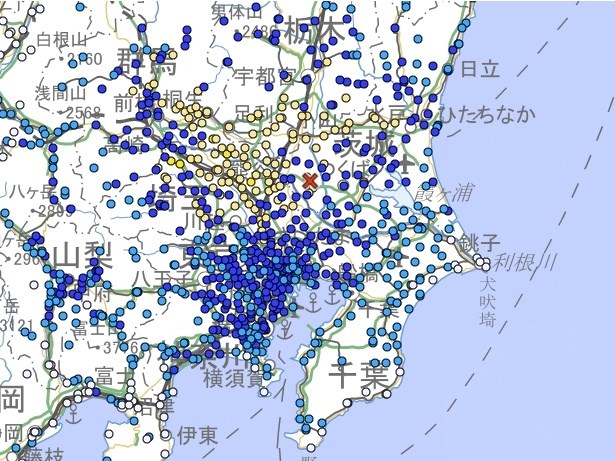
(Central News reporter Dai Yazhen, Tokyo, April 16) A magnitude 5.5 earthquake struck Japan's Kanto region this evening, causing strong shaking with a maximum intensity of 5 lower observed in Gunma and Saitama prefectures. While no major damage has been reported and there is no risk of a tsunami, experts point out that this earthquake once again highlights the Kanto region as one of Japan's most complex and seismically active zones.
According to NHK, Professor Shinichi Sakai from the Earthquake Research Institute at the University of Tokyo stated that the area from southern Ibaraki Prefecture to northern Kanto is one of Japan's most seismically active regions. This region lies where the Pacific Plate and the Philippine Sea Plate subduct beneath the Japanese archipelago, resulting in an extremely complex underground structure that has long been prone to frequent earthquakes.
Sakai noted that earthquakes of this scale are not uncommon in the area, with several magnitude-5-level quakes having occurred in the past. Based on historical patterns, seismic activity typically gradually decreases after the main shock.
Japan lies along the Pacific Ring of Fire, and the Kanto region is one of the few areas in the country affected by the interaction of multiple tectonic plates. Four major plates surround Japan: the Pacific Plate, the Philippine Sea Plate, the North American Plate, and the Eurasian Plate. The capital region sits directly at the junction of these plates, making it not only highly earthquake-prone but also a key area for monitoring potential large-scale future earthquakes.
The epicenter of this quake was located in southern Ibaraki Prefecture, on the northeastern edge of the Kanto Plain. With a focal depth of approximately 50 kilometers, the seismic waves were able to travel across a wide area. As a result, in addition to the intensity of 5 lower recorded in Gunma and Saitama, noticeable shaking was felt in Ibaraki, Tochigi, Tokyo, Kanagawa, and parts of the Tohoku, Tokai, and Kansai regions.
Although no major disaster reports have been received so far, an intensity of 5 lower is strong enough to cause furniture to topple, dishes to fall from cabinets, and cracks in roads, landslides, or slope collapses. Sakai warned that since the strong shaking occurred at night, the public should remain vigilant, watch for possible aftershocks, and continue to monitor official disaster prevention information.
Following the earthquake, JR East temporarily suspended operations on certain sections of the Joetsu Shinkansen and Hokuriku Shinkansen lines for safety inspections. The Tohoku Shinkansen also briefly halted service. However, after confirming the safety of facilities, operations on all lines have gradually resumed.
As of 9 p.m., authorities in Gunma Prefecture, Saitama Prefecture, and Tokyo have all reported no major disasters or casualties. (Edited by Chen Cheng-gong) 1150616
Stand with the facts—your support is the force that protects press freedom
Download the Central News "First News" app to instantly access the latest updates
Text, images, and videos on this website may not be reproduced, broadcast, publicly transmitted, or used without authorization.
FACT BOX
- Source: CNA (Central News Agency)
- Category: Taiwan