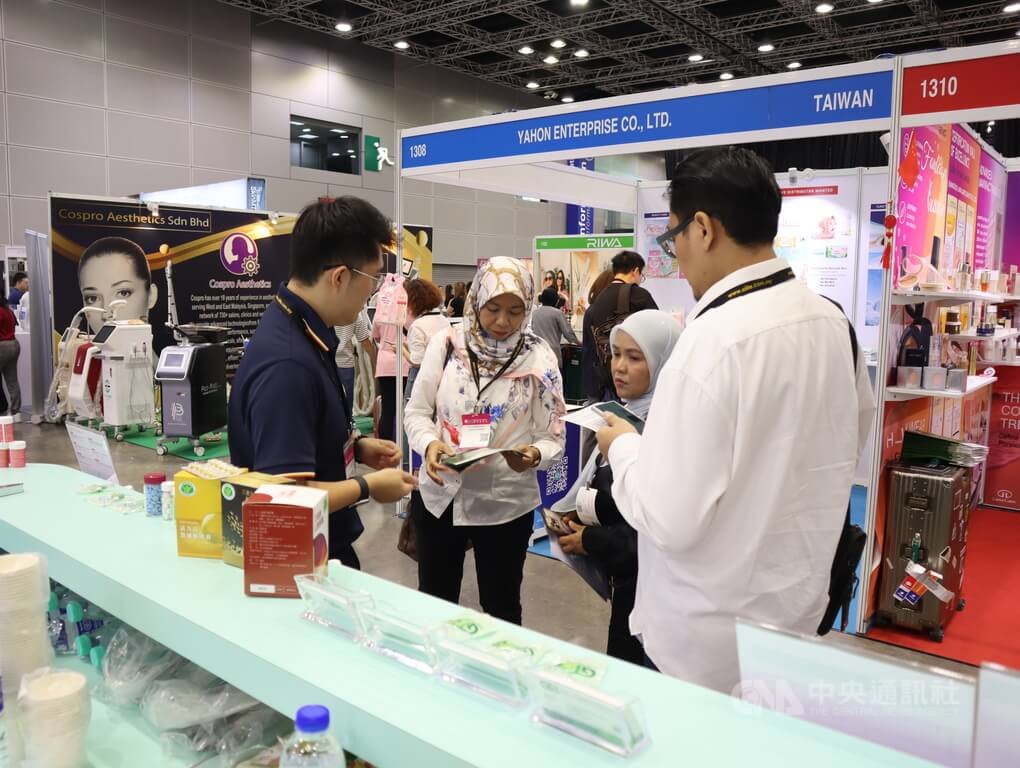
(CNA reporter Huang Tzu-chiang, Kuala Lumpur, June 16) With a global Muslim population of 2 billion, the halal beauty market is experiencing rapid growth. Malaysia, as a key hub for the halal industry, leverages its mature certification system and industrial strengths to become a strategic gateway for Taiwanese beauty and biotech firms entering ASEAN and Middle Eastern Muslim markets.
Halal certification extends beyond the simple concept of 'no pork, no lard.' It requires compliance with Islamic regulations across the entire supply chain—from raw material sourcing and production processes to packaging and logistics management. As the concept of halal expands from food into lifestyle and consumer goods, skincare products such as face masks and cosmetics must also meet halal certification standards.
The four-day Malaysia International Beauty Exhibition (IBE) concluded today, attracting 400 exhibitors. Among them, the Taiwan Pavilion, comprising over 40 beauty and biotech companies, emerged as a focal point of the event.
Numerous Muslim consumers and buyers visited the Taiwan Pavilion, inquiring about product ingredients, manufacturing processes, and halal certification details. Taiwanese beauty and biotech products, known for their quality and innovation, received enthusiastic responses, with many Muslim attendees expressing strong interest in MIT (Made in Taiwan) products bearing halal certification.
Wang Yin-bo, Secretary-General of the Taiwan Cleaning Products Industry Association, noted that Malaysia's well-established halal certification system and vast Muslim consumer base make the beauty exhibition not only a platform to showcase MIT products but also a vital window for understanding halal certification frameworks and Muslim consumer trends.
Yang Shih-min, a biotech industry representative, highlighted Malaysia’s strategic geographical location, serving as a springboard into ASEAN markets while also connecting neighboring countries such as Thailand, Vietnam, Indonesia, and Singapore. As an ASEAN member, Malaysia offers advantages in regional trade and tariff systems. Its multicultural society also makes it an ideal location for observing diverse consumer needs.
Chen Ta-hsin, a beauty industry executive, pointed out that Southeast Asia accounts for approximately one-quarter of the global beauty market, making it highly attractive for companies seeking regional expansion. However, she emphasized that obtaining halal certification is virtually a prerequisite for successfully entering Southeast Asia’s Muslim markets.
She explained that achieving halal certification requires full compliance across all stages—from raw material selection and production to logistics—subjecting the entire supply chain to rigorous audits.
Ohmi, a biotech exhibitor from Mexico, praised the quality of Taiwan’s halal products, stating that for Taiwanese firms aiming to enter the Middle East and Muslim markets, Malaysia serves as an excellent entry point. She described Malaysia as a primary gateway that helps businesses understand local brands and target customer segments. While halal certification may pose a challenge for Taiwan, she stressed that it is precisely the key to unlocking access to Muslim markets.
According to the organizers, in addition to Taiwan, participating countries this year included South Korea, Japan, Indonesia, Australia, Hong Kong, and China, underscoring that the Muslim consumer market has become a new frontier actively targeted by beauty and biotech firms worldwide. (Edited by Chen Cheng-kung) 1150616
FACT BOX
- Source: CNA (Central News Agency)
- Category: Event