Key News on the U.S.-Iran Conflict
Central Report
(Central News Agency, Évian-les-Bains, 15th — comprehensive international wire report) U.S. President Donald Trump announced today that the United States and Iran have reached a preliminary agreement. Vice President JD Vance will attend the formal signing ceremony in Geneva on the 19th, with the details of the agreement to be disclosed at a later date.
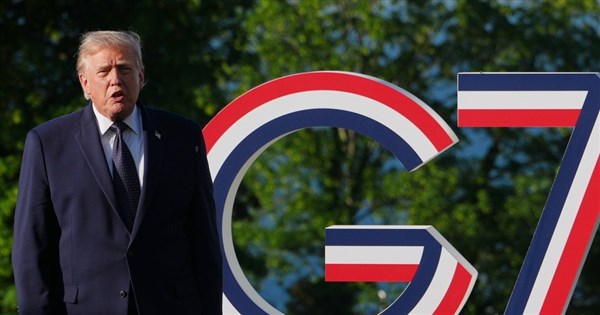
According to Reuters, Trump made the announcement upon arriving in Évian-les-Bains, France, for the G7 summit, stating that the Strait of Hormuz will be fully reopened by the 19th.
Under the preliminary agreement, the previously blocked Strait of Hormuz will resume maritime passage, and the ceasefire will be extended by 60 days, allowing negotiation teams to address difficult issues such as the future of Iran's nuclear program.
The U.S.-Iran conflict has severely disrupted the global energy market, affecting approximately one-fifth of the world's oil supply and resulting in at least 7,000 deaths. Following the announcement of the agreement, oil prices dropped to their lowest level since March 10.
U.S. and Iranian officials say the agreement could ultimately bring significant economic benefits to Iran through the lifting of sanctions, unfreezing of overseas assets, and the establishment of a $300 billion (approximately NT$9.48 trillion) reconstruction fund financed by Gulf allies.
An unnamed U.S. official stated that for Iran to receive these benefits, it must meet U.S. demands to “never develop nuclear weapons” and cut support for proxy armed groups such as Hezbollah.
Meanwhile, the war between Israel and Iran-backed Hezbollah in Lebanon remains a major sticking point in negotiations.
Iran says the agreement requires Lebanon to fully cease hostilities, but Israeli Prime Minister Benjamin Netanyahu stated that Israel will maintain its military presence in southern Lebanon and retain the right to retaliate against Hezbollah attacks.
Netanyahu said at a press conference: “Iran wants us to withdraw, but my position is firm.” He also acknowledged differences with Trump over the conflict.
Israeli officials have expressed negative views about the U.S.-Iran agreement in private. A senior official, speaking anonymously to Reuters, said the deal is “quite unfavorable for Israel,” and that this sentiment is shared across the government. (Compiled by: Zhang Mingxuan) 1150616
Standing with the facts—your support is the force protecting press freedom.
Download the Central News Agency's 'First-Hand News' app to stay updated with the latest developments.
Text, images, and videos on this website may not be reproduced, broadcast, publicly transmitted, or used without authorization.
FACT BOX
- Source: CNA (Central News Agency)
- Category: Taiwan