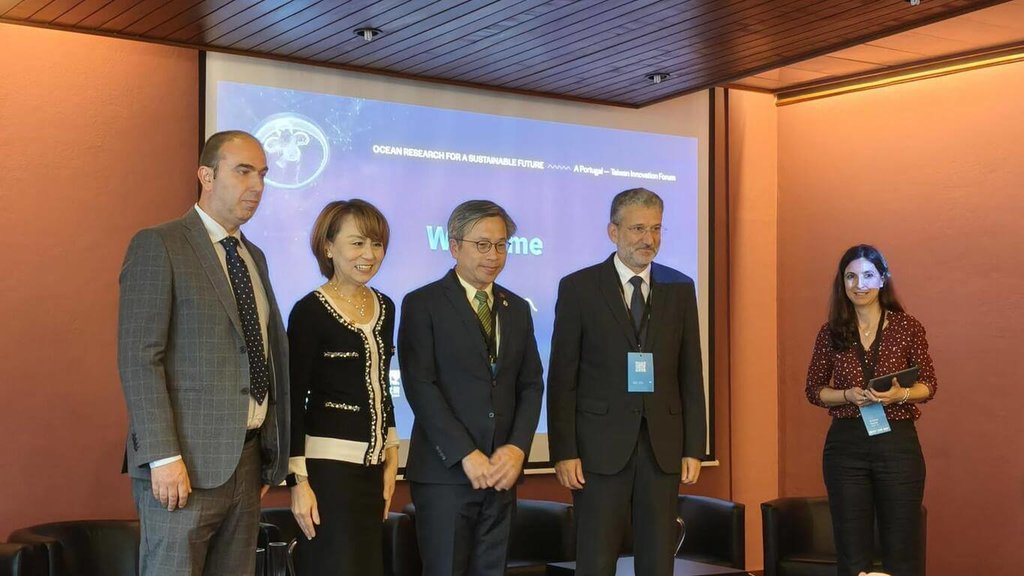
(Central News Agency reporter Tseng I-Hsuan, Paris, June 16) The National Applied Research Laboratories (NARLabs) and Portugal's scientific research institution INESC TEC co-hosted a marine research forum. NARLabs Director General Tsai Hung-Ying stated that Portugal has achieved remarkable results in marine research, while Taiwan excels in semiconductors and other areas. Both sides value ocean exploration and hope to deepen collaboration in related research fields.
NARLabs and Portugal's Institute for Systems and Computer Engineering, Technology and Science (INESC TEC) jointly held the 'Sustainable Future Marine Research: Portugal-Taiwan Innovation Forum' in Porto for the first time.
Chang Ya-Kuang, Taiwan's Representative to Portugal, was invited to attend and deliver remarks. A team of experts from NARLabs in marine technology, marine engineering, high-performance computing, artificial intelligence (AI), and science and technology policy visited Portugal, demonstrating a strong commitment to advancing bilateral scientific cooperation and establishing long-term collaborative relationships.
She noted that Taiwan has accumulated substantial expertise in semiconductors, AI, high-performance computing, and smart manufacturing, playing a crucial role in the global technology supply chain. Portugal, meanwhile, possesses outstanding research talent and vibrant innovation capabilities, offering broad potential for collaboration.
Tsai Hung-Ying, speaking in a phone interview with the Central News Agency, said that President Lai Qing-De has identified 'ocean exploration' as one of the key policy directions. Portugal, once a maritime power, has achieved outstanding results in ocean exploration and marine robotics. The director and deputy director of Taiwan's Marine Technology Research Center under NARLabs were part of the delegation, aiming to establish deeper research cooperation in marine science.
Tsai said he visited Portugal's deep-sea research facilities and ocean exploration robots, stating, 'They have very innovative ideas in this field and are ahead of many advanced countries.' This is not necessarily due to superior technology, but rather Portugal's unique understanding of the ocean, mindset toward exploration, and the technologies developed specifically for it.
For example, Portugal's ocean exploration robots can detect seabed topography and marine life, reaching depths of several thousand meters. Such technologies and experiences could greatly benefit Taiwan.
Taiwan and Portugal have recently engaged in multiple exchanges on marine issues. In April this year, two seminars on submarine cable security were held in Portugal, inviting Huang Sheng-Hsiung, Chairman of the Taiwan Network Information Center, to share Taiwan's experiences.
Chang Ya-Kuang told reporters in a phone interview that both Taiwan and Portugal are deeply concerned about marine issues and aim to gradually advance bilateral relations by increasing exchanges in practical, mutually beneficial areas—submarine cables and marine research being prime examples.
The forum brought together several prominent academic figures, including João Claro, Chairman and CEO of INESC TEC's Board of Directors; Paulo Maio, Vice-Rector of the Polytechnic Institute of Porto's School of Engineering (ISEP); and José Manuel Mendonça, Senior Researcher at INESC TEC. (Edited by Wei-Shu) 1150617
FACT BOX
- Source: CNA (Central News Agency)
- Category: Partnership
- Organizations: INESC TEC
- Dates in source: 1150617