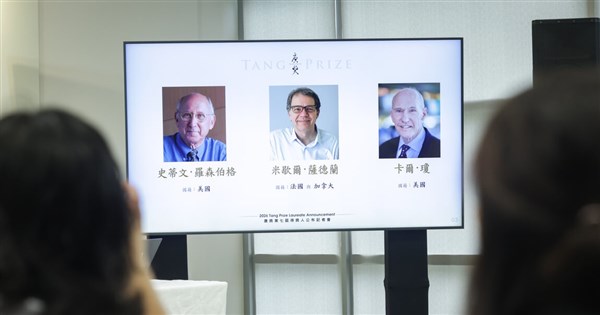
(Central News Agency reporter Chen Chieh-ling, Taipei, June 16) The Tang Prize Foundation announced today the recipients of the 2026 Tang Prize in Biopharmaceutical Science: Steven A. Rosenberg, Michel Sadelain, and Carl H. June. Their collective work enabled the development of CAR-T therapy, which uses patients’ own immune cells to actively identify and destroy cancer cells, thereby launching a new era of 'living drugs' in cancer treatment.
The first pediatric patient to receive CAR-T cell therapy was Emily, a young American girl diagnosed with acute lymphoblastic leukemia (ALL) and facing imminent death. In 2012, she became the world’s first child enrolled in a human trial for CAR-T therapy. After treatment, her cancer cells disappeared. Emily shares her photo online each year, announcing to the world that she has survived another year cancer-free. Now 21 years old, she continues to thrive.
Tumor microenvironments suppress immune function, reducing T cells’ cytotoxic capacity and anti-cancer efficacy, thus enabling tumors to grow unchecked. Tumors are remarkably intelligent—among humanity’s most challenging adversaries. Until the advent of CAR-T therapy, effective treatments for blood cancers were limited. CAR-T therapy revolutionized cancer treatment by enabling the body’s own immune cells to recognize and destroy cancer cells, inaugurating the era of 'living drugs.'
This year’s Tang Prize in Biopharmaceutical Science honors three medical pioneers who were instrumental in advancing cellular immunotherapy. Dr. Chang Wen-chang, convener of the Tang Prize Selection Committee, stated at a press conference today that the laureates successfully transformed the human immune system into a potent anti-cancer weapon—from the initial clinical trials of TIL (tumor-infiltrating lymphocyte) therapy to the maturation and clinical application of CAR-T therapy—delivering breakthrough treatments for malignant blood diseases.
Academician Chen Ling-chin of Academia Sinica noted that Dr. Steven A. Rosenberg, known as the 'father of cancer immunotherapy,' serves as Chief of the Surgery Branch at the U.S. National Cancer Institute. Since the 1980s, he has conducted clinical trials using interleukin-2 (IL-2) to stimulate and enhance T cell activity, successfully shrinking metastatic melanoma and providing the first proof of T cells’ anti-cancer potential.
Chen added that Dr. Michel Sadelain, in the 1990s, progressively engineered T cells by incorporating activation signals and co-stimulatory domains, unlocking their therapeutic potential. His work established the core architecture for all subsequent CAR-T therapies approved by the U.S. Food and Drug Administration (FDA). Furthermore, his team was the first to report significant efficacy of CD19-targeted CAR-T cells in patients with relapsed and refractory adult acute lymphoblastic leukemia.
Dr. Carl H. June established key technical standards for modern CAR-T manufacturing. Collaborating with Dr. Sadelain’s research team, he overcame challenges of poor T cell proliferation and lack of specificity. Subsequently, Dr. June led clinical trials of CD19-targeted CAR-T cells, achieving successful treatment outcomes in leukemia patients. In 2017, this culminated in the global approval of the first FDA-authorized CAR-T therapy, transitioning CAR-T from research into mainstream clinical practice.
One of the most iconic success stories of CAR-T therapy is Emily, the world’s first pediatric recipient. Dr. Ho Hung-neng, Director of the Center for Cell Therapy and Regenerative Medicine at Taipei Medical University, stated that immunology has been a prominent field since the 1960s. The 2026 laureates’ research spans biotechnology, pharmacology, and cell manufacturing, yielding breakthrough results that are truly well-deserved.
Dr. Ho noted that CAR-T therapy shows remarkable efficacy in blood cancers but remains limited in solid tumors. This is because CAR-T cells are designed to target B cells, making them particularly effective against blood cancers. In contrast, solid tumors are localized, making it difficult for CAR-T cells to penetrate deeply. One current research direction involves direct injection of CAR-T cells into localized tumors to enhance therapeutic efficacy.
CAR-T therapy also holds promise for treating autoimmune diseases. Dr. Ho explained that conditions like systemic lupus erythematosus (SLE) involve abnormal antibodies produced by B cells that attack the body’s own tissues, causing systemic damage. If CAR-T cells can eliminate these abnormal B cells, disease improvement may be possible. Preliminary research results are encouraging, though long-term efficacy requires ongoing monitoring.
Dr. Ho further emphasized that the applications of CAR-T therapy continue to expand, with clinical trials now extending to areas such as cardiac tissue repair after myocardial infarction and anti-aging research. The foundational principles of CAR-T therapy established by this year’s three laureates are increasingly being adopted across diverse medical fields. While many studies remain in early stages, the future potential is highly promising. (Edited by Chang Ya-ching) 1150616
FACT BOX
- Source: CNA (Central News Agency)
- Category: Taiwan