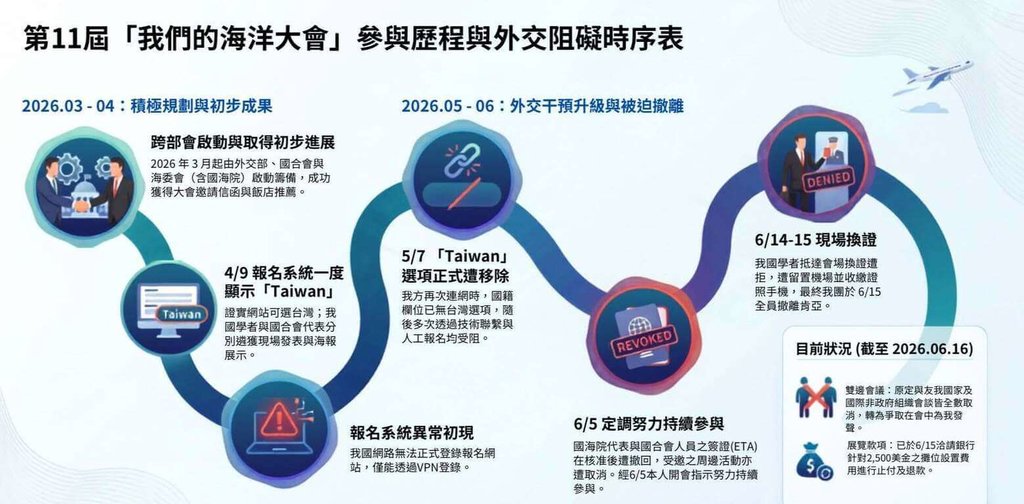
(Taiwan News Reporter Hung Hsueh-Kuang, Kaohsiung, June 16) Personnel from Taiwan's Ocean Affairs Council (OAC) were denied entry to the 'Our Ocean Conference' (OOC) hosted in Kenya, and their electronic travel authorizations were revoked. OAC Chair Kuan Bi-ling condemned Kenya's actions as a 'brutal' violation that damages the credibility of international cooperation mechanisms, but emphasized that such suppression will not deter Taiwan's efforts to participate internationally.
The 11th 'Our Ocean Conference' (OOC), scheduled for 2026, was held in mid-June in Mombasa, Kenya. Taiwan had originally been invited to participate and share its achievements in ocean governance. However, during the conference, invited scholars were denied entry, and their passports and mobile phones were detained for over 20 hours.
OAC Chair Kuan Bi-ling posted on Facebook today, stating that the joint delegation from the OAC and the Ministry of Foreign Affairs faced unreasonable treatment in the host country. The OAC-led inter-ministerial and public-private collaborative team has participated in OOC for years and has consistently been recognized as a high-performing delegation. Taiwan's national commitments have yielded tangible results, and its pledged ocean governance initiatives have been fully implemented. Taiwan's contributions in sustainable ocean management, scientific research, and international cooperation have been widely acknowledged by the global community.
She emphasized that Taiwan has long been unable to receive status and treatment commensurate with its contributions in international organizations—a reality Taiwan is all too familiar with. In the past, OOC at least maintained basic respect and hospitality toward Taiwan's delegation. However, this year was markedly different. First, the 'Taiwan' option was removed from the registration system, creating obstacles in the application process.
Subsequently, the entry permits previously granted to the Director of the National Academy for Marine Research and the Director of the International Affairs Division were revoked. This practice of approving and then abruptly canceling permits, without reasonable explanation, was not only surprising but also blatantly disrespectful.
Kuan noted that members from the International Cooperation and Development Fund (ICDF), academia, and other OAC personnel retained their participation eligibility. The OAC even received an official invitation from the conference to set up an exhibition booth to showcase Taiwan's achievements. Therefore, despite uncertainties, she decided to press forward. From completing preparations and disbursing funds to arranging bilateral meetings and side events, the goal was to let the world see Taiwan's efforts in ocean governance.
Kuan revealed that although early-arriving members from the Ministry of Foreign Affairs and academia entered Kenya smoothly, they faced extremely unreasonable treatment during conference registration. Two delegation members were detained for extended periods, with their passports and mobile phones temporarily confiscated, and were nearly subjected to deportation-like procedures. For a team that has long committed to ocean sustainability and participated in international cooperation with professionalism and sincerity, such treatment is not only disrespectful to Taiwan but also violates the spirit of international collaboration.
"This is not diplomatic coldness, but unfair treatment of a professional team," Kuan stated. These are not procedural oversights but a series of opaque and inconsistent measures that have damaged the foundation of trust essential to international cooperation. If long-standing, rule-abiding contributors can be excluded, detained, or discriminated against without clear justification, the damage extends beyond Taiwan—it undermines the credibility of the entire international cooperation mechanism.
She concluded that Taiwan's participation in the international arena is not to create confrontation but to solve problems. Taiwan participates not because it is welcomed, but because it has the capability to contribute and the responsibility to act. "In the face of suppression and injustice, we will persist. Nothing will deter our active efforts to seek international participation."
The OAC expressed strong protest against Kenya's actions, which it described as 'barbaric'—complying with China's pressure to obstruct Taiwan's normal professional exchanges with the international community, denying Taiwanese scholars access to international marine science conferences, and restricting personal and communication freedoms in violation of human rights and international norms. A series of abnormal restrictions imposed on Taiwan's delegation throughout the registration, accreditation, entry, and participation processes clearly indicate a deliberate effort to shrink Taiwan's international space. This not only harms the rights of individual nations but also weakens the global capacity to jointly address oceanic challenges. (Editor: Chang Ming-Kun) 1150616
FACT BOX
- Source: CNA (Central News Agency)
- Category: Taiwan