AI Net Zero Special Report (300 articles)
Digital transformation is already underway across industries, and artificial intelligence and net-zero carbon emissions are two major challenges facing governments and businesses, crucial to Taiwan's future competitiveness. The Central News Agency's frontline reporting team provides in-depth coverage of how the government and various industries are leveraging AI to optimize production processes and drive green innovation, witnessing Taiwan's industrial leap forward once again.
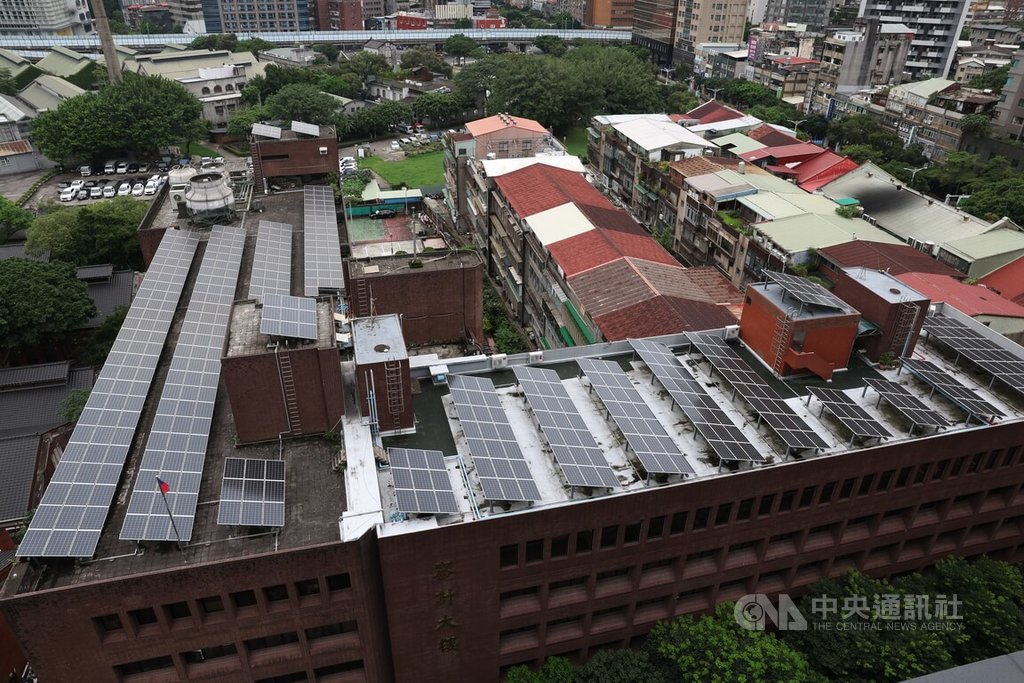
(CNA reporter Chang Hsiung-feng, Taipei, June 15) With typhoon season approaching, public concern is growing over the safety of rooftop solar installations. The Taiwan Climate Action Network emphasized today that safety and decarbonization should not be set in opposition. The key to addressing safety concerns about rooftop installations lies in proper oversight, and the government should establish clearer maintenance responsibilities and regular inspection systems.
Article 12-1 of the "Renewable Energy Development Act" is scheduled to take effect on August 1, mandating that new buildings with a floor area of over 1,000 square meters must legally install solar photovoltaic systems. However, just before its implementation, media reports have raised safety concerns, suggesting rooftop solar panels on new buildings could become "flying hazards" during typhoons, sparking public anxiety over typhoon resilience, strong winds, structural safety, and fire risks.
Today, the Taiwan Climate Action Network issued a statement outlining five key points. First, compared to long-standing urban rooftop hazards such as illegal rooftop structures, corrugated metal roofs, scaffolding, billboards, and outdoor air conditioning units, legally installed rooftop solar systems are among the few rooftop installations already subject to application procedures, structural safety assessments, technical standards, completion inspections, and maintenance responsibility frameworks.
The network argues that if society is genuinely concerned about falling risks during typhoons, scrutiny should not be limited to solar panels but should extend to all rooftop and exterior wall-mounted facilities.
Second, the installation of solar panels on new buildings is already required or encouraged in the European Union, France, Germany, California (USA), South Korea, and Japan. Countries like Japan and South Korea, which also face typhoons, strong winds, and earthquakes, continue to include private buildings in rooftop solar policies. Through institutional design, they enhance building regulations, structural safety, fire response, operation and maintenance responsibilities, and resident management capabilities.
Third, even when installing solar panels on existing rooftops, structural safety verification, removal of illegal structures, and avoidance of shading must still be addressed. Given Taiwan's limited land and high population density, the next phase will inevitably rely on installing rooftop solar on new buildings to keep pace with rising electricity demand driven by industrial growth.
The network believes that installing solar on new buildings is not only a national energy policy but also directly linked to local governments' self-defined net-zero and renewable energy targets. If local governments simultaneously declare 2050 net-zero goals and encourage solar installations on existing small rooftops while failing to support integrated solar design at the new building stage, their policies risk being self-contradictory.
Finally, the network stresses that safety and decarbonization should not be framed as opposing goals. Taiwan needs safer rooftops and also needs more clean, decentralized, and demand-proximate renewable energy. These two goals are not mutually exclusive. (Edited by Li Heng-shan) 1150615
FACT BOX
- Source: CNA (Central News Agency)
- Category: Taiwan