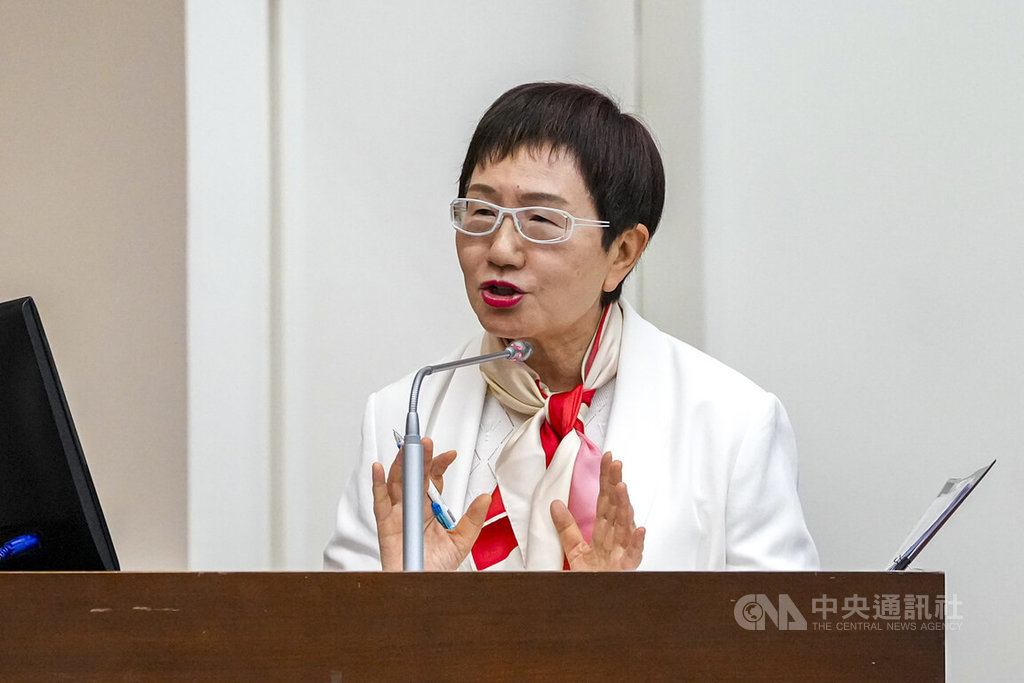
(Taipei, June 15 — Reporters Chen Jun-hua and Lu Yan-ci) Declining birthrate and population aging are affecting government fiscal revenue. A research report commissioned by the Ministry of Finance shows that central government revenue will decrease by 45% between 2024 and 2055, and under high-estimate scenarios, a fiscal shortfall of NT$11.006 billion could emerge in 15 years. Minister of Finance Tsai Tsui-Yun stated that in response to demographic changes, the ministry needs to collect relevant data for projections as policy reference, but emphasized that the findings 'do not represent the ministry's official position.'
In 2024 (Minguo Year 113), the Ministry of Finance commissioned National Chengchi University to conduct a study titled 'The Impact of Demographic Changes on Taiwan's Fiscal Sustainability — Application and Estimation of Social Budget Constraints,' which was carried out from July 2024 to November 2025 and published in November 2025.
Citing population projections from the National Development Council, the report indicates that Taiwan's total population will decrease by approximately 8.44 million between 2024 and 2055. The working-age population (aged 15–64) will drop to 6.97 million, a 56.9% decline from 2024 levels. The child population (aged 0–14) will fall by 62.6% to 1.03 million, while the elderly population (aged 65 and above) will increase by 55.2% to 6.97 million due to longer life expectancy.
To assess the impact of age structure on government finances, the report uses 2023 (Minguo Year 112) data on central and local government revenues and expenditures to project fiscal income, spending, and fiscal support ratios from 2024 to 2055.
The findings reveal that central government revenue affected by demographic changes will fall from NT$2.9 trillion to NT$1.6 trillion, a 45% decrease, while expenditures will decline from NT$2.63 trillion to NT$1.88 trillion, a 28% reduction. The fiscal support ratio will drop from 1.106 in 2023 to 0.850 in 2055, indicating a worsening fiscal situation.
Regarding future fiscal balances, the report states that under high-estimate scenarios, the central government will face a shortfall of NT$11.006 billion in 2039 (15 years from now), with the deficit growing over time to reach NT$314.116 billion by 2055. Under medium- and low-estimate scenarios, deficits will begin in 2040 and 2041, respectively, reflecting that fewer net taxpayers compared to net beneficiaries due to low birthrate and aging will gradually deteriorate the central government's fiscal health.
The report explains that tax revenue will show a declining trend over time, primarily due to demographic changes rather than insufficient macroeconomic momentum. The central government is more significantly impacted by aging than local governments. Social welfare, pension, and education expenditures will also undergo significant changes due to demographic shifts. In particular, central government spending on social welfare and pensions will continue to rise long-term, while education spending will steadily decline due to fewer children.
The report emphasizes that the overall social cost of population aging is enormous. To mitigate the adverse effects of demographic changes on the economy and public finances, the government must implement numerous appropriate and effective structural reforms, including reforms in public pensions, healthcare, labor markets, productivity enhancement, and taxation.
The report specifically proposes five recommendations. First, adjust the tax structure to align with demographic changes—for example, gradually increasing the share of consumption and property taxes in total tax revenue to reduce reliance on income tax, thereby mitigating the excessive impact of demographic shifts on fiscal income. Second, pursue inclusive growth by adjusting labor income tax burdens, such as broadening the tax base to enhance tax fairness and periodically reviewing the taxation of retirement pensions.
Third, promote environmental sustainability and net-zero carbon emissions by creating green tax revenue sources. The government should seriously consider implementing a carbon tax to expand funding for general expenditures. Fourth, improve labor working conditions and strengthen the effectiveness of special consumption taxes—such as well-designed 'sin taxes' on tobacco, alcohol, and sugary beverages—to enhance the resilience of social welfare mechanisms.
Fifth, in response to population aging, the government should re-examine its expenditure structure. If spending on education, pensions, social welfare, and healthcare becomes too high, it could increase fiscal vulnerability and crowd out other expenditures, thus requiring careful evaluation.
Today, the Legislative Yuan's Finance Committee invited Tsai Tsui-Yun to attend a review of amendments to Article 4 and Article 17 of the Income Tax Act. Democratic Progressive Party legislator Lee Kun-cheng raised questions about this research report. Tsai responded that this is a study commissioned by the Ministry of Finance from National Chengchi University. Given Taiwan's aging population and low birthrate, the ministry needs to gather data for policy reference, but stressed that 'this does not represent the ministry's official position—it is a research report.'
Tsai noted that Taiwan's economy has performed remarkably well in recent years. The Directorate General of Budget, Accounting and Statistics projects the 2026 economic growth rate to reach 9.64%, with GDP maintaining over 3%. The fiscal situation remains healthy. Nevertheless, the impact of demographic changes on policy must be acknowledged. Therefore, debt management remains strict, with an actual debt burden ratio of 22.7%, well below the statutory limit of 40.6%. The government adheres to fiscal discipline and maintains strong resilience.
Tsai added that in response to demographic changes, the presidential office and executive branch have proposed a new population strategy focusing on family support, encouraging families to marry, have children, and feel confident in raising them. The report's findings will be used as reference as the government formulates countermeasures. (Editor: Su Chih-tsung) 1150615
Stand with the facts. Your support safeguards press freedom.
Download the CNA 'First News' app to stay updated.
Text, images, and videos on this website may not be reproduced, broadcast, or transmitted without authorization.
FACT BOX
- Source: CNA (Central News Agency)
- Category: Survey