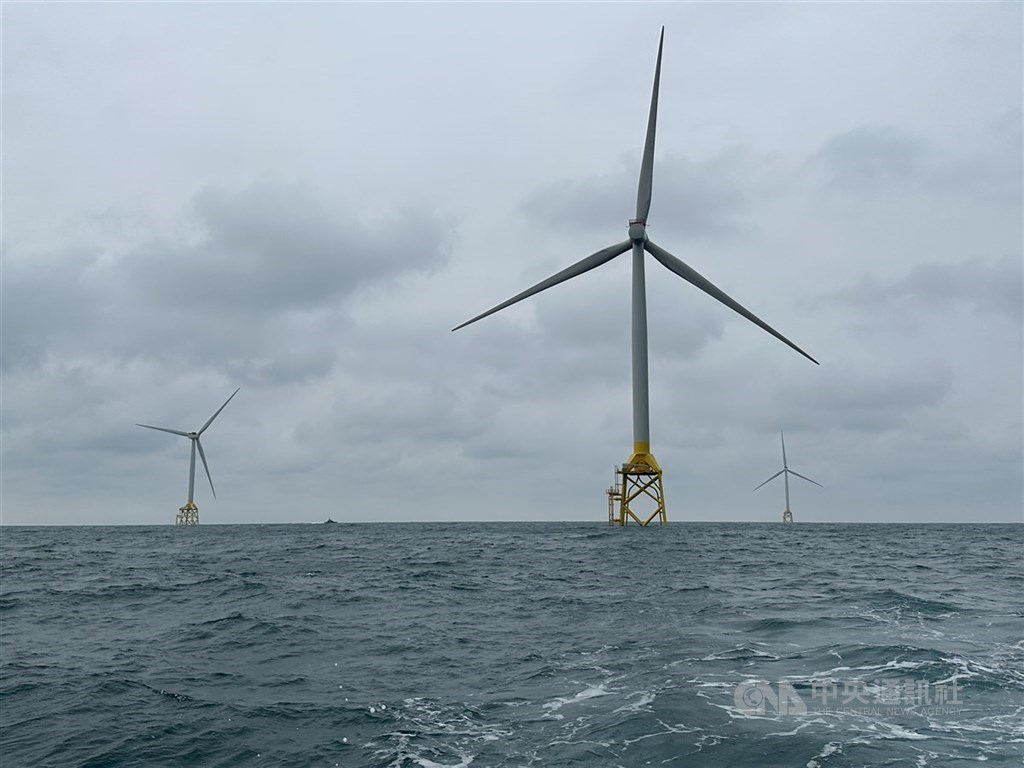
According to a report by Central News Agency (CNA) journalist Hsieh Yi-hsuan, Taipei, December 15 — The Bureau of Energy stated that international media have reported Taiwan's offshore wind power development, which began seven years after South Korea's, has now achieved an installed capacity 13 times greater. The Ministry of Economic Affairs (MOEA) announced that Taiwan's offshore wind capacity has reached 4.8 GW, ranking fifth globally, with foreign investment continuing to flow in — accumulating USD 3 billion in the first three quarters of last year.
The Bureau of Energy released a press statement today, citing the Global Wind Energy Council's (GWEC) 2026 report, confirming Taiwan as the world's fifth-largest offshore wind market, trailing only China, the UK, Germany, and the Netherlands. Since completing its first two demonstration turbines in 2017, Taiwan has advanced through public-private collaboration and continuous policy refinement, emerging as a policy leader among democratic nations in the Asia-Pacific region.
The MOEA stated that Taiwan has now installed over 500 offshore wind turbines, with a total capacity of 4.8 GW, and is projected to generate over 10 billion kWh by 2025. Foreign investment in Taiwan's offshore wind sector remains strong, with USD 3 billion accumulated in the first three quarters of the previous year.
To facilitate offshore wind development, the MOEA has established a single service window to consolidate industry challenges and coordinate cross-ministerial communication. Legal and regulatory frameworks have been institutionalized, including policy-level environmental assessments, fishery compensation mechanisms, and licensing requirements. In the early stages, the government clarified procedures through strategic environmental reviews, potential site zoning, and shared corridor planning.
Additionally, through cross-ministerial integration involving environmental review, maritime safety, and fisheries authorities, a joint review mechanism has been established to confirm site feasibility. Institutionalized processes for fishery compensation and local community engagement have enhanced the stability and predictability of the investment environment.
To ensure timely project execution, the MOEA regularly holds consultations with the Offshore Wind Association and monitors the progress of each wind farm. Key issues such as construction, grid integration planning, marine engineering, and local communication are addressed promptly. Cross-ministerial challenges are resolved via the Executive Yuan's coordination platform, improving communication efficiency among central and local governments and developers. Through rolling reviews, the overall development strategy continues to be refined.
The MOEA emphasized that offshore wind power has become a crucial source of green electricity in Taiwan and a key enabler for industrial transformation and integration into global supply chains. Building on existing achievements, the government will continue to advance offshore wind development, balancing energy supply, environmental protection, and industrial growth, steadily expanding green power generation and enhancing Taiwan's industrial competitiveness globally. (Edited by Lin Hsing-meng)
FACT BOX
- Source: CNA (Central News Agency)
- Category: Taiwan