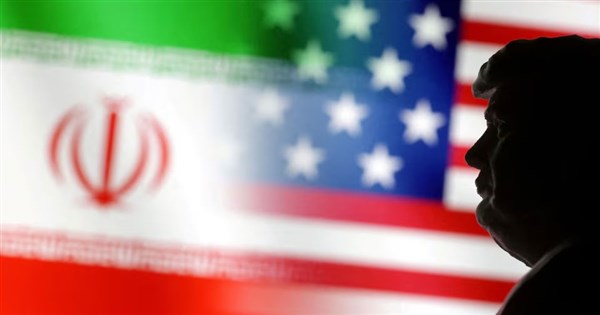
U.S.-Iran War: Key News
Central Report
(Central News Agency, Washington, June 14 —综合 international reports) The United States and Iran reached a preliminary agreement on June 14 to reopen the Strait of Hormuz and end maritime blockades, with a formal signing scheduled for Geneva on June 19. U.S. President Donald Trump praised the mediation efforts by Russian President Vladimir Putin and Chinese President Xi Jinping, while describing Israeli Prime Minister Benjamin Netanyahu as "a very difficult guy."
The Wall Street Journal reported that both Iran and the U.S. announced the preliminary agreement on June 14, bringing a temporary end to a nearly four-month-long conflict that triggered global political and economic turmoil. The agreement includes Iran's commitment to reopen the Strait of Hormuz and the U.S. lifting its maritime blockade. Both sides will enter 60 days of negotiations over Iran's nuclear program, with Iran receiving the release of frozen funds and the lifting of economic sanctions in exchange for compliance.
This preliminary deal opens a 60-day negotiation window on Iran's controversial nuclear program and paves the way for a final agreement. On June 14, Trump told The Wall Street Journal that the preliminary agreement includes Iran's commitment not to acquire nuclear weapons, although he did not mention this in a social media post later that evening. Trump stated he has no immediate plans to remove enriched uranium from Iran in the coming months.
Trump also expressed indifference toward regime change, saying, "As for regime change, I've never cared about that. They're already our third counterpart in dealing with Iran, and so far the most rational one."
The Washington Post noted that the U.S. and Israel launched military action against Iran on February 28 under close coordination with the Trump administration, without prior consultation with European allies. Netanyahu successfully convinced Trump in the weeks before the war that the time was ripe to overthrow the Iranian regime. However, as the war did not unfold as expected, Trump first criticized European allies for not providing support and later grew increasingly frustrated with Netanyahu, launching repeated criticisms.
The New York Times reported that Trump warned that if Iran fails to reach a final agreement with the U.S. on nuclear issues, he would resume military attacks on Tehran or assert U.S. dominance in the Middle East, taking 20% of regional revenues—referring to oil, gas, and shipping profits.
On June 14, Trump's 80th birthday, he gave a 28-minute phone interview to The New York Times from the White House. The Times noted that the sounds of his family celebrating a dinner could be heard in the background. During the call, Trump praised Chinese President Xi Jinping and Russian President Vladimir Putin for their peace mediation, while harshly criticizing Netanyahu for nearly derailing the agreement.
Regarding Netanyahu, Trump said: "He's a very difficult guy. Frankly, he should be very grateful to us for making this happen. Because if Iran had nuclear weapons, Israel wouldn't last two hours."
Analysts, including The New York Times, argue that the U.S.-Iran preliminary agreement merely restores the pre-war status quo: reopening the Strait of Hormuz for 60 days before addressing nuclear issues and launching regional dialogue. However, Iran had not blocked the strait before the war and had even offered to hand over enriched uranium, meaning Trump is effectively celebrating a return to the pre-war situation.
U.S. Vice President J.D. Vance, in an interview with Fox News, called the agreement a "major success" for the U.S., claiming Iran's leadership has agreed to never possess nuclear weapons—"not just not developing them, but also not acquiring or attempting to purchase them. All of this is included in the agreement."
Trump compared this new deal to the 2015 Joint Comprehensive Plan of Action (JCPOA), the Iran nuclear deal under the Obama administration, claiming this agreement ensures Tehran "cannot develop or purchase nuclear weapons."
However, Iran already committed not to acquire nuclear weapons when it ratified the Nuclear Non-Proliferation Treaty (NPT) in 1970, and reaffirmed this in the 2015 nuclear deal.
Trump stated that both sides are still discussing whether Iran will agree to halt uranium enrichment for 20 years, while hinting he might accept a 15-year period. He emphasized that Iran will only be allowed to conduct low-level enrichment in the future, at concentrations "impossible for military use"—a restriction already present in the 2015 nuclear agreement.
After Trump unilaterally withdrew the U.S. from the 2015 Iran nuclear deal in 2018, Iran began enriching uranium to levels far exceeding previous limits, including up to 60% concentration, approaching weapons-grade highly enriched uranium. (Compiled by Chen Yi-wei) 1150615
FACT BOX
- Source: CNA (Central News Agency)
- Category: Taiwan