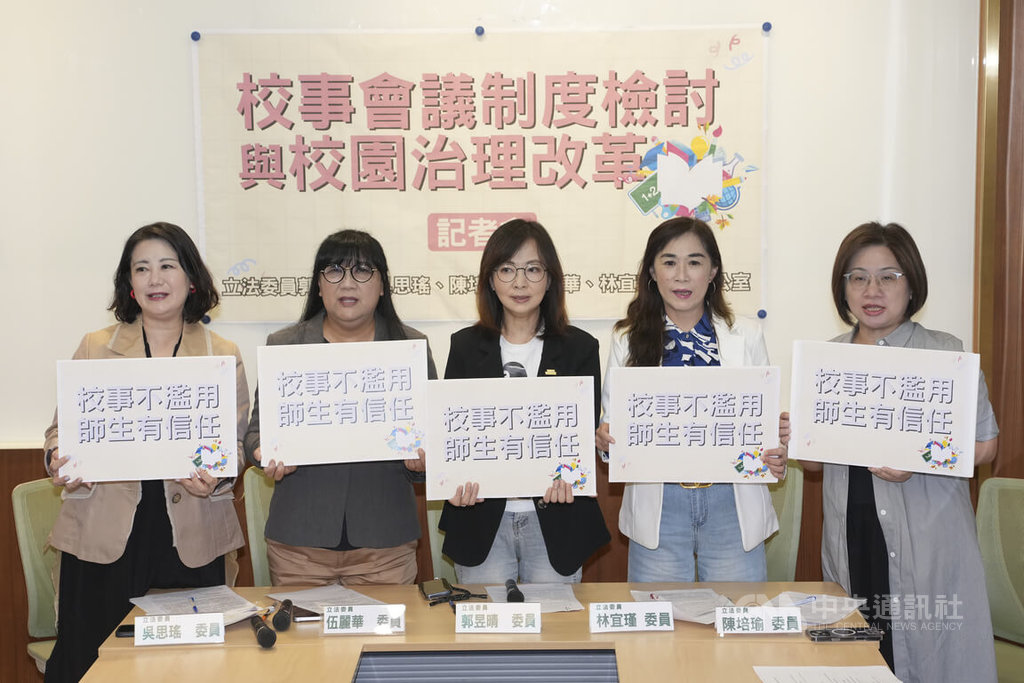
(CNA reporter Lin Jing-yin, Taipei, June 15) — The debate over the continuation or abolition of school incident review councils has intensified, with several Democratic Progressive Party (DPP) legislators today proposing multiple reforms. These include establishing a third-party dedicated agency to allow schools to return to being purely educational environments, developing occupational safety guidelines for teachers, and granting teachers the right to disconnect after work hours to reduce stress. They urged the Ministry of Education to continue reforming the school affairs council system to protect the rights of both teachers and students.
DPP legislators Kuo Yu-ching, Wu Li-hua, Lin Yi-chin, Chen Pei-yu, and Wu Szu-yao held a press conference this morning at the Legislative Yuan titled 'Review of the School Affairs Council System and Campus Governance Reform.'
Kuo Yu-ching stated that she was the first to question the school affairs council system last year, and later co-proposed legislative amendments with other legislators. The Ministry of Education announced in January the removal of anonymous accusations and pledged to compile results by July. After case分流 (diversion), the proportion of cases entering school affairs councils has dropped from 82% to 22%. However, teachers still face significant pressure.
Kuo emphasized that teachers lack legal assistance, lack the right to be informed during investigations, lack teaching resources, and lack psychological support. She argued that reforming the school affairs council system must go beyond textual changes and truly listen to the heartbroken voices of isolated teachers. She called on the Ministry of Education to swiftly reform the system to protect the rights of teachers and students.
Wu Li-hua noted that the original purpose of school affairs councils was to address unfit teachers and protect students' right to education. However, the current system has created widespread anxiety among teachers, revealing a gap between its ideals and practical implementation. In addition to ongoing review of the council system, she stressed the need to actively build a teacher support system, including reducing administrative burdens, strengthening psychological support, and establishing more comprehensive professional counseling mechanisms.
Lin Yi-chin said the Ministry of Education must take seriously the backlash from frontline teachers. Many educators desire a mechanism that adheres to the principle of proportionality and includes professional support. She emphasized that the Ministry has a duty to respond to current educational realities and plan a reasonable reform path that benefits both teachers and students.
Chen Pei-yu proposed four recommendations: continued emphasis on family education; establishment of a third-party dedicated agency with professional personnel and supporting systems to allow schools to focus solely on teaching; development of occupational safety guidelines for teachers; and the introduction of an 'offline right' for teachers, allowing them time to rest without being constantly contacted by parents after work hours, which causes immense stress.
Wu Szu-yao pointed out that while the system aims to protect students' rights and prevent campus bullying and gender-related incidents, it must also ensure teachers can teach in a secure environment. She criticized the current teacher support system as virtually non-existent, leaving teachers to fight legal battles alone when facing frivolous lawsuits. The school affairs council must be reformed into a 'supportive' body. (Edited by Hsieh Chia-chen) 1150615
FACT BOX
- Source: CNA (Central News Agency)
- Category: Taiwan