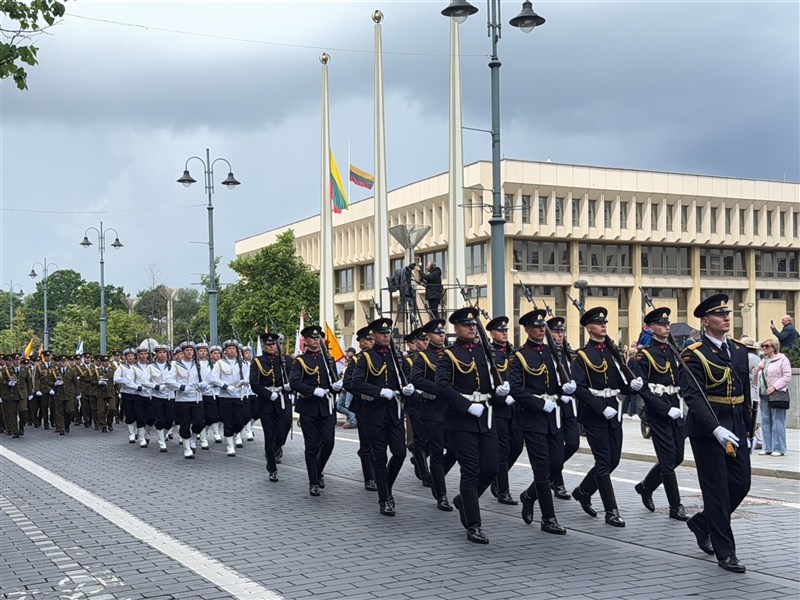
(By Central News Agency reporter Yu Yao-ju, Vilnius, June 15) Lithuania held a 'Day of Mourning and Hope' on June 14 to commemorate the 85th anniversary of the first large-scale deportation of residents to Siberia in 1941. Many families of deportation victims attended the event. One family member stated that enslaved nations suffer greatly and urged the people of Taiwan to cherish and defend their freedom.
The afternoon event 'Memory Cannot Be Deported' was one of the key activities of the 'Day of Mourning and Hope,' featuring a 24-hour continuous reading of the names of deportees to honor victims of Soviet-era deportations and repression. Journalists interviewed several elderly attendees on-site, asking them to share their experiences and personal stories from the Soviet occupation period.
Onute Vailioniene, 70, said Soviet authorities initially targeted intellectuals such as teachers and students, deporting them to Siberia in an attempt to destroy Lithuania's social elite, before later deporting wealthier farming families.
Onute said her parents were large-scale farmers, and her entire family was sent to a remote forested area in the Tomsk region of Siberia. 'It was a taiga region, and Ukrainians deported before us barely survived,' she said. In the early days, many people, especially children, died of starvation. One of her brothers starved to death, while another survived.
She said her family was only allowed to return to Lithuania after five years. Later, she and her mother returned to Siberia to retrieve her brother's remains. 'He was buried in the forest, surrounded by Lithuanians—there, it became a Lithuanian cemetery,' she said. She emphasized that hard work and mutual support enabled some deportees to survive.
Onute told reporters that living under enslavement was extremely difficult and urged the people of Taiwan to cherish and defend their freedom. 'We lived under turmoil and restrictions for 50 years, with everything constrained. I hope the people of Taiwan will do everything they can to preserve their freedom.'
Vaclovas Juodpusis, 88, said he was never deported himself, but his wife was sent as a child to the Irkutsk region of Russia for 10 years.
He noted that because his wife spent most of her childhood in Russia, she struggled to speak her native language fluently upon returning to Lithuania and had to complete her education under the Russian system.
Vaclovas recalled that his wife’s passport, issued in Irkutsk, served as proof of deportation under Soviet rule, which initially prevented her from enrolling in university. To change their situation, he managed to alter her old passport, allowing her to obtain new documents and erase the record. She later successfully enrolled at Vilnius University, earned a law degree, and obtained a doctorate.
However, he said the deportation experience had long-term health effects on his wife, who died at the young age of 54.
Vaclovas said he was fortunate to have survived those difficult years and continues to participate in commemorative events. 'I don’t want anyone to be deported again or forced to leave their homeland.'
He also expressed concern about the situation in the Taiwan Strait, advocating for peaceful coexistence and hoping Taiwan can continue to maintain freedom and development. 'Tens of millions of people live and work there, with high creativity. I hope they can continue developing and striving in science.'
Danguole Valentaite said her parents met in Siberia and gave birth to her and her sister during their deportation. Although she has no memory of life in Siberia, she believes events like the 'Day of Mourning and Hope' are important and regularly participates.
According to data from Lithuania’s Genocide and Resistance Research Center, approximately 23,000 Lithuanian residents were deported, killed, or imprisoned during the Soviet Union’s first occupation from 1940 to 1941. By 1953, around 130,000 people had been deported, and another 156,000 were imprisoned.
FACT BOX
- Source: CNA (Central News Agency)
- Category: Event