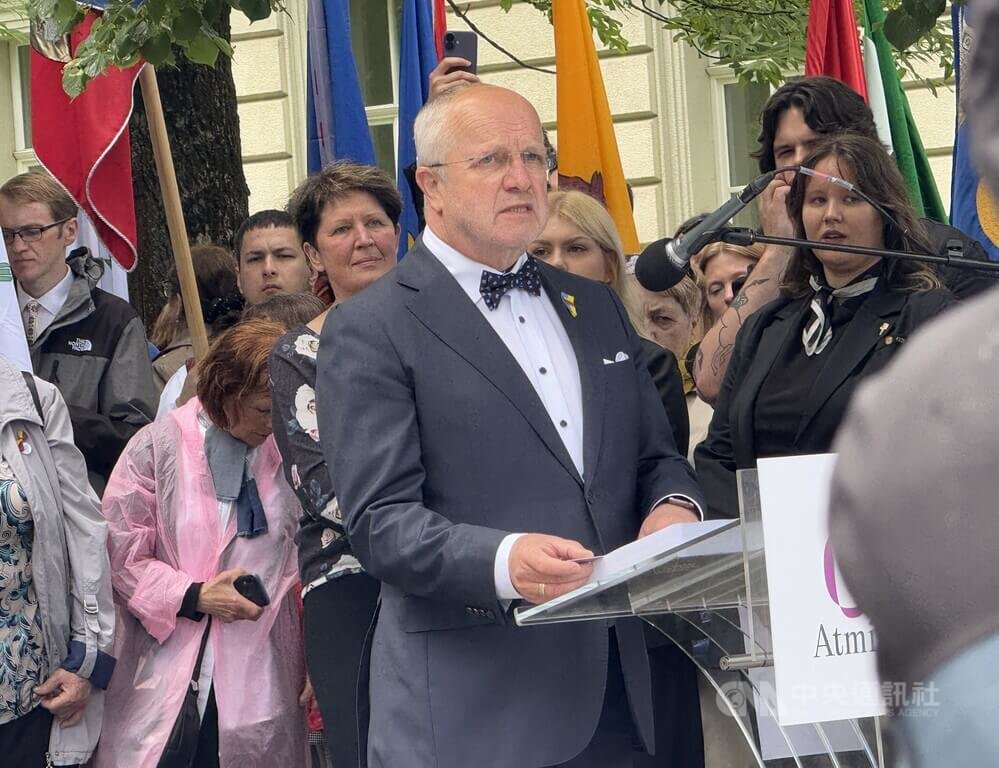
(By Central News Agency reporter Yu Yao-ju, Vilnius, June 15) Lithuania held commemorative events on June 14 for 'Day of Mourning and Hope,' marking the 85th anniversary of the first large-scale deportation of Lithuanians to Siberia in 1941, and reflecting on 86 years since the Soviet occupation began in 1940. Lithuanian Parliament Speaker Juozas Olekas stated that safeguarding national freedom is the responsibility of every generation.
According to data from Lithuania's 'Genocide and Resistance Research Center,' approximately 23,000 Lithuanian residents were deported, killed, or imprisoned during the first Soviet occupation from 1940 to 1941. By 1953, around 130,000 people had been deported, with another 156,000 imprisoned.
On the 'Day of Mourning and Hope,' memorial events and exhibitions were held across Lithuania to honor the nation's historical trauma and spirit of resistance, and to pay tribute to victims of Soviet-era deportations and repression.
Olekas (Juozas Olekas) had parents and grandparents forcibly deported to labor camps by Soviet authorities, and he himself was born in 1955 in a Siberian exile settlement.
Speaking at a parliamentary commemoration, Olekas said: 'Freedom is not given. Each generation must protect it, defend it, and pass it on. This is the most important lesson taught to us by deportees, political prisoners, and those who did not yield even in the most difficult circumstances.'
He noted that June 14 symbolizes in Lithuanian history a day when families were torn apart and lives destroyed, as people were forced to leave their homes for unknown destinations. He emphasized that the day is not only about commemorating a historical event, but also remembering the life stories of each individual victim.
At noon on June 14, a moment of silence and flag-raising ceremony was held at Independence Square next to the Parliament, attended by President Gitanas Nauseda, Prime Minister Inga Ruginiene, and numerous government officials and lawmakers.
Following this, citizens marched, led by military honor guards and delegations from various cities, to a memorial site near the 'Museum of Occupation and Freedom Struggles,' participating in the civic initiative 'Memory Cannot Be Deported.'
Organized annually on June 14 by the Lithuanian Youth Organizations Council (LiJOT), the event preserves historical memory and honors victims by reading aloud the names and experiences of deportees and political prisoners.
The core of the event is an uninterrupted 24-hour reading of names, continuing until the fate of the last victim recorded in the book is read aloud. President Nauseda, Prime Minister Ruginiene, and Speaker Olekas also participated in reading the names of deportees.
Umberto Masi, head of the Lithuanian Youth Organizations Council, said they aim to honor victims through the name-reading, encourage youth participation, and create opportunities for different generations to gather and share their historical stories.
Lithuania was occupied by the Soviet Union in 1940 and incorporated into the Soviet system. After a brief liberation when Nazi Germany invaded the USSR in 1941, it was re-occupied by the Soviets in 1944 and remained under Soviet control until it declared the restoration of independence in 1990. During Soviet rule, mass deportations, arrests, and repression continued, leaving a profound impact on Lithuanian society. (Edited by Wei-Shu) 1150615
FACT BOX
- Source: CNA (Central News Agency)
- Category: Event