(Central News Agency reporter Wang Pao-erh, Taipei, June 15) — Artists such as Chen Cheng-po, Huang Tu-shui, and Chen Jin have gradually become more widely recognized in recent years. The NTNU Museum of Art has now launched the 'Symbiotic Blossoms' exhibition, guiding visitors to explore how the teachers of these pioneering artists further influenced modern Taiwanese art.
The opening ceremony for the special exhibition 'Symbiotic Blossoms — The Glorious Era of Japanese Art and Its Convergence with Taiwan' was held today. The exhibition brings together over 200 modern Japanese artworks and crafts, spanning diverse categories such as Japanese painting, Western-style painting, wood carving, metalwork, lacquerware, shippo enamel, and ceramics, reorganizing the artistic exchange between Taiwan and Japan from the late 19th century to the first half of the 20th century.
NTNU Museum of Art Director Chang Yuan-feng stated that the first-floor exhibition features a primarily academic-focused main display. As visitors enter the space, they will encounter a large number of artworks, aiming to recreate the environment that Taiwanese artists experienced when studying at institutions such as the Tokyo School of Fine Arts and the Kansai Art Institute.
Chang explained that the exhibition includes works by teachers, classmates, and younger peers of Japanese-educated artists such as Liao Chi-chun and Lin Yu-shan, as well as pieces by artists who once visited Taiwan, painted Taiwanese scenes, or assisted in organizing the Taiwan Fine Arts Exhibition (Tai-ten) and Prefectural Exhibitions. This allows visitors to feel the artistic environment in which pioneers like Huang Tu-shui developed — for example, how he evolved into a master during his five years of study in Japan.
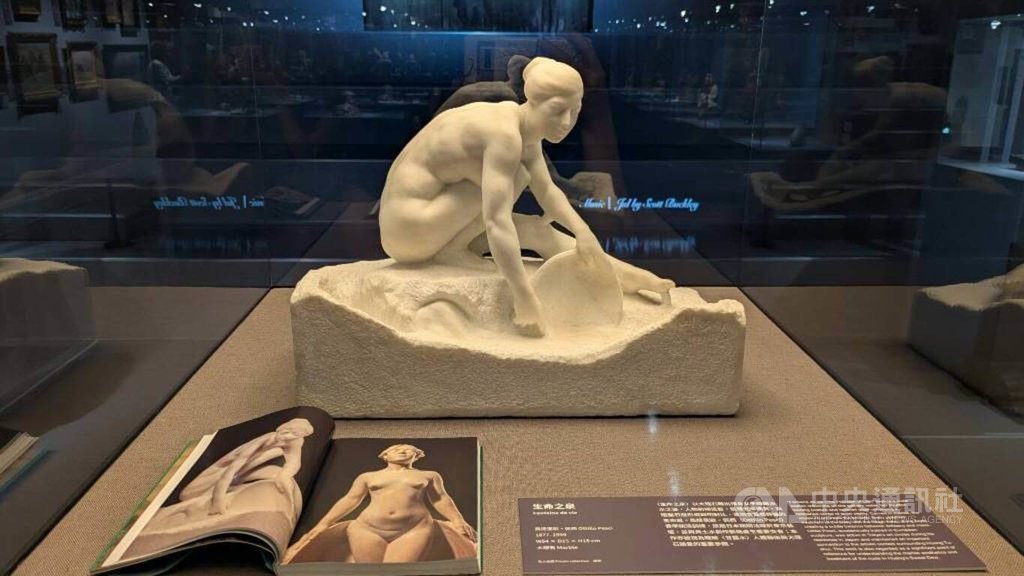
One notable work is Italian sculptor Ottilio Pesci’s marble sculpture 'The Fountain of Life,' depicting a nude woman bending forward. During Pesci’s stay in Japan, Huang Tu-shui visited his workshop and even replicated his sculpting tools. 'The Fountain of Life' is often compared with Huang’s own nude-themed masterpiece 'Water of Sweet Dew.'
The exhibition presents a list of figures, tracing the lineage from a group of pioneering Taiwanese artists back to their mentors, clearly showing who they studied under and which artistic systems they adopted. For instance, painter Saburoku Okada, known for 'Shin no Koin' (Forest Shade), taught artists including Yan Shui-long, Li Mei-shu, Li Shi-chiao, Kuo Po-chuan, and Chen Cheng-po.
The second-floor展区 showcases the beauty of Japanese crafts such as painting, ceramics, lacquerware, metal carving, and shippo enamel. The most eye-catching piece is the large-scale 'Iron Self-moving Python Ornament,' measuring 308 centimeters in total length and weighing 10 kilograms. The snake’s body can freely bend and twist, even simulating the motion of slithering.
Director Chang stated that the second-floor展区 aims to demonstrate the integration of aesthetics into daily life. Through crafts such as metalwork, ceramics, and Japanese painting, the museum hopes to show that beauty extends beyond the campus.
The NTNU Museum of Art will host the special exhibition 'Symbiotic Blossoms — The Glorious Era of Japanese Art and Its Convergence with Taiwan' from now until September 20. (Edited by Kuan Chung-wei) 1150615
FACT BOX
- Source: CNA (Central News Agency)
- Category: Event